India’s rooftop solar growth is giving households a practical way to reduce electricity bills, embrace clean energy, and become more energy-independent. Here’s what homeowners need to know about subsidies, installation costs, savings, and the road ahead.
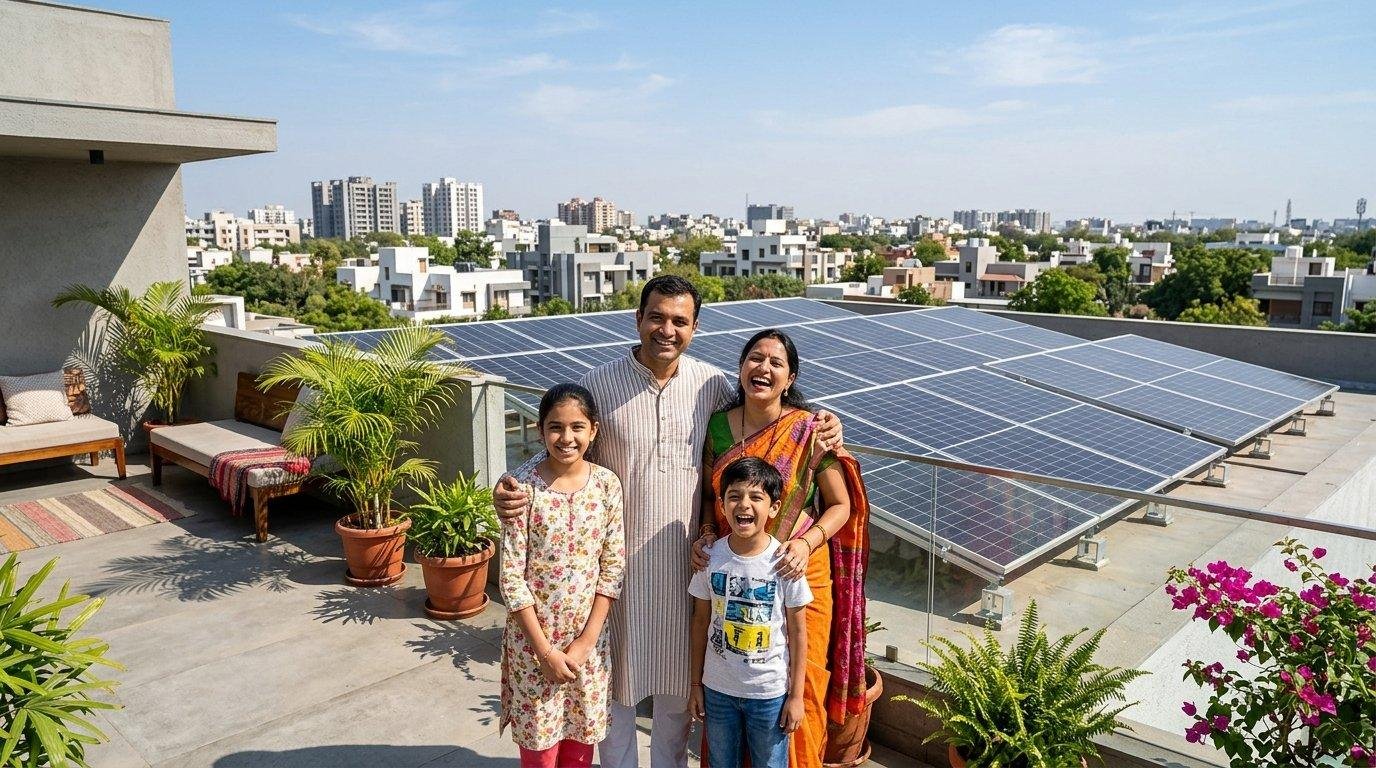
Imagine starting your morning by switching on the lights, making tea, charging your phone, and running your household appliances—all while knowing that the sun shining above your home is helping power your day.
For millions of Indian families, this idea is becoming more than a dream. Rooftop solar is emerging as a practical solution for households that want to manage rising electricity expenses while contributing to a cleaner environment.
From busy cities and growing towns to villages where sunshine is abundant for much of the year, solar panels are changing how people think about electricity. Instead of depending entirely on power supplied through the grid, homeowners can generate a portion of their own electricity right from their rooftops.
Government support has also helped bring this technology within reach of more families. Through the PM Surya Ghar: Muft Bijli Yojana, eligible households can receive financial assistance for installing residential rooftop solar systems.
But the real story is not just about solar panels or government targets. It is about ordinary people looking for ways to stretch their monthly budgets, make thoughtful environmental choices, and build a more sustainable future for their children.
Let’s explore how India’s rooftop solar growth is unfolding, what it means for household finances, and how you can decide whether solar power is right for your home.
India’s Rooftop Solar Growth: A Positive Change Taking Shape
India has enormous potential for solar energy. Much of the country receives substantial sunshine throughout the year, making rooftop solar an attractive option for homes, apartment communities, and small businesses.
The government launched the PM Surya Ghar: Muft Bijli Yojana in February 2024, with an overall financial outlay of ₹75,021 crore and an ambitious target of supporting rooftop solar installations in one crore, or 10 million, households.
The programme is designed to make residential solar more affordable through central financial assistance and a simplified online application process.
The scale of progress is already significant. According to India’s Ministry of New and Renewable Energy, 9,566.89 megawatts of rooftop solar capacity had been added under the scheme by March 20, 2026, demonstrating how quickly household solar is expanding. The programme aims to support one crore households by March 2027.
This growth matters for several reasons:
- Lower electricity expenses: Households can generate electricity during daylight hours and reduce the amount they need to purchase from the grid.
- Greater energy independence: Producing some electricity at home can reduce exposure to changes in grid electricity costs.
- Environmental benefits: Solar power generates electricity without burning fossil fuels at the point of generation.
- New employment opportunities: Growing demand creates work in solar manufacturing, installation, electrical services, maintenance, and related industries.
The journey is not without challenges. Financing, paperwork, installation quality, and differences in state electricity regulations can affect how easily a household adopts solar. Still, the direction is encouraging: clean energy is becoming a practical household decision rather than a technology reserved for large companies.
What Is Rooftop Solar, and How Does It Work?
Rooftop solar systems use photovoltaic panels to convert sunlight into electricity. An inverter then converts the electricity produced by the panels into a form suitable for household use.
A typical grid-connected residential system includes:
- Solar panels: Capture sunlight and produce electricity.
- An inverter: Converts the electricity for household use.
- Mounting structures: Secure the panels to the roof.
- Electrical protection equipment: Helps protect the system and household wiring.
- A bidirectional meter, where applicable: Measures electricity imported from and exported to the grid.
During sunny hours, your panels generate electricity. Your household uses that power first, reducing the amount drawn from the electricity grid.
If your system generates more electricity than you need at a particular moment, surplus power may be exported to the grid, depending on the connection and your local electricity regulations.
At night, when the panels are not generating electricity, your home generally draws power from the grid unless you have a suitable battery-storage system.
This is an important distinction: ordinary grid-connected rooftop solar does not automatically provide backup power during a blackout. Many grid-tied inverters shut down during an outage for safety reasons. Backup power requires compatible equipment and, typically, a battery or another approved backup arrangement.
Understanding this basic setup helps homeowners choose a system that matches their actual needs instead of paying for features they may not require.
PM Surya Ghar Yojana: How Much Solar Subsidy Can You Get?
For many families, the biggest question is simple: How much does the government contribute toward the cost of installation?
Under the central subsidy structure announced for the PM Surya Ghar scheme, eligible residential consumers can receive financial assistance based on the installed system capacity.
Central subsidy for residential rooftop solar
| Solar system capacity | Central subsidy |
|---|---|
| 1 kW | ₹30,000 |
| 2 kW | ₹60,000 |
| 3 kW | ₹78,000 |
| Above 3 kW | Generally capped at ₹78,000 |
The standard structure provides ₹30,000 per kW for the first 2 kW and ₹18,000 per additional kW for the next 1 kW. The central subsidy is capped at ₹78,000 for eligible systems of 3 kW or more.
These amounts refer to the central financial assistance under the scheme. Additional state-level benefits, where available, may have separate conditions.
Who can apply?
The scheme is intended for eligible residential electricity consumers with a grid-connected electricity connection. Applicants must follow the official programme requirements, including using the appropriate registered or empanelled vendor and completing the prescribed installation and verification process.
A household should not assume that purchasing panels independently or installing a system before following the required process will automatically qualify it for the subsidy.
How to apply for the subsidy
The general process is straightforward:
- Visit the official PM Surya Ghar National Portal.
- Register using your electricity consumer details and the information requested by the portal.
- Submit your rooftop solar application.
- Follow the applicable utility approval and technical requirements.
- Select a suitable registered vendor through the prescribed process.
- Complete installation and the required inspection, metering, and commissioning steps.
- Submit the required documents and bank details for subsidy processing.
The subsidy is generally transferred to the eligible consumer’s bank account after the required steps and verification are completed.
Keep copies of your electricity bills, application details, installation documents, bank information, and commissioning records. Check the portal for current instructions before making payments or signing a contract.
The important lesson is to confirm eligibility and the application procedure first. Doing so can help prevent avoidable delays and disappointment later.
Rooftop Solar Installation Cost in India
The subsidy makes solar more affordable, but households still need to understand the total installation cost.
The price depends on several factors, including the system’s capacity, panel and inverter quality, roof structure, wiring requirements, installation complexity, and local market conditions.
For planning purposes, the following figures are illustrative estimates, not official government prices or vendor quotations.
| System size | Example gross cost | Central subsidy | Example net cost |
|---|---|---|---|
| 1 kW | ₹60,000 | ₹30,000 | ₹30,000 |
| 2 kW | ₹1,10,000 | ₹60,000 | ₹50,000 |
| 3 kW | ₹1,60,000 | ₹78,000 | ₹82,000 |
| 5 kW | ₹2,50,000 | ₹78,000 | ₹1,72,000 |
Actual prices may be lower or higher. These examples assume that the quoted gross cost includes the necessary standard installation components and that the household qualifies for the stated subsidy. Extra structural work, unusual wiring, batteries, or other additions may increase the final cost.
Before choosing an installer, request a written quotation showing:
- Panel brand, wattage, quantity, and product warranty.
- Inverter brand, model, and warranty.
- Mounting structures, cabling, earthing, and safety equipment.
- Installation, commissioning, and metering-related charges.
- Applicable taxes and any additional fees.
- Expected generation and the assumptions behind the estimate.
- Maintenance requirements and the process for handling warranty claims.
Do not select a vendor solely because the initial price is the lowest. A properly designed system with reliable components and competent installation can be more valuable over its lifetime than a cheaper system with unclear warranties or inadequate after-sales support.
How Much Can a Household Save Every Month?
The financial benefit of rooftop solar depends on how much electricity a household consumes, how much the panels generate, and how local electricity rules credit any surplus power.
Consider a family that uses around 300 units of electricity each month. A suitably sized 2–3 kW solar system may cover a substantial share of that consumption, depending on the roof’s sunlight exposure and other conditions.
Let’s use a simple example.
Suppose a household’s electricity costs average ₹8 per unit. If rooftop solar reduces the amount of electricity purchased from the grid by 200 units per month, the approximate energy-charge saving would be:
200 units × ₹8 = ₹1,600 per month
That works out to ₹19,200 over 12 months if the same saving is maintained.
This is an illustration, not a promise of savings. Actual results vary with weather, shading, system performance, seasonal consumption, electricity tariffs, fixed charges, and export-credit rules.
Example savings at different levels of solar generation
| Grid electricity avoided each month | Assumed rate per unit | Estimated monthly energy-charge saving |
|---|---|---|
| 100 units | ₹8 | ₹800 |
| 200 units | ₹8 | ₹1,600 |
| 300 units | ₹8 | ₹2,400 |
These figures exclude fixed charges and other fees that may remain on the electricity bill. They also do not include any additional value from exporting surplus electricity.
How long does it take to recover the investment?
Using the illustrative 3 kW system above:
- Gross installation cost: ₹1,60,000
- Central subsidy: ₹78,000
- Estimated net investment: ₹82,000
- Assumed monthly energy-charge saving: ₹2,000
- Estimated annual energy-charge saving: ₹24,000
The simple payback period would be approximately:
₹82,000 ÷ ₹24,000 = 3.4 years
In practice, the payback period could be longer or shorter. System maintenance, financing costs, changes in tariffs, reduced generation, and the value of surplus electricity can all affect the outcome. Panel degradation and future inverter replacement should also be considered when assessing long-term returns.
Even so, this calculation demonstrates why rooftop solar deserves serious consideration for households with suitable roofs and substantial daytime electricity use.
Will Rooftop Solar Really Make Your Electricity Bill Zero?
The phrase “Muft Bijli” understandably attracts attention, but it is important to know what it means in practice.
The scheme’s name does not mean every participating household will automatically receive a zero bill every month.
A system generating more than 300 units per month, for example, may still fail to eliminate the entire bill if the household uses significantly more electricity, consumes most of its power at night, or has charges that solar generation does not offset.
Your final bill can depend on:
- The size and performance of your solar system.
- Your household’s monthly consumption.
- The timing of electricity generation and usage.
- The local net-metering or other applicable settlement rules.
- Fixed charges, taxes, and other fees.
For some households, a solar system may reduce the bill dramatically. Others may see more moderate savings. The best way to estimate your outcome is to compare at least 12 months of electricity consumption with a vendor’s generation forecast and your local utility’s billing rules.
Which Solar System Size Is Right for Your Home?
A larger system is not always the best choice. The right size depends on your consumption, available roof area, budget, and local regulations.
As a starting point, the scheme’s published guidance has associated average monthly consumption of 0–150 units with approximately 1–2 kW, 150–300 units with 2–3 kW, and consumption above 300 units with systems above 3 kW.
These are broad planning guidelines, not a substitute for a site assessment.
A simple way to start
If your household uses around 100–150 units monthly: Explore whether a 1–2 kW system would meet your needs.
If your household uses around 200–300 units monthly: Compare 2 kW and 3 kW quotations, paying attention to roof space and daytime consumption.
If your household uses more than 300 units monthly: Ask for a generation estimate based on your actual consumption and check the subsidy cap before deciding on a larger system.
Remember that a home’s electricity needs can change. Families adding air conditioners, electric vehicles, water heaters, or other appliances may want to plan for future demand rather than choosing a system based on one month’s bill.
Is Your Rooftop Suitable for Solar Panels?
Before investing, take a good look at your roof.
A suitable rooftop generally needs adequate sunlight, sufficient usable space, and a structure that can safely support the equipment. Nearby buildings, trees, water tanks, and other obstructions can cast shadows that reduce generation.
Here are a few practical checks:
- Sunlight: Is the roof exposed to direct sunlight for much of the day?
- Shading: Will trees or neighbouring buildings block sunlight?
- Roof condition: Does the roof need repairs before installation?
- Available space: Is there enough room for the proposed number of panels?
- Electrical setup: Is the existing wiring suitable, or will upgrades be needed?
- Future access: Can the panels be cleaned and serviced safely?
If you live in an apartment, rooftop access and ownership can complicate installation. Ask the housing society or resident welfare association about shared systems, common-area installations, and applicable metering arrangements.
For individual homeowners, completing roof repairs before installing panels can help avoid the cost of removing and reinstalling equipment later.
What About Batteries and Power Cuts?
One common misconception is that solar panels alone will keep the lights on during a power outage.
In a typical grid-connected system, the inverter shuts down when the grid fails, protecting utility workers and preventing electricity from feeding into lines that may be under repair.
If you need backup power, ask about a hybrid inverter and a compatible battery system or another approved backup arrangement.
Batteries can provide useful backup, but they increase the initial investment. Their value depends on how frequently outages occur, which appliances you want to run, and how much backup time you need.
For households with reliable grid supply, a grid-connected system without batteries may offer a lower-cost route to reducing electricity bills. For homes facing frequent outages, backup requirements deserve separate consideration.
Environmental Benefits: A Small Roof Can Make a Big Difference
The household financial benefits are important, but rooftop solar has a wider purpose.
When solar electricity replaces electricity generated from fossil fuels, it can reduce associated greenhouse-gas emissions. The exact reduction depends on the electricity generation displaced, the local grid mix, and the lifecycle impacts of manufacturing and installing the equipment.
Solar power also distributes electricity generation across many locations instead of relying exclusively on large power plants and transmission networks.
Imagine thousands of homes in a town producing electricity from their rooftops. Each installation may appear small on its own, but together they can contribute meaningful clean-energy capacity.
There are practical responsibilities, too. Solar panels and inverters have finite lifespans, and equipment will eventually need maintenance, replacement, or recycling. Responsible installation and end-of-life management are part of making solar genuinely sustainable.
The positive news is that environmental progress does not always require dramatic individual gestures. Sometimes, it begins with a practical decision that benefits both a family budget and the community.
Challenges India Must Address
Rooftop solar has enormous promise, but successful adoption requires more than subsidies.
Some households face difficulties obtaining financing, completing documentation, navigating utility procedures, or finding installers who provide reliable service.
Others may have roofs that are shaded, structurally unsuitable, or shared with multiple property owners.
To make solar more accessible, India needs continued improvements in consumer awareness, installation quality, timely approvals, financing, after-sales service, and transparent electricity-settlement rules.
Consumers also need realistic expectations. A vendor’s projected savings should be checked against the household’s actual bills, roof conditions, and local tariff structure.
A strong solar programme is not simply one that installs more panels. It is one that helps households obtain safe, well-designed systems that continue delivering value for years.
How to Get Started: A Homeowner’s Solar Checklist
If you are considering rooftop solar, take these steps before committing your money.
- Collect your last 12 months of electricity bills.
- Calculate your average monthly consumption and identify major daytime appliances.
- Check the available roof space, shading, and structural condition.
- Review the eligibility requirements on the official PM Surya Ghar portal.
- Obtain detailed quotations from suitable registered vendors.
- Compare the total cost, eligible subsidy, estimated generation, warranties, and maintenance requirements.
- Check your local DISCOM’s rules for metering, exported electricity, and billing.
- Confirm the installation and verification procedure before paying a substantial advance.
- Keep your application number, invoice, warranty documents, and commissioning records.
- After installation, compare actual electricity generation and bills with the original estimate.
Taking these steps can help you avoid rushed decisions and choose a system based on evidence rather than advertising.
Frequently Asked Questions
1. How much subsidy is available for rooftop solar in India?
Under the central PM Surya Ghar scheme, eligible residential consumers can receive ₹30,000 for 1 kW, ₹60,000 for 2 kW, and ₹78,000 for 3 kW or larger systems, subject to the applicable rules and maximum subsidy limit.
2. How much does a 3 kW rooftop solar system cost?
Costs vary by location, equipment, roof conditions, and vendor. For illustration, a system priced at ₹1.6 lakh before subsidy would cost ₹82,000 after a ₹78,000 central subsidy, assuming the household qualifies and no additional charges apply.
3. Can rooftop solar eliminate my electricity bill?
It may substantially reduce the bill and, in some circumstances, help offset most eligible energy charges. A zero bill is not guaranteed because consumption, generation, metering rules, and fixed charges vary.
4. How much electricity can a 3 kW solar system generate?
Generation depends on location, sunlight, orientation, shading, temperature, and system losses. A 3 kW system may generate more than 300 units in an average month under suitable conditions, but actual monthly output can vary significantly.
5. Can tenants apply for rooftop solar?
Eligibility and practical feasibility depend on the property, electricity connection, permission from the owner, and applicable scheme rules. Tenants should obtain the necessary consent before making installation arrangements.
6. Does rooftop solar work during a power cut?
A standard grid-connected system generally shuts down during a grid outage. Backup operation requires suitable additional equipment and a compatible system design.
7. Where can I apply for the PM Surya Ghar subsidy?
Start at the official National Portal: https://pmsuryaghar.gov.in/. Review the current requirements and follow the prescribed process before installation.
Final Thoughts: A Brighter Future Begins at Home
India’s rooftop solar growth is an encouraging example of how national goals can connect with everyday household needs.
For one family, it may mean a smaller electricity bill. For another, it may mean greater control over long-term energy expenses. For the country, it represents an opportunity to expand clean electricity, support skilled jobs, and make better use of abundant sunshine.
The most important step is not to install the biggest system or follow a trend. It is to understand your household’s needs, calculate the likely costs and savings, and make an informed decision.
The sun rises over India every day. With the right planning, some of that sunlight can do more than brighten our homes—it can help power them.
Beyond the Feel-Good Narrative
The growth is impressive, but it is still uneven. Execution quality varies, DISCOM processes can be slow in some areas, and rising domestic-content rules have kept module prices firmer than pure global trends. Not every roof is suitable, and very low-consumption households may see longer paybacks.
Yet for the large middle band of Indian homes—those paying ₹1,500–4,000 a month in electricity—the combination of subsidy, falling system costs and rising tariffs has flipped the equation. What used to feel like an expensive green experiment now often looks like one of the better financial decisions available.
India’s rooftop solar story is no longer mainly about climate targets or national capacity numbers. It is about ordinary families reclaiming control over one of their most predictable monthly expenses. The panels on the terrace are not just generating electricity. In thousands of homes, they are quietly generating breathing room in the household budget.
If your electricity bill has been climbing and your roof gets decent sun, it is worth running the numbers for your specific location and consumption. The tools and the support structure exist. The decision, for many, has never been more practical.
Thinking about rooftop solar for your home? Start by reviewing your electricity bills, checking your roof’s suitability, and exploring the official PM Surya Ghar scheme. A well-informed decision today could bring financial and environmental benefits for years to come.
Authoritative sources/official resources of the article
- PM Surya Ghar National Portal — applications and scheme information.
- Ministry of New and Renewable Energy — rooftop solar programme guidance.
 Ministry of New and Renewable Energy+1
- Government of India’s March 2026 progress update — reported rooftop solar capacity additions through March 20, 2026. Press Information Bureau