
Introduction
Additionally, data has become one of the most valuable business assets in the digital age. It is a strategic resource for decision makers. This shift affects strategy, governance, and how firms compete across markets. Leaders must adapt to data-centric approaches to stay ahead.
Moreover, every interaction, transaction, and process generates information. This data reveals customer behavior, operational performance, and market opportunities for AI and Business Intelligence. Nevertheless, collecting data by itself is not enough for success. This insight drives smarter decisions, faster responses, and measurable competitive advantage across functions.
Consequently, AI and Business Intelligence work together.
It supports understanding performance through reports, dashboards, and analytics.
Thus, together, they enable proactive, data-driven strategies.
Moreover, organizations that successfully integrate AI and BI are building faster, smarter, and more resilient enterprises prepared for the future.
Understanding AI and Business Intelligence
Although AI and BI are closely connected, they serve different purposes within an organization.
Business Intelligence (BI) focuses on organizing and visualizing business data so leaders can understand what has happened and measure performance through reports, KPIs, and dashboards.
Artificial Intelligence (AI) goes a step further by analyzing patterns, identifying opportunities, forecasting future outcomes, and automating decisions that previously required human intervention.
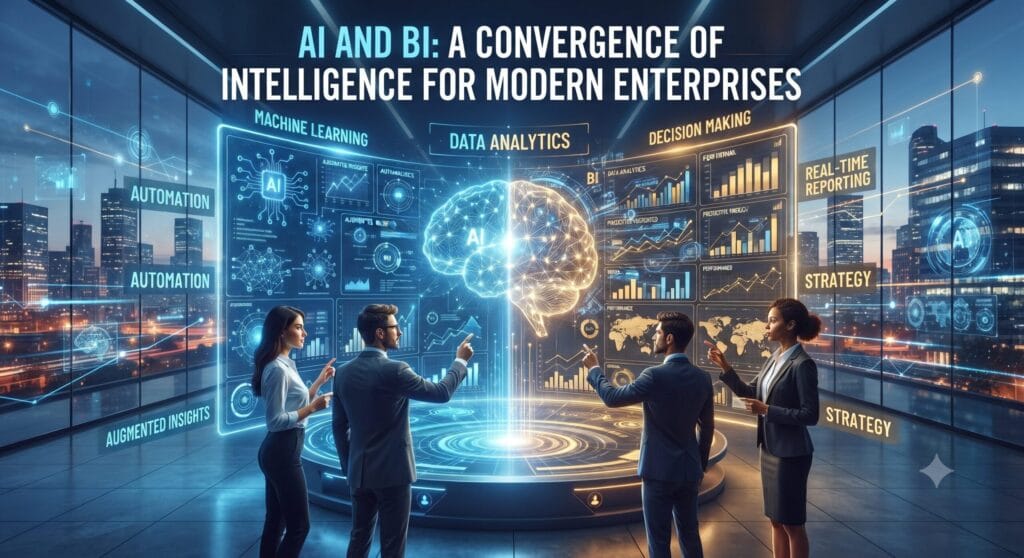
Rather than competing technologies, AI and BI complement each other. BI provides visibility into business operations, while AI transforms those insights into intelligent recommendations and automated actions.
From Historical Reporting to Intelligent Decision-Making
Historically, organizations relied on AI and Business Intelligence tools primarily to answer questions such as:
- Additionally, what happened?
- Additionally, which departments performed well?
- Moreover, how did revenue change?
- Where are operational bottlenecks?
Today’s businesses require deeper intelligence. Moreover, modern enterprises need answers to questions like:
- Why did performance change?
- What is likely to happen next?
- Which customers are at risk of leaving?
- What actions should management take immediately?
AI enables organizations to answer these questions by combining machine learning, predictive analytics, and automation with traditional BI capabilities.
How AI Enhances Business Intelligence
Integrating AI into BI platforms unlocks several powerful capabilities.
Predictive Analytics
AI models can forecast future demand, customer behavior, inventory requirements, and financial trends using historical and real-time data.
Automated Insights
Instead of manually searching through reports, AI can automatically identify unusual patterns, emerging risks, and growth opportunities.
Real-Time Decision Support
Businesses no longer need to wait for weekly or monthly reports. AI-powered analytics continuously monitor operations and provide instant recommendations.
Intelligent Automation
Routine analytical tasks—including report generation, anomaly detection, and workflow optimization—can be automated, allowing employees to focus on higher-value activities.
Benefits of Combining AI and BI
Organizations that integrate AI and BI gain advantages across multiple areas.
Better Business Decisions
Executives receive data-backed recommendations rather than relying solely on intuition, improving confidence and reducing uncertainty.
Improved Operational Efficiency
AI identifies process inefficiencies and recommends optimizations that lower costs and increase productivity.
Enhanced Customer Experience
By analyzing customer preferences and behavior, businesses can personalize products, services, and marketing campaigns.
Stronger Risk Management
Predictive analytics helps organizations detect fraud, identify operational risks, and respond before problems escalate.
Greater Competitive Advantage
Businesses that make faster, more informed decisions are better positioned to adapt to changing markets and customer expectations.
Real-World Applications Across Industries
The combination of AI and BI is transforming nearly every sector.
Healthcare
Hospitals use AI-driven analytics to improve patient care, optimize staffing, and predict disease outbreaks.
Banking and Finance
Financial institutions detect fraudulent transactions, evaluate credit risk, and personalize financial services using intelligent analytics.
Retail
Retailers forecast demand, optimize inventory, and recommend products based on customer purchasing behavior.
Manufacturing
Manufacturers use predictive maintenance to reduce equipment failures and improve production efficiency.
Logistics
Transportation companies optimize delivery routes, reduce fuel costs, and improve supply chain visibility through AI-powered analytics.
Building an Intelligent Enterprise
Modern organizations are moving beyond traditional reporting toward intelligent ecosystems where data continuously drives business improvements.
An intelligent enterprise combines:
- Centralized data management
- High-quality governance
- AI-powered analytics
- Interactive BI dashboards
- Cloud-based scalability
- Continuous learning and optimization
This integrated approach enables organizations to respond quickly to market changes while maintaining operational efficiency.
Challenges Organizations Should Address
Despite its advantages, successful AI and BI adoption requires careful planning.
Common challenges include:
- Poor data quality
- Legacy systems
- Data silos
- Shortage of AI talent
- Security and privacy concerns
- Ethical use of AI
- Change management and employee adoption
Addressing these challenges early increases the likelihood of long-term success.
Best Practices for AI and BI Transformation
Organizations planning to adopt AI-driven Business Intelligence should focus on the following principles:
- Establish strong data governance.
- Build a scalable cloud-based data architecture.
- Start with high-impact business use cases.
- Invest in employee training and data literacy.
- Monitor AI models for accuracy and fairness.
- Continuously improve processes using measurable business outcomes.
The Future of Data-Driven Enterprises
The future belongs to organizations that treat data as a strategic asset rather than simply an operational byproduct.
Emerging technologies such as Generative AI, autonomous analytics, natural language querying, digital twins, and AI agents will further enhance how businesses collect, analyze, and act on information.
In the coming years, AI and BI will become increasingly integrated, allowing employees to ask business questions in plain language, receive instant insights, and automate routine decision-making.
Organizations that embrace this evolution will be better equipped to innovate, improve customer experiences, and maintain a competitive edge.
Final Thoughts
Artificial Intelligence and Business Intelligence are reshaping how organizations operate. Together, they enable businesses to transform raw data into actionable intelligence, improve operational efficiency, and make faster, more informed decisions.
Success, however, depends on more than technology alone. Organizations must combine intelligent systems with strong leadership, ethical governance, and a culture that embraces continuous learning.
As AI continues to evolve, the companies that thrive will be those that balance technological innovation with human expertise. By integrating AI and BI into a unified strategy, enterprises can unlock new opportunities, strengthen resilience, and build a smarter future.
Frequently Asked Questions
What is the difference between AI and Business Intelligence?
Business Intelligence analyzes historical and current business data using reports and dashboards, while Artificial Intelligence predicts future outcomes, automates processes, and generates intelligent recommendations.
Why should organizations combine AI and BI?
Combining AI with BI improves forecasting, automates analysis, supports faster decision-making, and enables organizations to respond proactively to changing business conditions.
Which industries benefit the most?
Healthcare, finance, retail, manufacturing, logistics, telecommunications, and e-commerce are among the industries experiencing significant benefits from AI-powered Business Intelligence.
Is AI replacing Business Intelligence?
No. AI enhances Business Intelligence by adding predictive analytics, automation, and machine learning. Together, they create a more powerful decision-support system.


I have read some excellent stuff here Definitely value bookmarking for revisiting I wonder how much effort you put to make the sort of excellent informative website