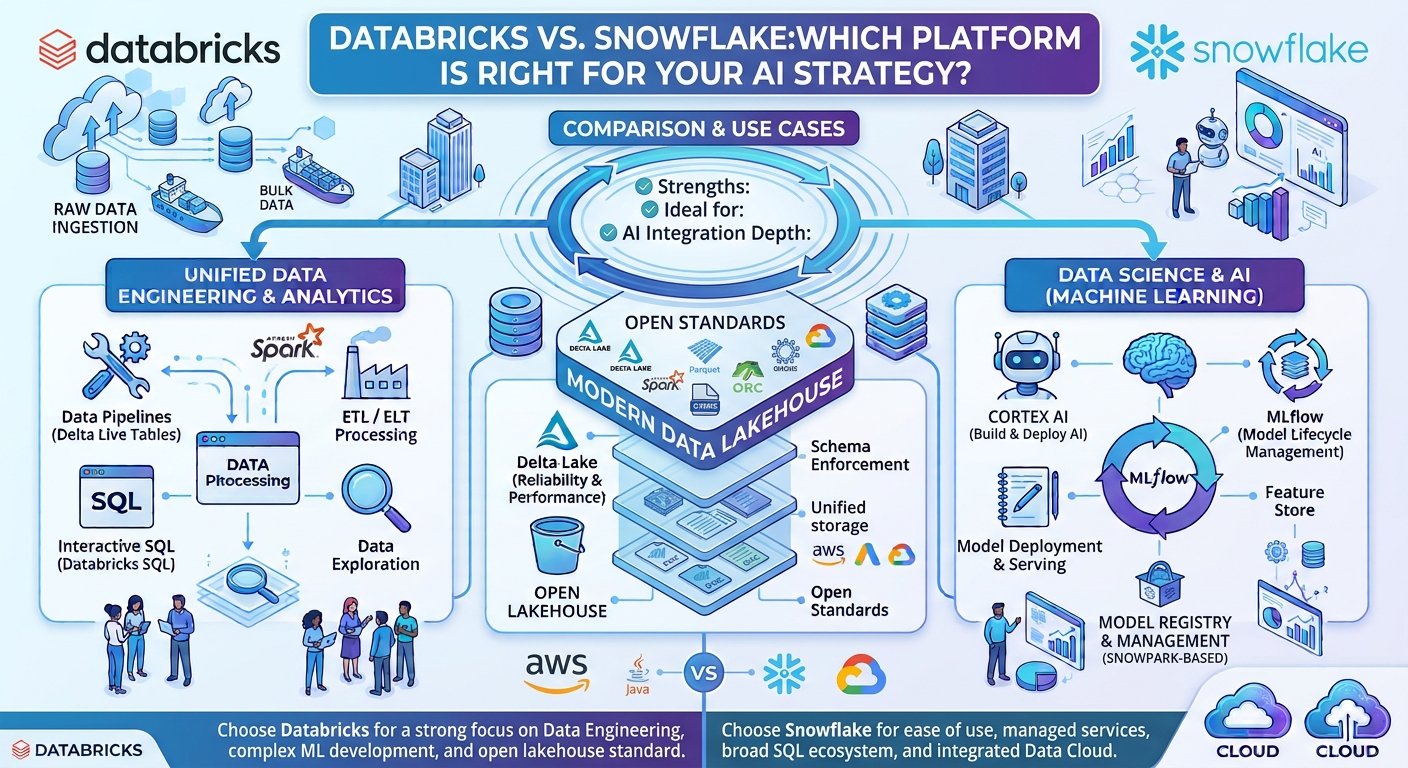
For years, this comparison was easy: Snowflake was the warehouse for SQL analysts, and Databricks was the lakehouse for data engineers and data scientists. That framing is now outdated. Both platforms now cover most core data and AI workloads, including warehousing, streaming, and AI on a single platform. The real question is which platform’s philosophy fits how your organization intends to build and use AI.
The market has moved
Both vendors have spent the past year closing gaps. Databricks launched Lakebase, a Postgres-compatible engine for transactional workloads, while Snowflake took Cortex AI functions and Cortex Agents to general availability. The business momentum is notable too: Databricks reported $6.9B in annualized revenue in June 2026, while Snowflake’s fiscal 2026 revenue reached $4.68B, up 29% year over year.
Revenue doesn’t tell you which tool is better for you. It does tell you that neither vendor is going away, and that both are investing heavily in your AI use cases.
Two philosophies: “build and differentiate” vs. “buy and apply”
The sharpest way to frame the difference is by philosophy. Snowflake offers a “buy and apply” approach with turnkey AI capabilities, while Databricks provides a “build and differentiate” strategy for organizations that want maximum flexibility and custom AI development.
Snowflake: AI brought to your data, mostly through SQL. Cortex lets analysts and application developers call AI functions directly in SQL for tasks like extracting information from documents, summarizing text, and asking questions of governed data. Snowflake thrives in governed data marts and ad-hoc SQL queries. The operational burden is also lower, because Snowflake abstracts most platform operations. If your AI ambitions center on getting value from structured enterprise data quickly, with minimal infrastructure, this is a strong fit.
Databricks: AI as something you engineer. Databricks offers deeper native tooling for the full ML lifecycle: experiment tracking, feature engineering, model registry, vector search, and model serving. The 2026 launch of Agent Bricks, a multi-agent supervisor system, positions it as the place where serious AI engineering happens. The trade-off is that it demands more operational effort, because Databricks gives you more control over compute, runtime, pipelines, and data layout. Databricks is also usually stronger when unstructured or multimodal data is part of an engineering-led ML or AI pipeline.
A shorthand version: Databricks is for building AI systems, and Snowflake is for consuming AI capabilities.
How to decide: five questions
1. Who is building the AI?
If your AI work is done by ML engineers and data scientists who want control over training, fine-tuning, and orchestration, Databricks will feel natural. If it’s done by analysts, BI developers, and application teams who live in SQL, Snowflake will get them productive faster.
2. What kind of data matters most?
Structured, curated, governed data points toward Snowflake. Large volumes of raw, streaming, semi-structured, or unstructured data (documents, images, logs, sensor data) point toward Databricks.
3. Are you customizing models or using them?
Calling foundation models over your data for summarization, search, or Q&A is well served by either platform, and arguably easier on Snowflake. Fine-tuning, training custom models, or building compound AI systems with multiple agents and tools is where Databricks has more depth.
4. How much platform engineering can you absorb?
Be honest about team capacity. More control means more decisions, more tuning, and more to govern. A platform that is theoretically more powerful but under-staffed will lose to a simpler one that your team actually operates well.
5. How important is openness?
Databricks leans toward open formats and open ecosystems, while Snowflake leans toward a managed, integrated experience. Snowflake has been adding Apache Iceberg support, so the gap is narrowing, but the default posture of each still differs. If avoiding lock-in is a strategic priority, weigh this carefully.
Governance is part of your AI strategy
AI amplifies existing governance problems. Models and agents will happily surface data that nobody meant them to see. Both platforms have invested here, with Unity Catalog on the Databricks side and Horizon on the Snowflake side, and Databricks added built-in ML-based sensitive data classification in 2026. Whichever you choose, evaluate access control, lineage, and auditability for AI workloads specifically, not just for dashboards.
Cost: look at workloads, not list prices
Both platforms use consumption-based pricing, which makes cost comparisons slippery. A fair rule of thumb: Databricks typically offers better price-performance for massive-scale transformations, while Snowflake’s isolated virtual warehouses make costs for interactive SQL concurrency easier to reason about. Run a proof of concept on your own workloads and measure total cost, including the engineering time to operate each one.
The honest answer: you may need both
Plenty of enterprises don’t pick one. A common hybrid pattern uses Databricks as the ingestion engine for heavy engineering, streaming, and model training, with Snowflake serving governed analytics to the business. For many enterprise data architectures, the right answer isn’t Databricks or Snowflake, but Databricks and Snowflake.
The cost of a hybrid is real: duplicated governance, data movement, and two skill sets. Open table formats like Iceberg are reducing that friction, but you should adopt the pattern deliberately rather than by accident.
A simple decision guide
- Choose Snowflake if your priority is governed analytics, SQL-first teams, fast time to value with AI on structured data, and low operational overhead.
- Choose Databricks if your priority is ML and AI engineering, unstructured or streaming data, custom model work, agent development, and open-format flexibility.
- Consider both if you have distinct audiences (data science and engineering on one side, business analytics on the other) and the scale to justify the added complexity.
Final thought
The platform is rarely the thing that makes or breaks an AI strategy. Data quality, governance, clear use cases, and a team that can ship matter more. Pick the platform that matches your workloads and your people, validate it with a real pilot, and revisit the decision as both vendors keep evolving. Given the pace of releases in 2026, any feature gap you see today may be gone by next quarter.