A positive environmental story about how a simple idea is helping animals move safely through a world increasingly shaped by roads and human development.
Imagine driving through a beautiful national park. Mountains rise in the distance, forests stretch across the landscape, and wildlife moves quietly through its natural home. But between one part of that wilderness and another lies a busy highway.
For a deer, bear, or elk, crossing that road can be dangerous. One moment, the animal is searching for food or moving toward familiar territory. The next, it may face speeding vehicles, noise, and the risk of a fatal collision.
This is a challenge that conservationists around the world are trying to solve. In Canada’s Banff National Park, however, an innovative approach offers a hopeful answer: build bridges that allow wildlife to cross over roads instead of crossing through traffic.
The idea sounds simple, but its impact is remarkable.
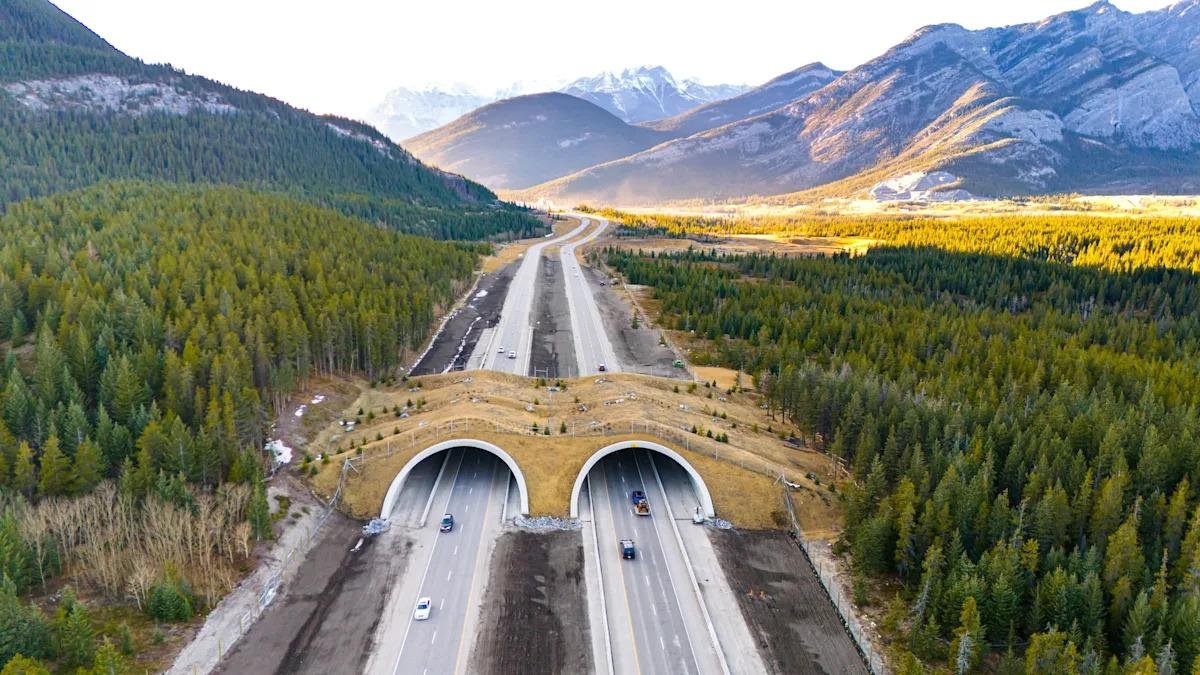
Banff’s wildlife crossing system combines six vegetation-covered overpasses, 38 underpasses, and fencing along approximately 82 kilometres of highway. According to Parks Canada, wildlife-vehicle collisions have fallen by more than 80% since the crossing system was introduced. Researchers have also recorded more than 200,000 crossings by wildlife across the structures. These findings make Banff an inspiring example of how infrastructure and nature can coexist more responsibly.
The story is about more than bridges. It is about understanding that progress should not require animals to lose their homes, migration routes, or chances of survival.
The Problem: When Roads Divide the Natural World
Roads connect cities, towns, workplaces, and communities. They help people travel, transport goods, and reach places that were once difficult to access.
But when highways cut through forests and wildlife habitats, they create an unintended problem.
Animals that once moved freely between different parts of their territory may suddenly encounter a dangerous barrier. A highway can separate feeding grounds from shelter, disrupt seasonal movement, and make it harder for animals to find mates.
For drivers, the consequences can also be serious. Collisions with large animals can damage vehicles, cause injuries, and put human lives at risk.
In Banff National Park, the expansion of the Trans-Canada Highway from two lanes to four created an important question: How could the highway be improved without making life more dangerous for the wildlife living around it?
The answer required a different way of thinking about road construction.
Instead of treating animals as obstacles to traffic, planners began designing a system that would allow both people and wildlife to move more safely through the same landscape.
The Green Bridges That Changed the Story
At first glance, a wildlife overpass may look like an ordinary bridge from a distance. The difference becomes clear when you look at its surface.
Instead of concrete and asphalt, the top is covered with soil and vegetation. Grass, shrubs, trees, and other natural features help create an environment that resembles the surrounding landscape.
For an animal approaching the crossing, the structure can feel much more familiar than a conventional bridge.
The purpose is straightforward: give wildlife a safer route across the highway while allowing vehicles to continue travelling below.
Banff’s system includes six such overpasses. But the overpasses are only one part of the solution.
The wider project also includes 38 underpasses, which allow animals to travel beneath the road. Fencing guides wildlife toward these designated crossing points and helps prevent animals from wandering directly onto the highway.
Together, these measures create a connected network rather than relying on a single bridge to solve a complex problem.
It is an important distinction. Building a crossing is one step; creating a system that animals will actually use is the real challenge.
The Results: What Happened When Wildlife Got a Safer Route?
The strongest part of Banff’s story is that the approach has been monitored for decades.
Parks Canada has conducted ongoing research into wildlife crossings since 1996. This long-term monitoring has helped researchers understand which animals use the structures, how frequently they cross, and how crossing designs can be improved.
Here are some of the most notable findings.
1. Wildlife-vehicle collisions fell significantly
Parks Canada reports that wildlife-vehicle collisions have declined by more than 80% since fencing and crossing structures were introduced.
For elk and deer alone, the reduction has been greater than 96%, according to the agency.
These figures illustrate why wildlife crossings matter beyond conservation. Fewer animals entering traffic can also mean safer journeys for motorists.
2. Animals are using the crossings
Researchers have recorded more than 200,000 crossings by 11 mammal species through the system, according to reporting by The Economic Times.
The documented users include black bears, grizzly bears, elk, red foxes, wolverines, lynx, and other wildlife.
The crossings demonstrate that animals can adapt to purpose-built infrastructure when it is designed around their needs.
3. The benefits extend beyond preventing road deaths
A highway can affect wildlife even when no collision occurs.
When animals cannot move freely between habitats, populations can become isolated. Over time, this separation may limit opportunities to find mates and maintain genetic diversity.
Research on grizzly bears in Banff has indicated that wildlife crossings help maintain movement between populations on opposite sides of the highway.
This is a crucial reminder: successful conservation is not only about preventing immediate harm. It is also about preserving the natural connections that allow wildlife populations to survive over the long term.
Source: Parks Canada — Wildlife Crossing Structures and Research.
Not Every Animal Needs the Same Kind of Bridge
One of the most interesting lessons from Banff is that wildlife crossing design cannot follow a single formula.
Different species behave differently, and a structure that works well for one animal may not be the best option for another.
Some large mammals, including elk and grizzly bears, tend to use open, wide overpasses where they can see their surroundings. Other species, including black bears and cougars, may use underpasses that provide a more enclosed route.
Designers must consider several factors:
- Width and openness: Some animals prefer spacious crossings with clear sightlines.
- Vegetation: Natural ground cover can make an overpass more familiar and inviting.
- Location: Crossings should connect habitats and follow established wildlife movement routes.
- Human disturbance: Excessive noise and activity may discourage animals from using a structure.
- Monitoring: Cameras and field research can reveal whether the crossings are working as intended.
The lesson is simple: wildlife infrastructure works best when it is designed around the animals that need it.
Nature does not operate according to a standard engineering blueprint. Conservation projects must respect that reality.
An Idea That Is Inspiring Other Countries
Banff’s experience has attracted attention from researchers, conservationists, and infrastructure planners elsewhere in the world.
Wildlife crossings have been explored or developed in different regions, including parts of the United States, China, Argentina, and Mongolia.
The underlying challenge is widely shared. As populations grow and transport networks expand, new roads increasingly pass through areas that animals depend on.
A crossing designed for the Canadian Rockies cannot simply be copied everywhere. The animals, terrain, climate, vegetation, and road conditions may be entirely different.
A structure intended for elk and bears, for example, may not be suitable for smaller mammals or species with different movement patterns.
But the central principle travels well: think about wildlife movement before a road becomes a barrier, rather than trying to repair the damage after construction is complete.
That approach could help countries incorporate conservation into highway planning, particularly in ecologically sensitive areas.
Could Wildlife Crossings Work in India?
India offers an especially relevant setting for this lesson.
Highways, railway lines, and expanding urban areas intersect with forests and other habitats used by elephants, deer, leopards, tigers, and numerous smaller species.
In some locations, animals must cross transport corridors to reach different parts of their habitat. These movements can create risks for both wildlife and people.
The Banff model provides several useful lessons for Indian infrastructure planners.
Plan crossings around actual animal movement
Before construction begins, ecological surveys can help identify established wildlife routes, migration patterns, and areas where collisions are more likely.
The right crossing locations should be based on evidence, not simply on where a bridge is easiest to build.
Match the design to the species
An elephant needs a very different crossing from a small mammal. The dimensions, ground conditions, vegetation, and surrounding landscape must reflect the animals expected to use the structure.
Combine crossings with fencing
A crossing may be less effective if animals can easily wander onto the highway nearby. Properly planned fencing can guide animals toward designated routes and reduce dangerous access to traffic.
Monitor results over time
Building a crossing should not be the end of a project.
Monitoring can reveal whether animals use the structure, whether collisions decline, and whether improvements are needed. The findings can then inform future infrastructure projects.
Make conservation part of development
Perhaps the most important lesson is that wildlife protection should be considered during the planning stage, alongside road safety, budgets, and engineering requirements.
India does not need to copy every feature of Banff’s system. It can apply the same principle to local ecosystems and build solutions suited to its own wildlife.
Why These Bridges Matter Beyond the Numbers
It is easy to look at a conservation project through statistics: the number of structures built, kilometres of fencing installed, or collisions prevented.
Those figures matter. They help governments evaluate results and decide where future investment is worthwhile.
But there is another side to the story.
Imagine a young bear moving through its territory without having to cross a stream of speeding traffic. Imagine elk reaching a feeding area without entering a dangerous road. Imagine a wildlife population remaining connected to other groups instead of becoming separated by a permanent human-made barrier.
These are the kinds of possibilities that make wildlife crossings meaningful.
The bridges do not eliminate every threat facing wild animals. They cannot stop habitat loss everywhere, prevent every collision, or solve all conflicts between humans and wildlife.
What they can do is remove one avoidable danger and give animals a safer way to continue their natural movement.
Sometimes, a meaningful environmental solution does not require humans to leave an area entirely. It requires us to build more thoughtfully.
The Challenges: Can Every Road Have a Wildlife Bridge?
Wildlife crossings are promising, but they are not a universal or inexpensive solution.
Building overpasses requires substantial investment, careful engineering, suitable land, and long-term maintenance. Their effectiveness also depends on where they are placed and whether animals use them.
Underpasses, fencing, and other mitigation measures may be more appropriate in some locations. In others, protecting an existing habitat corridor or avoiding a sensitive area during road planning may offer greater benefits.
There is also a need for continued research. Wildlife populations change, animals adapt, and different species respond differently to infrastructure.
Banff’s experience is valuable partly because the project has been monitored over many years. That evidence helps distinguish an attractive idea from a solution that produces measurable results.
The wider lesson is not that every highway needs six green bridges. It is that roads passing through important wildlife habitats deserve careful planning, and conservation measures should be evaluated against real outcomes.
Five Lessons We Can Learn From Banff
The Banff wildlife crossing project offers lessons that extend beyond environmental engineering.
1. Progress and nature do not always have to compete. With thoughtful planning, infrastructure can serve people while reducing harm to wildlife.
2. Small design decisions can have far-reaching effects. A crossing’s location, shape, vegetation, and surrounding fencing can influence whether animals use it.
3. Evidence matters. Long-term monitoring helps establish whether a project is genuinely reducing collisions and improving habitat connectivity.
4. Prevention is often better than repair. Including wildlife movement in early planning can help avoid problems that are harder and more expensive to address later.
5. Successful ideas can inspire solutions elsewhere. The most useful lesson from Banff is not to reproduce its structures everywhere, but to apply its evidence-based approach to local conditions.
Final Thoughts: A Bridge Between Development and Compassion
Banff’s wildlife crossings tell a hopeful story about what can happen when engineering takes the natural world seriously.
A highway remains a highway. Vehicles continue to move across the landscape, carrying people toward their destinations. But above and below that traffic, animals have designated routes that allow them to move between habitats with less danger.
Six green overpasses, 38 underpasses, and a network of fencing have become part of a broader effort to reduce wildlife collisions and reconnect fragmented habitat.
The achievement is not that humans have found a way to control nature. It is that planners have recognized the importance of leaving room for it.
As countries continue to build roads and expand cities, this lesson becomes increasingly important. Development is necessary, but it should not automatically come at the expense of the living systems around us.
Perhaps the most inspiring part of Banff’s story is its simplicity: sometimes, making the world safer for wildlife begins with giving animals a way to cross the road.
And sometimes, a bridge can connect much more than two sides of a highway. It can connect human progress with a more thoughtful relationship with nature.
Frequently Asked Questions
1. What are wildlife overpasses?
Wildlife overpasses are bridges built over roads or highways to allow animals to cross safely. They often include soil and native vegetation to make the crossing resemble the surrounding habitat.
2. How many wildlife crossings are there in Banff National Park?
The system along the Trans-Canada Highway includes six overpasses and 38 underpasses, supported by approximately 82 kilometres of highway fencing within the Banff project.
3. Have Banff’s wildlife crossings reduced animal collisions?
Yes. Parks Canada reports that wildlife-vehicle collisions have fallen by more than 80% since fencing and crossing structures were introduced. The reduction for elk and deer has exceeded 96%.
4. Which animals use the Banff wildlife crossings?
Recorded users include grizzly bears, black bears, elk, red foxes, wolverines, lynx, and other wildlife. Different species show different preferences for overpasses and underpasses.
5. Can wildlife crossings help in India?
Yes, potentially. Similar approaches can help protect wildlife near roads that intersect important habitats. The design and location must be tailored to local species, terrain, and animal movement patterns.
6. Are wildlife overpasses expensive to build?
They can require significant investment, along with fencing, maintenance, and monitoring. The appropriate solution depends on the location, the species involved, traffic conditions, and the risks that need to be reduced.
References and Further Reading
- Parks Canada: Wildlife Crossing Structures and Research
- The Economic Times: Banff’s wildlife overpasses and connected animal corridors
Editorial note: Statistics in this article are based on the cited reporting and Parks Canada information. The article is an independently written educational feature; the Banff project is an example of wildlife mitigation, not a guarantee that every crossing p