
Storage & Data Lake (S3, Glue, Athena)
1. How would you design a scalable and cost-effective data lake architecture on AWS using S3, Glue, and Athena?
The “Senior” Perspective: I’m not just looking for a list of services. I want to hear about the design decisions. A junior engineer will say, “We put data in S3, catalog it with Glue, and query it with Athena.” A senior engineer will start talking about:
- Partitioning Strategy: Why partitioning by date (e.g.,
year/month/day) is often a good starting point, but how it can fail with high-cardinality columns. You’d talk about the need to choose partition keys that your queries will actually use as filters to avoid full table scans. - File Optimization: This is a big one. You need to mention the “small files problem.” If your ETL jobs write thousands of tiny files, Athena’s performance will be terrible and you’ll be charged for all those list operations. A senior will mention using AWS Glue’s built-in features (like
groupFilesandgroupSize) or using a compaction job to coalesce small files into larger, more efficient ones (e.g., 128MB or 256MB) in Parquet or ORC format. - Schema Evolution: Things change. You’d talk about how the Glue Data Catalog supports schema evolution (adding new columns), but you’d also warn about the dangers of making breaking changes (like changing a column’s data type), which would force you to use a workaround like creating a view.
2. When would you prefer Redshift over Athena or vice versa?
This is all about understanding the use case. Here’s the mental framework I’d expect:
- Athena is for: Ad-hoc, interactive querying on data that lives in S3. It’s serverless, so you pay per query. It’s great for exploration, data lakes, and when you don’t want to manage a cluster. But it’s not ideal for high-concurrency, complex joins, or when you need sub-second performance.
- Redshift is for: A traditional data warehouse. It’s a petabyte-scale, managed cluster. You pay for the compute and storage, even when idle. You’d choose Redshift when you have complex, predictable, and high-performance analytical workloads (like your BI dashboards). It shines with massive joins and aggregations.
The real test is when a candidate talks about the “middle ground” like Redshift Spectrum. This lets you use Redshift’s compute layer to query data directly in S3, effectively blurring the line between a data lake and a warehouse.
ETL & Data Processing (Glue vs. EMR)
3. Compare and contrast EMR and Glue for large-scale ETL workloads.
This is the classic question. A superficial answer is “Glue is serverless, EMR is managed.” A senior answer shows a deep understanding:
- AWS Glue: I’d expect you to mention that Glue is great for:
- Serverless ETL: You don’t manage clusters. It’s perfect for sporadic or unpredictable workloads.
- Simple transformations: It’s fantastic for straightforward data cleaning and transformation jobs, especially if they are Spark-based.
- Data Catalog: Glue’s biggest unsung hero is the Data Catalog, a central metadata repository that integrates with almost every other AWS analytics service (Athena, EMR, Redshift Spectrum).
- EMR (Elastic MapReduce): I’d expect you to talk about EMR as the “power tool.” It’s for:
- Custom Frameworks: If you need to run not just Spark, but also Hive, HBase, Presto, or other custom Hadoop ecosystem tools, you’re on EMR.
- Deep Optimization: You have direct access to the underlying cluster, so you can tweak Spark configurations, EC2 instance types, and the OS. This is crucial for massive, complex jobs that are too big or too slow for serverless Glue.
- Cost: If you have a 24/7 ETL pipeline with a predictable load, a long-running EMR cluster with reserved instances is often cheaper than the on-demand pricing model of Glue.
In short, Glue is “Configuration over Code,” and EMR is “Code over Configuration.”
Real-Time & Streaming Data (Kinesis & MSK)
4. You need to build a real-time analytics pipeline. Walk me through your design and service selection (Kinesis vs. MSK, etc.).
This is where your architectural decision-making is put to the test. I’d be looking for clarity on:
- The Problem: First, define the scale and requirements. Is it high-throughput IoT telemetry? Clickstream data? The volume and velocity matter.
- Ingestion:
- Kinesis Data Streams: For a purely AWS-native solution with simple setup and “just works” semantics. It’s great when you need tight integration with Lambda for processing.
- Amazon MSK (Managed Streaming for Kafka): When you need more control, need to maintain compatibility with an existing Kafka ecosystem, or require advanced features like finer-grained topic-level configurations. It’s more to manage, but offers more flexibility.
- Processing: I’d expect to hear about Kinesis Data Analytics for real-time SQL processing or AWS Lambda for lightweight, event-driven transformations. For heavy processing, you’d use a Spark Streaming job on EMR.
- Delivery: You’d use Kinesis Data Firehose to load the processed data into destinations like S3 for a data lake, Redshift for a warehouse, or Elasticsearch for analytics.
- Tuning: A senior engineer would discuss the trade-offs of Kinesis Firehose’s buffering hints (
buffer_sizevs.buffer_interval). Need low latency? Lower the buffer interval, but be prepared for smaller, less cost-efficient files in S3. Need to optimize for cost? Increase the buffer, but accept higher latency.
Performance Tuning & Optimization
5. Your nightly ETL job in Redshift is failing or running slow. What’s your optimization playbook?
This is a classic “tell me how you think” question. I don’t want a single answer; I want a systematic approach:
- Analyze the Query: “I’d start by looking at the explain plan for the query or the failing COPY command to find bottlenecks.”
- Data Distribution: “I’d check the distribution styles of the tables. Are we joining two massive tables where one is distributed ‘ALL’ and the other is ‘EVEN’? That would force a broadcast, hurting performance.” I’d want to hear about
DISTKEYto keep data collocated for joins. - Sort Keys: “Then I’d look at the sort keys. Are they aligned with our most frequent and restrictive filter columns (like
WHERE date = '...')? Using the wrong sort key makes the query planner scan the whole table.” - Maintenance: “I’d check the last time a
VACUUMandANALYZEwere run.VACUUMreclaims space after deletes, andANALYZEupdates table statistics so the query planner makes better decisions. A staleANALYZEis one of the most common performance killers in Redshift.” - Workload Management: “Finally, I’d review the WLM configuration. Is the ETL job running in the same queue as critical BI dashboards? I’d probably create separate WLM queues for ETL and BI and configure Concurrency Scaling for the BI queue to handle peak read requests without starving the ETL jobs. This is a classic senior-level concern.”
Monitoring & Governance
6. How do you ensure the security and governance of your data in AWS? (Security, Compliance, Audit)
This is about protecting the company and its customers. A senior engineer will have a comprehensive answer:
- Encryption: “It’s non-negotiable. We encrypt data at rest in S3 (SSE-S3 or KMS) and Redshift. We encrypt data in transit using TLS. Key management is centralized with KMS, and we use IAM roles and policies for granular, least-privilege access control.”
- Governance: “I’d use AWS Lake Formation as the central governance layer over the data lake. This allows us to define and manage fine-grained permissions for tables and columns, even down to row-level security, without having to write custom code in applications. It’s also where we would set up a centralized audit trail of who is accessing what data.”
- Auditing: “AWS CloudTrail is the backbone for auditing all API calls, so we can see who did what and when. We also use AWS Glue Data Catalog‘s built-in metadata to track data lineage, and we monitor everything with Amazon CloudWatch for operational health and cost.”
Methodology for Senior-Level Answers
The biggest differentiator for me isn’t just knowing the answers, but the way they’re delivered. This is what I call the “Senior Mindset” in an interview:
- Always Discuss Trade-offs: For every service choice, there’s a reason. “We could use Kinesis, but if we need custom partitioning or more advanced Kafka features, MSK might be a better fit, though it adds operational overhead.”
- Connect to Business Goals: Frame your technical decisions around business value. “We chose Glue because it’s serverless, which allows us to scale quickly without upfront investment, but we’re also monitoring costs closely.”
- Show Your “Battle Scars”: Bring in personal experiences. “In a previous project, we faced a huge performance issue on Redshift, and after analyzing the distribution style, we found the key was to…”. A personal anecdote is often more memorable than a theoretical answer.
- Structure Your Answers: The STAR method (Situation, Task, Action, Result) is perfect for behavioral questions. For technical architecture questions, it’s more about the “Problem → Solution → Trade-offs → Result” framework.
Good luck with your preparation. Focus on the “why” behind the “what,” and you’ll be in a great position.
Here’s a practical, interview-ready collection of questions and answers on AWS Data Services, written the way a Senior Technical Manager would expect candidates to answer — clear, structured, with real-world context, trade-offs, and “why” behind the choices.
I’ve grouped them by service/area so you can revise systematically. Answers are humanized: conversational, not robotic textbook dumps.
1. Amazon S3 (Object Storage – Foundation of almost every data pipeline)
Q: What is Amazon S3 and why is it so central to AWS data architectures? S3 is a highly durable, highly available object storage service. We use it as the backbone of data lakes because it scales infinitely, costs very little for large volumes, and integrates with almost every analytics and ETL service (Athena, Glue, Redshift Spectrum, EMR, Lake Formation, etc.). Durability is 11 nines (99.999999999%), which is why teams trust it for raw and processed data.
Q: Explain S3 storage classes and when you would use each.
- S3 Standard – frequent access, low latency.
- S3 Intelligent-Tiering – automatically moves objects between tiers based on access patterns (great when you’re not sure).
- S3 Standard-IA / One Zone-IA – infrequent access, lower cost.
- S3 Glacier Instant Retrieval / Flexible Retrieval / Deep Archive – archival with different retrieval times and costs.
In a data lake we usually keep raw data in Standard or Intelligent-Tiering for a few months, then move older partitions to Glacier via lifecycle policies.
Q: How do you secure data in S3? Multiple layers:
- Bucket policies + IAM policies (least privilege).
- Block Public Access (almost always enabled).
- Encryption – SSE-S3, SSE-KMS, or client-side.
- VPC endpoints / PrivateLink so traffic never leaves the AWS network.
- Object Lock + MFA Delete for compliance (WORM).
- Access logging + CloudTrail for audit.
Q: What are S3 versioning, lifecycle policies, and event notifications used for? Versioning protects against accidental deletes/overwrites. Lifecycle policies automate transitions (Standard → IA → Glacier) and expiration. Event notifications (or EventBridge) trigger Lambda, SQS, or SNS when objects are created/deleted — classic pattern for kicking off ETL jobs.
2. Amazon Redshift (Cloud Data Warehouse)
Q: What is Redshift and when would you choose it over Athena or RDS? Redshift is a fully managed, petabyte-scale columnar data warehouse optimized for complex analytical queries (OLAP). Choose it when you need high-performance SQL analytics on large structured datasets, concurrency for many BI users, and features like materialized views, spectrum (query S3 directly), and RA3 nodes with managed storage.
Athena is better for ad-hoc/serverless queries on the data lake; RDS is for transactional (OLTP) workloads.
Q: Explain Redshift architecture (leader node, compute nodes, slices). Leader node receives queries, creates execution plans, and coordinates. Compute nodes do the actual work; each has multiple slices (parallel units). Data is distributed across slices using distribution styles (KEY, EVEN, ALL). Sorting and compression are critical for performance.
Q: How do you load data into Redshift efficiently? Prefer COPY from S3 (parallel, compressed files in columnar formats like Parquet or ORC). Use Spectrum for querying S3 without loading. For continuous loading, use Kinesis Firehose or Glue. Avoid row-by-row inserts.
Q: What are distribution styles and sort keys? Why do they matter? Distribution style decides how data is spread across nodes (KEY for join-heavy tables, ALL for small dimension tables, EVEN as default). Sort key defines physical order — improves range-restricted scans and merge joins. Wrong choices kill performance.
3. Amazon DynamoDB (NoSQL)
Q: When would you pick DynamoDB over RDS or Redshift? When you need single-digit millisecond latency at any scale, flexible schema, and pure key-value or document access patterns. Great for user profiles, session data, real-time leaderboards, IoT, etc. Not ideal for complex multi-table joins or heavy analytical queries.
Q: Explain partition keys, sort keys, GSIs, and LSIs. Partition key determines the physical partition. Sort key allows range queries within a partition. Global Secondary Indexes (GSI) give alternate access patterns (different partition key). Local Secondary Indexes (LSI) share the same partition key but different sort key. Design access patterns first — this is the #1 reason DynamoDB projects fail.
Q: How does DynamoDB handle scaling and consistency? On-demand or provisioned capacity (with auto-scaling). Strongly consistent or eventually consistent reads. Transactions are supported (up to 100 items). Streams + Lambda for change data capture.
4. Amazon Athena + AWS Glue (Serverless Query + ETL)
Q: What is Athena and how does it work with the Glue Data Catalog? Athena is a serverless interactive query service — you write standard SQL against data sitting in S3. The Glue Data Catalog acts as the metastore (tables, partitions, schemas). No infrastructure to manage; you pay only for data scanned.
Q: How do you optimize Athena performance and cost?
- Store data in columnar formats (Parquet/ORC) with compression (Snappy/ZSTD).
- Partition by high-cardinality filters (date, region, etc.).
- Use partition projection when possible.
- Avoid SELECT *; project only needed columns.
- Compress and use larger files (aim for 128 MB–1 GB).
- Workgroup with cost controls and result reuse.
Q: What is AWS Glue and its main components? Fully managed ETL service. Key pieces:
- Crawlers – discover schema and populate Data Catalog.
- Jobs – Spark (or Python Shell / Ray) based transformations.
- Data Catalog – central metadata store.
- Triggers & Workflows – orchestration.
- DataBrew – visual data prep for analysts.
- Studio – visual ETL development.
Glue is excellent for schema evolution, job bookmarks (incremental processing), and integrating with Lake Formation for fine-grained access control.
5. Amazon Kinesis (Real-time / Streaming)
Q: Difference between Kinesis Data Streams, Firehose, and Data Analytics?
- Data Streams – low-latency, real-time, custom consumers (you manage scaling and processing).
- Firehose – fully managed delivery to S3, Redshift, OpenSearch, Splunk, etc. (near real-time, automatic scaling, transformation via Lambda).
- Data Analytics (Apache Flink / Managed Service for Apache Flink) – SQL or Flink applications for real-time analytics.
Q: When would you choose Kinesis over Kafka (MSK)? Kinesis is simpler (fully managed, seamless AWS integration). MSK (Managed Streaming for Kafka) when you already have Kafka expertise, need exactly-once semantics more easily, or want open-source compatibility and more control over partitioning/consumer groups.
6. Amazon EMR (Big Data Processing)
Q: When do you use EMR instead of Glue or Athena? When you need full control over a Spark/Hadoop/Hive/Presto cluster, custom libraries, long-running jobs, or very large-scale processing that benefits from persistent clusters or specific instance types. Glue is better for simpler, serverless Spark ETL. Athena is for interactive SQL.
EMR supports Spot instances, auto-scaling, and integration with S3 as the data store (instead of HDFS).
7. Architecture & Scenario Questions (Very Common)
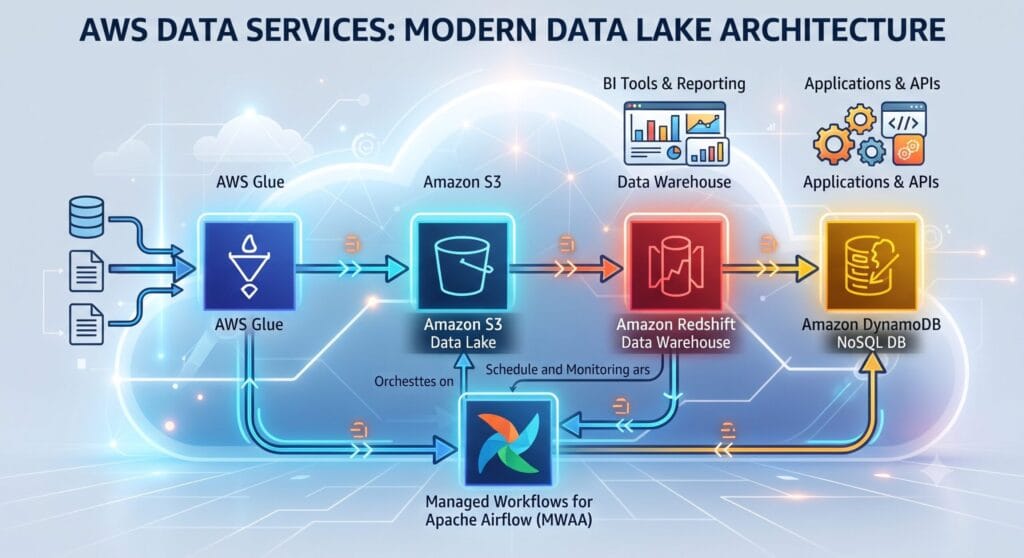
Q: How would you design a modern data lake on AWS?
- Landing zone: S3 (raw)
- Catalog & governance: Glue Data Catalog + Lake Formation
- ETL/ELT: Glue jobs / EMR / Lambda
- Query: Athena + Redshift Spectrum / Redshift
- Streaming: Kinesis / MSK → Firehose or Glue Streaming
- BI: QuickSight
- Security: Lake Formation fine-grained access, encryption, VPC endpoints
- Orchestration: Step Functions or Airflow (MWAA)
Q: How do you handle schema evolution? Glue crawlers + schema versioning in the Data Catalog. For Iceberg/Hudi/Delta Lake tables (increasingly preferred), you get ACID, time travel, and schema evolution natively on S3.
Q: Batch vs Streaming – how do you decide?
- Latency requirement < few minutes → streaming (Kinesis/Flink).
- Cost and simplicity preferred, and near-real-time is enough → micro-batch or scheduled Glue/Athena.
- Hybrid is common: stream into S3, then process with Glue/EMR.
Q: How do you ensure data quality and monitoring? Glue Data Quality rules, Great Expectations or custom checks in Spark, CloudWatch metrics/alarms, data lineage (Glue or OpenLineage), and Athena/QuickSight dashboards for freshness and volume anomalies.
Quick Tips from a Hiring Manager Perspective
- Always talk about access patterns, cost, scalability, and failure modes.
- Mention Lake Formation and Iceberg — interviewers love seeing modern best practices.
- Be ready to whiteboard a pipeline (S3 → Glue → Redshift/Athena + Kinesis for streaming).
- Know the difference between provisioned vs serverless (Redshift Serverless, Glue, Athena, DynamoDB On-Demand).
Below is a comprehensive interview guide in another format.
1. What are AWS Data Services?
Answer
AWS Data Services are managed cloud services used to store, process, migrate, analyze, stream, and secure data without managing infrastructure.
They include services such as:
| Category | AWS Service |
|---|---|
| Object Storage | Amazon S3 |
| Relational Database | Amazon RDS |
| Data Warehouse | Amazon Redshift |
| NoSQL Database | DynamoDB |
| Data Migration | AWS DMS |
| ETL | AWS Glue |
| Big Data | Amazon EMR |
| Streaming | Amazon Kinesis |
| Search | Amazon OpenSearch |
| Data Lake | AWS Lake Formation |
| Analytics | Amazon Athena |
| Visualization | Amazon QuickSight |
| Cache | ElastiCache |
| Time Series | Amazon Timestream |
2. Explain Amazon S3.
Answer
Amazon S3 (Simple Storage Service) is AWS’s highly durable object storage service.
Think of S3 as an unlimited hard drive in the cloud.
It stores:
- Images
- Videos
- Backups
- Data Lakes
- CSV files
- JSON
- Parquet
- Machine Learning datasets
- Logs
Durability:
99.999999999% (11 Nines)
Availability:
99.99%
Common Uses
- Data Lake
- Static Website
- Backup
- ML Training Data
- Archive
- ETL Input
- Data Sharing
Interview Follow-up
Q: Difference between Bucket and Object?
Answer
Bucket
- Container
Object
- Actual file
Example
Bucket
    SalesData

Objects

sales.csv

customers.json

report.parquet
3. What are S3 Storage Classes?
Answer
| Storage Class | Use Case |
|---|---|
| Standard | Frequently accessed |
| Intelligent Tiering | Unknown access pattern |
| Standard IA | Infrequent access |
| One Zone IA | Cheap storage |
| Glacier Instant | Archive |
| Glacier Flexible | Long-term archive |
| Glacier Deep Archive | Compliance data |
Interview Question
Why use Intelligent Tiering?
Answer
Because AWS automatically moves objects between storage tiers based on access frequency, reducing storage costs without impacting availability.
4. Explain Amazon RDS.
Answer
Amazon RDS is a managed relational database service.
Supported Databases
- MySQL
- PostgreSQL
- SQL Server
- Oracle
- MariaDB
- Aurora
AWS manages:
- Backup
- Patch
- Failover
- Replication
- Monitoring
You manage:
- Database schema
- Queries
- Users
- Indexes
Interview Question
Why use RDS instead of EC2 Database?
Answer
RDS provides automated backups, Multi-AZ failover, patch management, monitoring, scalability, and significantly reduces operational overhead.
5. Explain Aurora.
Answer
Aurora is AWS’s cloud-native relational database.
Compatible with:
- PostgreSQL
- MySQL
Advantages
- 5x faster than MySQL
- 3x faster than PostgreSQL
- Auto scaling
- Six copies across three Availability Zones
- Self-healing storage
Interview Question
Why Aurora instead of MySQL?
Answer
Aurora delivers better performance, higher availability, automatic storage scaling, and lower administrative effort.
6. Explain DynamoDB.
Answer
DynamoDB is a fully managed NoSQL database.
Stores data as:
Key → ValueNo joins
No fixed schema
Single-digit millisecond latency
Best For
- Gaming
- Shopping carts
- Banking sessions
- IoT
- Mobile apps
- Real-time APIs
Interview Question
Difference between SQL and DynamoDB?
| SQL | DynamoDB |
|---|---|
| Tables | Tables |
| Fixed Schema | Flexible Schema |
| SQL Query | API Calls |
| Joins | No Joins |
| Vertical Scaling | Horizontal Scaling |
7. Explain Amazon Redshift.
Answer
Amazon Redshift is AWS’s petabyte-scale data warehouse.
Optimized for:
- BI
- Reporting
- Analytics
- Dashboards
Uses
- Columnar Storage
- Compression
- Massively Parallel Processing (MPP)
Interview Question
Difference between Redshift and RDS?
| RDS | Redshift |
|---|---|
| OLTP | OLAP |
| Transactions | Analytics |
| Small Queries | Huge Queries |
| Row Storage | Column Storage |
Example
Bank Application
RDS
Customer transaction
Redshift
Monthly fraud analysis
8. Explain AWS Glue.
Answer
Glue is a serverless ETL service.
Responsibilities
- Read data
- Transform data
- Clean data
- Load data
Supports
- Spark
- Python
- Scala
Glue Components
Crawler
Discovers schema
↓
Data Catalog
Stores metadata
↓
ETL Job
Transforms data
↓
Target
S3 / Redshift / RDS
Interview Question
What is Glue Data Catalog?
Answer
It is a centralized metadata repository that stores table definitions, partitions, schemas, and locations, enabling services like Athena, EMR, and Redshift Spectrum to query data consistently.
9. Explain AWS Lake Formation.
Answer
Lake Formation simplifies building and securing data lakes.
Instead of manually configuring IAM, S3 permissions, and Glue permissions, Lake Formation centralizes governance.
Features
- Fine-grained access control
- Data catalog
- Security
- Data sharing
- Row-level security
- Column-level security
10. Explain Athena.
Answer
Athena is a serverless SQL query engine.
Query directly on S3.
No infrastructure.
Uses ANSI SQL.
Example
CSV

↓

Upload to S3

↓

Create Glue Catalog

↓

Athena

↓

Run SQL
Interview Question
Why Athena instead of Redshift?
Answer
Athena is ideal for ad hoc analysis without infrastructure, while Redshift is better suited for high-performance, recurring analytical workloads.
11. Explain EMR.
Answer
EMR (Elastic MapReduce) is AWS’s managed big data platform.
Supports
- Spark
- Hadoop
- Hive
- HBase
- Presto
- Flink
Use Cases
- Large ETL jobs
- Machine Learning
- Graph processing
- Log processing
Interview Question
Glue vs EMR?
| Glue | EMR |
|---|---|
| Serverless | Cluster Based |
| Managed | More Control |
| ETL | Big Data |
| Easy | Flexible |
12. Explain AWS DMS.
Answer
Database Migration Service migrates databases with minimal downtime.
Supports
Oracle
↓
SQL Server
↓
MySQL
↓
Aurora
↓
PostgreSQL
↓
RDS
Migration Types
- Full Load
- CDC (Change Data Capture)
- Full Load + CDC
Interview Question
How does DMS reduce downtime?
Answer
After the initial full load, DMS captures ongoing source database changes using CDC and continuously replicates them to the target until cutover.
13. Explain Amazon Kinesis.
Answer
Real-time streaming service.
Used for
- IoT
- Financial transactions
- Log analytics
- Fraud detection
Services
- Data Streams
- Firehose
- Data Analytics
- Video Streams
Interview Question
Difference between Kinesis Streams and Firehose?
| Streams | Firehose |
|---|---|
| Real-time | Near Real-time |
| Custom Apps | Automatic Delivery |
| Consumers Required | Managed |
14. Explain AWS QuickSight.
Answer
Business Intelligence service.
Creates
- Dashboards
- Reports
- KPIs
- Executive dashboards
Supports
- Athena
- Redshift
- RDS
- S3
- SQL Server
- Snowflake
Interview Question
SPICE in QuickSight?
Answer
SPICE is an in-memory engine that accelerates dashboard performance by caching datasets for fast analytical queries.
15. Explain OpenSearch.
Answer
Search and log analytics engine.
Used for
- Full-text search
- Application logs
- Kibana/OpenSearch Dashboards
- Security analytics
16. Explain ElastiCache.
Answer
Managed caching service.
Supports
- Redis
- Memcached
Purpose
Reduce database load.
Improve response time.
17. Explain Timestream.
Answer
Time-series database.
Used for
- IoT
- Sensors
- Stock market
- CPU metrics
- Monitoring
18. Real Project Scenario
Question
Design an AWS data pipeline for processing 5 TB of sales data every day.
Answer
A robust architecture could be:
Source Systems
      │
      ▼
AWS DMS / Kinesis
      │
      ▼
Amazon S3 (Raw Zone)
      │
      ▼
AWS Glue Crawlers
      │
      ▼
AWS Glue ETL Jobs
      │
      ▼
Amazon S3 (Curated Parquet)
      │
      ├──────────────► Amazon Athena (ad hoc analysis)
      │
      └──────────────► Amazon Redshift (enterprise reporting)
                              │
                              ▼
                       Amazon QuickSight
Security controls would include IAM roles, KMS encryption, Lake Formation permissions, VPC endpoints, CloudTrail logging, and least-privilege access. Performance can be improved by storing data in Parquet, partitioning by date or region, compressing files, and optimizing Glue jobs.
19. Senior-Level Scenario Questions
- How would you design a multi-petabyte AWS Data Lake?
- When would you choose Glue over EMR?
- How would you optimize Redshift for billions of rows?
- How do you secure sensitive data in S3?
- Explain Lake Formation permission inheritance.
- How do you optimize Athena query costs?
- How would you migrate a 50 TB Oracle database to Aurora?
- Explain Glue job bookmarks.
- What are Redshift distribution styles and sort keys?
- How do you design a real-time streaming architecture using Kinesis?
20. Common Mistakes Interviewers Watch For
- Choosing RDS for large analytical workloads instead of Redshift.
- Using DynamoDB when complex joins and relational integrity are required.
- Storing analytical data in CSV instead of optimized formats like Parquet.
- Ignoring S3 lifecycle policies and storage class optimization.
- Overlooking IAM, KMS, Lake Formation, and VPC endpoint security.
- Failing to partition large datasets for Athena and Glue.
- Not considering cost implications of Glue, EMR, or Redshift cluster sizing.
- Designing pipelines without monitoring, retry mechanisms, or data quality validation.
What a Senior Technical Manager Expects
Beyond definitions, I expect candidates to demonstrate:
- The ability to justify why they chose one AWS data service over another.
- Understanding of trade-offs involving performance, scalability, cost, and security.
- Experience designing end-to-end data pipelines rather than using individual services in isolation.
- Familiarity with operational concerns such as monitoring, disaster recovery, encryption, governance, and infrastructure automation.
- Real-world examples where they solved production-scale data challenges.
A candidate who can confidently discuss these topics with practical examples is typically well prepared for Senior AWS Data Engineer, Data Architect, or AWS Solution Architect interviews.


There is definately a lot to find out about this subject. I like all the points you made
Reliable platform with quick payouts that actually show up on my account same day. The live dealer section feels so authentic and the chat works perfectly. Really glad I stumbled upon this one. Stop by vn99ww