Artificial intelligence isn’t just getting smarter — it’s becoming an autonomous partner in how we think, build, and operate. According to Rakesh Gohel, AI agents from Anthropic are now at the epicenter of this transformation, bringing 90 % automation within reach for many knowledge work tasks.
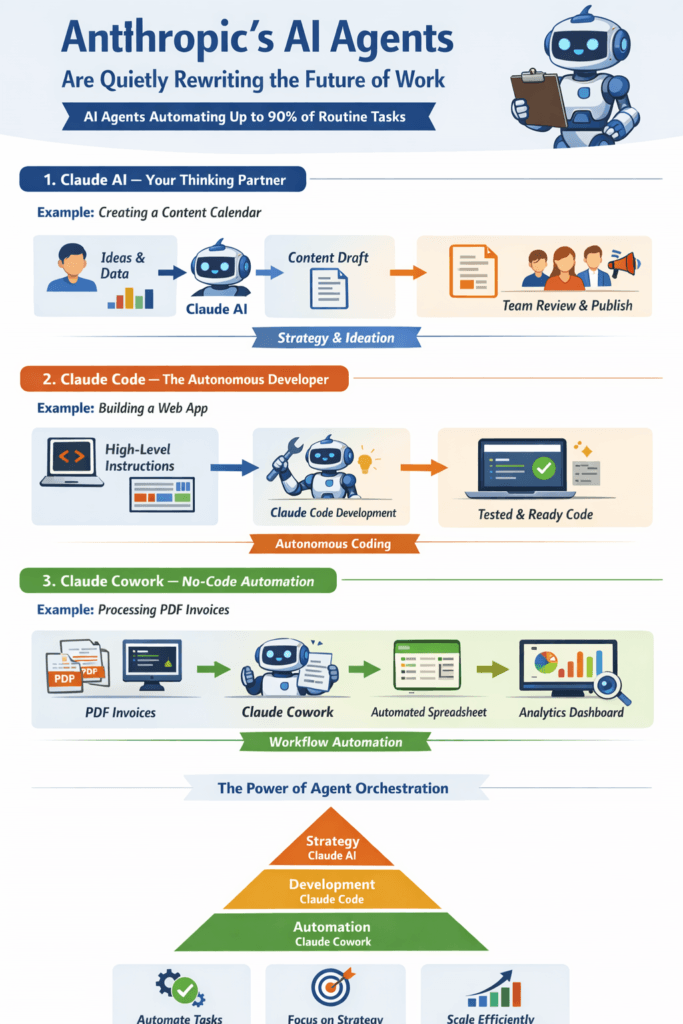
As AI ecosystems mature, the focus has shifted from simple conversational tools to agentic systems capable of executing real work. Here’s how Anthropic’s trio of agent technologies is redefining the workplace:
🧠 1. Claude AI – The Thinking Partner
At its core, Claude AI functions as a versatile conversational assistant — ideal for ideation, research, drafting, and analysis. It’s designed to help users think better and faster, whether they’re writing emails, creating reports, or exploring complex topics. Because it requires no setup, it’s accessible to almost anyone from students to executives.
Best suited for: creative thinking, drafting, research support
Trade-offs: limited to interactive use — does not automate beyond conversations.
💻 2. Claude Code – Autonomous Engineering Agent
For professional developers, Claude Code brings autonomous coding capabilities directly into the terminal. It can understand entire codebases, generate features spanning multiple files, refactor legacy systems, and even write and fix tests on its own. Essentially, it acts like a junior engineer that doesn’t sleep.
What makes Claude Code stand out is its execution autonomy: it can take high-level instructions and carry them through to concrete code outputs. Yet this power comes with responsibilities — developers must still review results carefully and manage associated cost implications.
Best suited for: software engineers, dev teams, technical execution
Trade-offs: requires oversight and thoughtful integration into workflows.
📂 3. Claude Cowork – No-Code Workflow Automation
Not all professionals write code — and Claude Cowork offers a bridge for non-developers to automate tedious tasks without writing a single line of code. From reorganizing thousands of files at once to extracting structured data from PDFs and automating repetitive copy-paste workflows across applications, Cowork brings AI into everyday digital work.
It’s still in early stages, but its promise is clear: empower knowledge workers to build automation workflows through simple, intuitive actions.
Best suited for: business analysts, operations roles, task automation
Trade-offs: early-stage features, limited configuration today.
The Combined Power of the Agent Ecosystem
Gohel’s framework isn’t just about three standalone tools — it’s about how they orchestrate together:
- Claude AI provides strategy and understanding.
- Claude Code turns that strategy into executable results.
- Claude Cowork operationalizes outputs and automates mundane tasks.
This layered approach mirrors how digital platforms evolve from manual processes to managed ecosystems. When thinkers, builders, and operators are all augmented by specialized AI agents, work stops being just faster — it becomes fundamentally different.
What This Means for the Future of Work
The agent economy isn’t a futuristic concept — it’s happening now. Teams and individuals who embrace agent orchestration can automate far beyond what traditional tools allowed. With the right mix of strategy, execution, and operations automation:
- Routine tasks get out of human hands.
- Strategic thinking takes center stage.
- Technical execution scales without proportional increases in team size.
In this new paradigm, the emerging skill won’t just be how well you work with AI — it will be how well you integrate multiple AI agents into your workflows.
If you want to explore how AI agents can be woven into your work — whether you’re a creator, engineer, or operations lead — start by understanding the capabilities and trade-offs of Claude AI, Claude Code, and Claude Cowork. The automation frontier is closer than most people think.
🌐 Practical Impact on Work
- Marketing: Automate content creation and scheduling, freeing time for strategic decisions.
- Software Development: Reduce manual coding, accelerate releases, and improve code quality.
- Operations: Automate repetitive tasks, reducing errors and increasing productivity.
Example Scenario:
A SaaS startup uses Claude AI to draft a product launch plan, Claude Code to implement integration features, and Claude Cowork to automate CRM updates — all in parallel, dramatically reducing time-to-market.
⚡ The Future Skillset: AI Orchestration
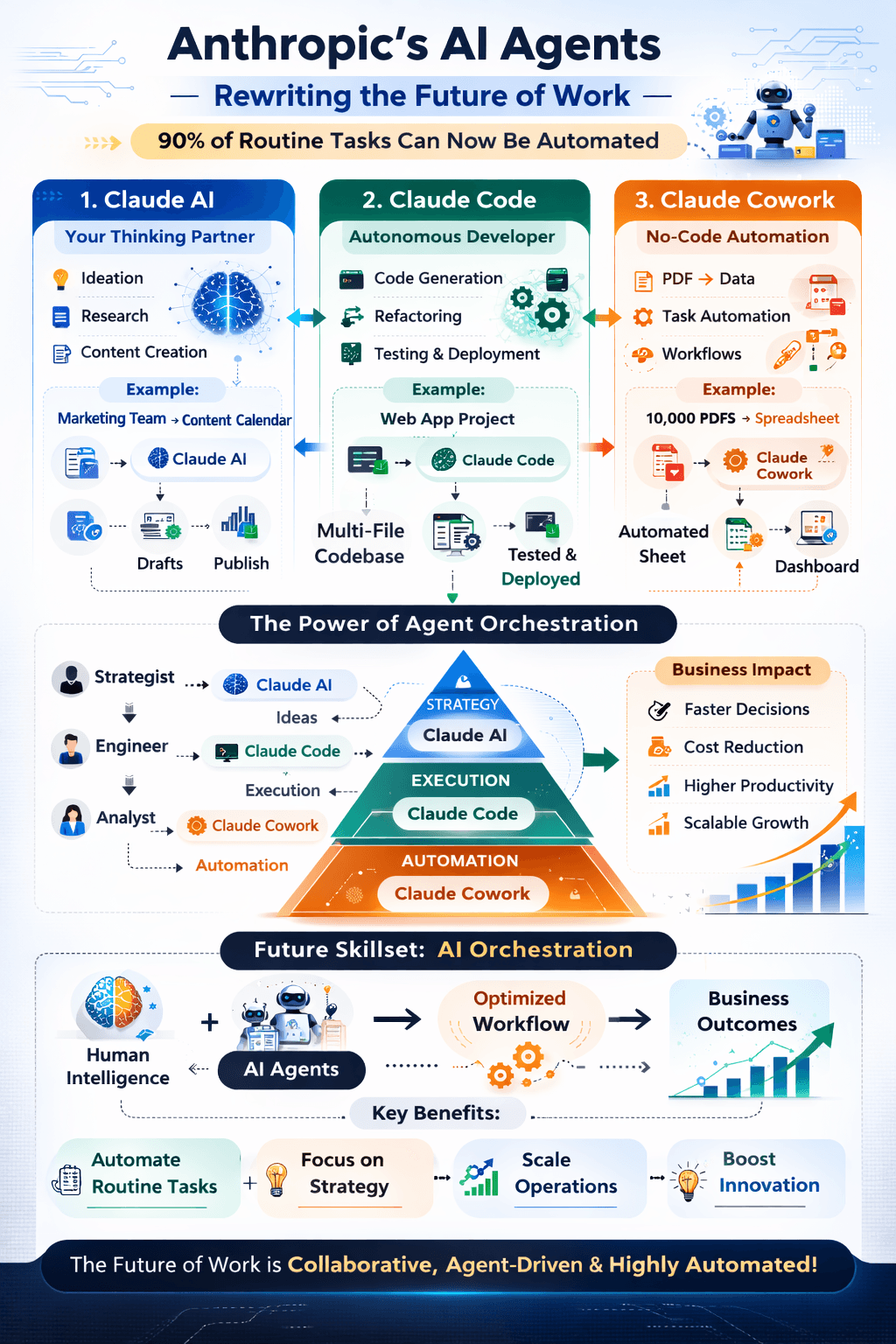
The emerging skill isn’t just “using AI” — it’s orchestrating multiple AI agents to complement human intelligence. Professionals who master this orchestration can:
- Automate routine tasks with minimal supervision.
- Focus on high-value strategic decisions.
- Scale operations without proportional increases in headcount.
Visual Concept:
- Infographic: “Human + AI Agents → Optimized Workflow → Business Outcomes.”
- Emphasizes synergy, not replacement.
Anthropic’s AI agents are not just tools — they are digital colleagues that amplify human capabilities. Claude AI, Claude Code, and Claude Cowork collectively demonstrate that the future of work is collaborative, agent-driven, and highly automated.