
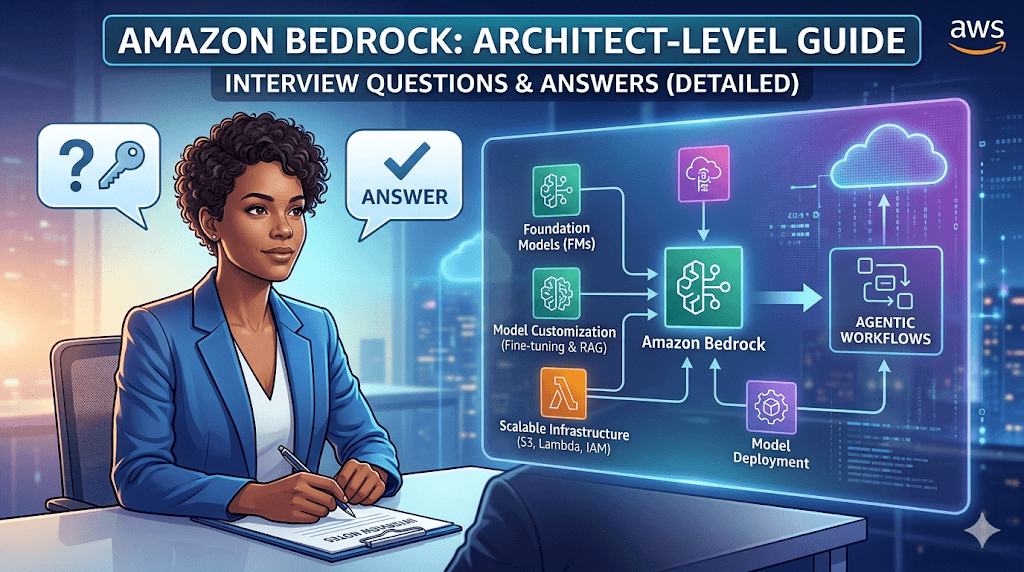
Amazon Bedrock is one of the most important topics for AI Architect, Cloud Architect, AI Engineer, Solution Architect, and Generative AI roles. Interviewers often ask architecture, security, implementation, governance, and enterprise adoption questions.
1. What is Amazon Bedrock?
Answer
Amazon Bedrock is a fully managed AWS service that allows developers to build and scale Generative AI applications using foundation models (FMs) from multiple providers without managing infrastructure.
Bedrock provides access to models from:
- Anthropic
- Meta
- Mistral AI
- Cohere
- AI21 Labs
- Amazon (Titan Models)
Key Benefits
- Serverless
- No GPU management
- Enterprise security
- Pay-as-you-go
- Multiple model choices
- RAG support
- Agent support
- Fine-tuning support
2. Why use Amazon Bedrock instead of managing your own LLM?
Answer
Without Bedrock:
- Provision GPU infrastructure
- Install models
- Scale clusters
- Patch systems
- Manage security
With Bedrock:
- Fully managed
- Automatic scaling
- Built-in security
- Easy API access
- Access to multiple model providers
Interview Sound Bite
Bedrock abstracts infrastructure complexity so teams can focus on business value rather than model hosting.
3. What Foundation Models are available in Bedrock?
Answer
Common models include:
| Provider | Model |
|---|---|
| Amazon | Titan |
| Anthropic | Claude |
| Meta | Llama |
| Mistral | Mistral Large |
| Cohere | Command |
| AI21 | Jurassic |
Use cases:
- Chatbots
- Summarization
- Content generation
- Code generation
- Q&A systems
4. What are Amazon Titan Models?
Answer
Titan models are Amazon’s proprietary foundation models.
Examples:
Titan Text
Used for:
- Text generation
- Summarization
- Chat
Titan Embeddings
Used for:
- Semantic search
- RAG
- Vector databases
Titan Image
Used for:
- Image generation
- Image editing
5. What is Retrieval-Augmented Generation (RAG)?
Answer
RAG combines:
- Enterprise knowledge
- Foundation models
Flow:
User Question
↓
Retrieve Relevant Documents
↓
Add Context
↓
LLM Generates Response
Benefits:
- Reduces hallucinations
- Uses company data
- Improves accuracy
6. How does Bedrock support RAG?
Answer
Bedrock provides:
Knowledge Bases for Bedrock
Automatically:
- Ingests documents
- Creates embeddings
- Stores vectors
- Retrieves relevant chunks
Supported sources:
- S3
- Confluence
- SharePoint
- Salesforce
Flow:
Documents
↓
Embeddings
↓
Vector Store
↓
Semantic Search
↓
Claude/Titan Response
7. What are Bedrock Knowledge Bases?
Answer
Knowledge Bases automate the entire RAG workflow.
Features:
- Data ingestion
- Chunking
- Embeddings
- Vector indexing
- Retrieval
Benefits:
- No custom RAG code
- Faster deployment
- Enterprise-grade scalability
8. Which Vector Databases can Bedrock Knowledge Bases use?
Answer
Common vector stores:
- Amazon OpenSearch Service
- Pinecone
- Redis
- MongoDB Atlas
9. What are Bedrock Agents?
Answer
Agents enable LLMs to perform actions.
Agent workflow:
User Request
↓
Reasoning
↓
Tool Selection
↓
API Invocation
↓
Response
Example:
User:
“Book my flight”
Agent:
- Finds flight
- Calls booking API
- Confirms reservation
10. Explain Bedrock Agents Architecture
Answer
Components:
Agent
Reasoning engine
Foundation Model
Claude/Titan/Llama
Action Groups
API definitions
Lambda Functions
Business logic execution
Flow:
User
↓
Agent
↓
Action Group
↓
Lambda
↓
Backend Systems
11. What are Action Groups?
Answer
Action Groups connect agents to APIs.
Example:
GetCustomerData
CreateTicket
BookFlight
Typically backed by:
- API Gateway
- Lambda
- REST APIs
12. Explain Prompt Engineering in Bedrock
Answer
Prompt Engineering means designing effective prompts.
Example:
Bad:
“Explain cloud.”
Good:
“Explain cloud computing for a CIO in less than 200 words.”
Best Practices:
- Role prompting
- Few-shot examples
- Context injection
- Structured outputs
13. What is Prompt Management?
Answer
Bedrock allows centralized prompt storage and versioning.
Benefits:
- Reusability
- Governance
- Consistency
- Version control
14. What is Fine-Tuning?
Answer
Fine-tuning customizes a model using domain-specific data.
Example:
Base Model:
General English
Fine-Tuned Model:
Medical assistant
Benefits:
- Better accuracy
- Domain expertise
- Reduced prompt size
15. Difference Between Fine-Tuning and RAG
| Fine-Tuning | RAG |
|---|---|
| Changes model weights | Doesn’t change weights |
| Expensive | Less expensive |
| Long training | Quick setup |
| Static knowledge | Dynamic knowledge |
| Domain behavior | Enterprise data retrieval |
Interview Answer
For enterprise knowledge use RAG first. Use fine-tuning when behavior customization is required.
16. What Security Features does Bedrock Provide?
Answer
Security includes:
- IAM integration
- KMS encryption
- VPC endpoints
- CloudTrail logging
- Private networking
Enterprise benefits:
- Data protection
- Compliance
- Auditability
17. How does Bedrock protect customer data?
Answer
AWS states customer prompts and outputs are not used to train foundation models unless explicitly permitted.
Security:
- Encryption at rest
- Encryption in transit
- Access controls
- Audit logging
18. What is Guardrails for Amazon Bedrock?
Answer
Guardrails help enforce AI safety policies.
Capabilities:
- Block harmful content
- Filter PII
- Restrict topics
- Enforce compliance
Examples:
Block:
- Hate speech
- Violence
- Sensitive information
19. Explain Bedrock Guardrails Use Cases
Answer
Banking:
Prevent disclosure of account numbers.
Healthcare:
Prevent exposure of patient data.
Customer Service:
Prevent inappropriate responses.
20. What is Model Evaluation in Bedrock?
Answer
Model Evaluation helps compare models.
Metrics:
- Accuracy
- Relevance
- Toxicity
- Latency
Example:
Claude vs Llama vs Titan
Select model based on business requirements.
21. How does Bedrock integrate with AWS Services?
Answer
Common integrations:
| Service | Purpose |
|---|---|
| S3 | Document storage |
| Lambda | Business logic |
| API Gateway | APIs |
| OpenSearch | Vector search |
| KMS | Encryption |
| CloudWatch | Monitoring |
| CloudTrail | Auditing |
| EKS | AI applications |
| Step Functions | Workflow orchestration |
22. Design a Bedrock-Based Enterprise Chatbot
Answer
Architecture:
Users
↓
API Gateway
↓
Lambda
↓
Bedrock Agent
↓
Knowledge Base
↓
OpenSearch Vector Store
↓
S3 Documents
Security:
- IAM
- KMS
- Guardrails
- CloudTrail
23. How would you reduce hallucinations?
Answer
Methods:
- RAG
- Better prompts
- Guardrails
- Context enrichment
- Human review
- Model evaluation
24. Explain Multi-Model Strategy in Bedrock
Answer
Different models for different tasks:
Claude:
Reasoning
Titan:
Embeddings
Llama:
Cost optimization
Mistral:
Fast inference
Benefit:
Avoid vendor lock-in.
25. What are common enterprise Bedrock use cases?
Answer
Customer Support
AI assistant
Knowledge Management
Enterprise search
Content Generation
Marketing content
Code Generation
Developer productivity
Document Analysis
Contracts, policies
Healthcare
Clinical assistants
Banking
Fraud and support assistants
26. Bedrock vs OpenAI API
| Feature | Bedrock | OpenAI |
|---|---|---|
| Multi-model | Yes | No |
| AWS Integration | Native | Limited |
| IAM Security | Yes | No |
| VPC Support | Yes | No |
| Enterprise Governance | Strong | Moderate |
| Managed Infrastructure | Yes | Yes |
27. Bedrock vs SageMaker
| Bedrock | SageMaker |
|---|---|
| Generative AI Service | ML Platform |
| Managed Foundation Models | Build/train models |
| Fast Deployment | Full ML lifecycle |
| Minimal ML expertise | Advanced ML expertise |
28. What Monitoring is available for Bedrock?
Answer
Use:
- CloudWatch
- CloudTrail
- Cost Explorer
- AWS Config
Monitor:
- Latency
- Errors
- Token usage
- Cost
- Throughput
29. How would you design a secure Bedrock solution for a bank?
Answer
Architecture:
- Private VPC endpoints
- KMS encryption
- Guardrails
- Knowledge Base
- IAM least privilege
- CloudTrail auditing
- Multi-account architecture
Compliance:
- PCI DSS
- SOC2
- ISO 27001
30. What are the most important Bedrock interview topics?
Expected Focus Areas
- Foundation Models
- Titan Models
- RAG
- Knowledge Bases
- Agents
- Action Groups
- Prompt Engineering
- Guardrails
- Security
- Fine-Tuning
- Vector Databases
- Enterprise Architecture
- Monitoring
- Cost Optimization
- AWS Integrations
Senior Architect Interview Tip
A strong answer should consistently connect:
- Business requirement
- Bedrock capability
- Security controls
- Scalability
- Cost optimization
- Governance
That combination is what interviewers typically look for in AI Architect, Generative AI Architect, Principal Architect, and Enterprise Solution Architect roles involving Amazon Bedrock.