
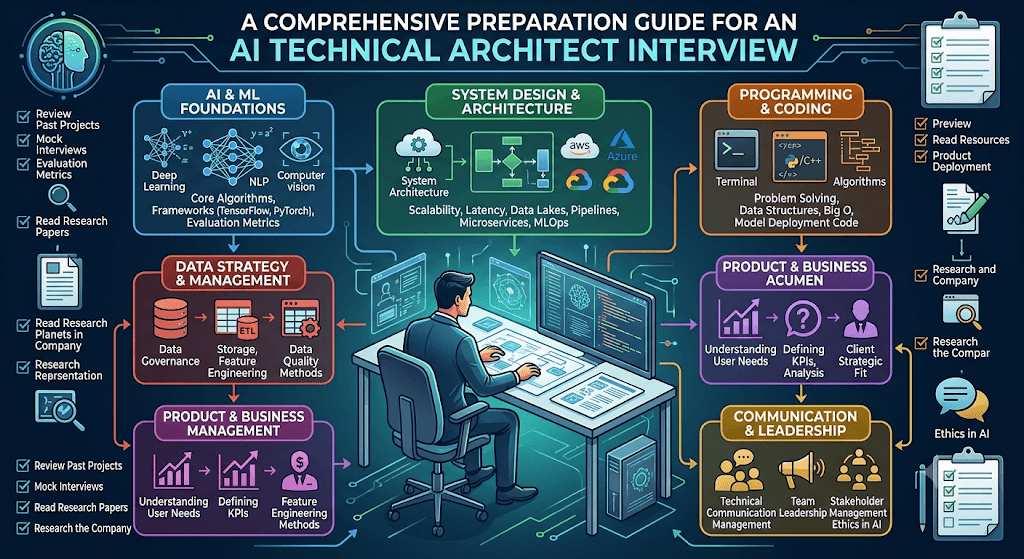
Here’s a comprehensive preparation guide for an AI Technical Architect interview. This covers fundamentals, advanced topics, system design, MLOps, cloud integration, generative AI/LLMs, architecture principles, and behavioral questions. Use this to build your personal document—add your experiences, diagrams, and notes for each section.
1. AI/ML Fundamentals
Q: Explain the difference between AI, Machine Learning, and Deep Learning. A: AI is the broad field of creating intelligent machines. ML is a subset where models learn from data without explicit programming. Deep Learning uses multi-layered neural networks (especially on large datasets) to automatically learn hierarchical features.
Q: What are supervised, unsupervised, semi-supervised, and reinforcement learning? Give examples. A: Supervised: Labeled data (e.g., classification like spam detection). Unsupervised: No labels (e.g., clustering customers). Semi-supervised: Mix of labeled/unlabeled. Reinforcement: Agent learns via rewards (e.g., game-playing AI).
Q: How do you handle overfitting vs. underfitting? A: Overfitting (high variance): Use regularization (L1/L2), dropout, early stopping, more data, cross-validation. Underfitting (high bias): More complex model, better features, longer training.
Q: Explain bias-variance tradeoff. A: Total error = Bias² + Variance + Irreducible error. Aim for balance to minimize generalization error.
2. Deep Learning & Neural Networks
Q: Describe the Transformer architecture and why it’s foundational for modern AI. A: Transformers use self-attention (multi-head), positional encodings, encoder-decoder structure. They process sequences in parallel (unlike RNNs), capture long-range dependencies efficiently, and scale well. Key for LLMs.
Q: What are CNNs used for? Explain key layers. A: Primarily computer vision. Convolution layers extract features, pooling reduces dimensionality, fully connected for classification.
Q: Explain attention mechanisms (self-attention, multi-head). A: Attention computes weighted importance of input parts. Multi-head allows focusing on different subspaces simultaneously.
Q: How do you manage vanishing/exploding gradients? A: Use ReLU/Leaky ReLU activations, batch normalization, residual connections (ResNets), proper initialization (Xavier/He).
3. Generative AI & LLMs
Q: What is Generative AI? Compare base models vs. instruction-tuned/fine-tuned models. A: Models that create new content (text, images, etc.). Base: Pre-trained on raw data for prediction. Instruction-tuned: Further trained on instructions/preferences (e.g., ChatGPT) for better usability.
Q: Explain RAG (Retrieval-Augmented Generation). When to use it? A: Retrieves relevant documents from a vector DB and augments the prompt to the LLM. Reduces hallucinations, adds up-to-date knowledge. Use for domain-specific Q&A over fine-tuning when data changes often.
Q: How do you evaluate LLMs? (Metrics and techniques) A: Perplexity, BLEU/ROUGE (for generation), human eval, benchmarks (MMLU, GSM8K), hallucination detection, toxicity scores. Use guardrails for safety.
Q: Discuss prompt engineering techniques. A: Chain-of-Thought, few-shot, zero-shot, tree-of-thoughts, ReAct (Reason + Act). Iterate with temperature, top-p, etc.
Q: What are agents in GenAI? Agentic workflows? A: Autonomous systems that use tools, plan, and iterate (e.g., multi-agent setups). Vs. passive chatbots.
4. MLOps & Productionization
Q: What is MLOps? How does it differ from DevOps? A: MLOps applies DevOps to ML: data versioning, experiment tracking, model serving, monitoring drift. ML has non-deterministic models, data dependencies, and retraining needs.
Q: Key components of an MLOps pipeline? A: Data ingestion → Feature store → Training (experiment tracking with MLflow) → Validation → CI/CD (model packaging) → Deployment (Kubernetes/SageMaker) → Monitoring (drift, performance) → Feedback loop.
Q: How do you monitor models in production? A: Statistical drift (KS test), performance metrics, data quality, latency, resource usage. Tools: Prometheus, Evidently AI. Set alerts and retrain triggers.
Q: Explain model versioning, A/B testing, and rollback. A: Use tools like MLflow or DVC. Shadow/canary deployments for testing. Rollback via previous container/image.
Q: How do you ensure reproducibility? A: Version data (DVC), code (Git), environments (Docker/Conda), seeds, experiment trackers.
5. System Design for AI Architect
Common questions: Design a scalable recommendation system, real-time fraud detection, LLM-powered chat with RAG, image generation service, etc.
Framework to answer:
- Requirements — Functional (e.g., latency <200ms), non-functional (scale, cost, reliability).
- Data — Ingestion (Kafka), storage (feature store like Feast), processing (Spark).
- Model — Selection, training (distributed with Ray), serving (Triton, vLLM for LLMs).
- Infrastructure — Microservices, Kubernetes, auto-scaling, vector DBs (Pinecone, FAISS).
- Monitoring & Ethics — Drift, bias, security.
- Trade-offs — Cost vs. accuracy, batch vs. real-time.
Example: Design Recommendation System
- Offline: Batch training with collaborative filtering + embeddings.
- Online: Real-time ranking with candidate generation + re-ranking.
- Handle cold start, scalability with sharding.
6. Cloud & Technical Architecture
Q: How would you choose AWS/Azure/GCP for AI workloads? A: AWS (SageMaker, Bedrock), Azure (ML Studio, OpenAI service), GCP (Vertex AI, strong in data analytics). Consider existing ecosystem, cost, compliance.
Q: Design a scalable, secure AI system architecture. A: Multi-layer: Data lake (S3), compute (EC2/GKE), serving (KServe), API gateway, IAM, encryption, VPC. Use serverless where possible for cost. Ensure high availability (multi-AZ), disaster recovery.
Q: Trade-offs: Scalability, cost, performance, maintainability. A: Discuss horizontal scaling, caching, quantization for LLMs, spot instances, etc.
Q: Explain microservices vs. monolith in AI context. A: Microservices for independent scaling of data pipelines, training, inference. Challenges: Data consistency, latency in distributed systems.
7. Ethics, Governance & Advanced Topics
Q: How do you ensure explainability and mitigate bias? A: Use SHAP/LIME for interpretability. Fairness metrics, diverse datasets, adversarial debiasing. Implement governance frameworks.
Q: Discuss data governance for AI. A: Lineage, quality, privacy (GDPR), consent, access controls.
Q: Recent advancements and how they’ve impacted designs? A: Mixture of Experts (MoE), efficient inference (quantization, distillation), agentic AI, multimodal models.
8. Behavioral & Experience Questions
- Walk through end-to-end AI solution you designed.
- Trade-off decision between models/tools.
- Challenge with production model and how you resolved it.
- How do you stay updated? (PapersWithCode, arXiv, conferences, hands-on projects).
- Build vs. buy decision.
Preparation Tips
- Practice: Draw architectures on whiteboard/tools like Excalidraw. Mock interviews on system design.
- Tools: Know Kubernetes, Docker, Terraform, MLflow, Kubeflow, Airflow, Prometheus, vector DBs, LangChain/LlamaIndex.
- Projects: Prepare 2-3 real examples with metrics (e.g., reduced latency by X%, cost savings).
- Document: Create sections with diagrams (Transformer, MLOps pipeline, reference architectures). Review cloud certifications (AWS ML Specialty, etc.).
- Questions for them: Ask about team structure, current challenges, tech stack, scaling plans.
Tailor answers to the company (e.g., more cloud-specific for AWS roles). Focus on business impact, scalability, and trade-offs—architects are evaluated on holistic thinking, not just coding. Good luck! Update this doc as you practice.