
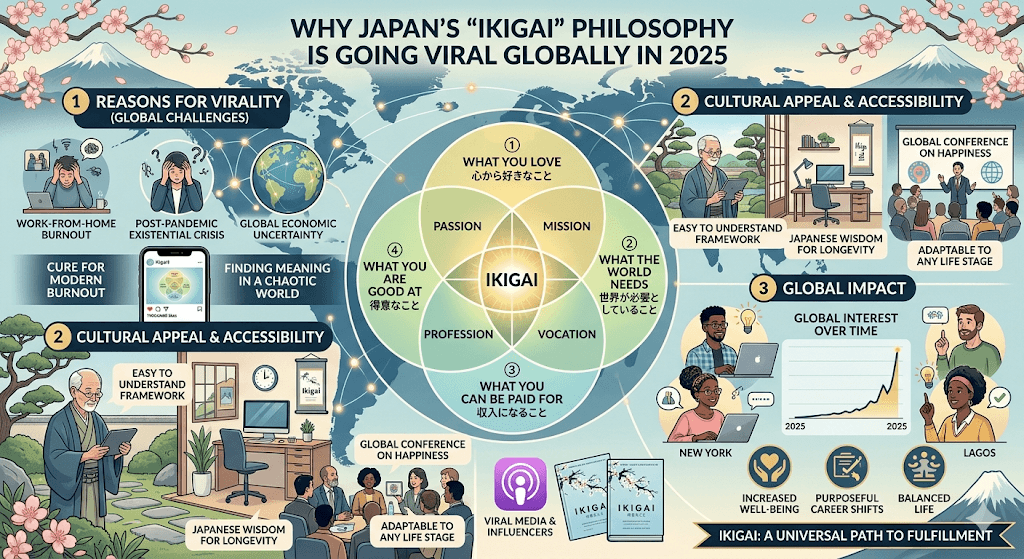
In a world drowning in burnout, hustle culture, and existential scrolling — an ancient Japanese idea about purpose is quietly changing how millions think about what it means to live well.
Something strange happened in 2025. While the internet was busy arguing about AI replacing our jobs and social media was serving up another round of anxiety, millions of people around the world quietly Googled the same Japanese word: ikigai. Not a new app. Not a productivity hack. Not a supplement or a morning routine with seventeen steps. Just a centuries-old idea from a small island nation that asks one deceptively simple question — what makes your life worth living?
And somehow, that question hit different this time around.
Ikigai (pronounced ee-key-guy) isn’t new to the English-speaking world. The concept made a splash several years ago thanks to bestselling books and a viral Venn diagram that circulated on every self-improvement account on Instagram. But the 2025 resurgence isn’t just a rehash. It’s deeper. More personal. Less about “optimizing your career sweet spot” and more about something people actually need right now — a reason to get out of bed in the morning when the world feels like it’s spinning a little too fast.
So what changed? Why is a philosophy rooted in Japan’s Heian period — that’s over a thousand years ago — suddenly the thing resonating with burned-out Gen Z workers in Chicago, overwhelmed parents in London, and early retirees in São Paulo?
Let’s talk about it.
First, What Is Ikigai — Really?
Here’s where most Western interpretations get it slightly wrong. If you’ve seen the famous Venn diagram — four overlapping circles representing what you love, what you’re good at, what the world needs, and what you can be paid for — you’ve seen a simplified version that’s become wildly popular online. And it’s not a bad starting point. But actual ikigai, as it’s understood in Japan, is both simpler and more profound than a career planning framework.
The word itself combines iki (生き), meaning “life,” and gai (甲斐), meaning “value” or “worth.” Researchers trace the word’s origins back to the Heian period, between 794 and 1185 CE. Clinical psychologist Akihiro Hasegawa published research noting that the root “gai” actually derives from “kai,” the Japanese word for shell — shells being precious objects in ancient Japan.
In daily Japanese life, ikigai doesn’t need to be some grand, life-defining mission. It can be the morning cup of tea you savor before anyone else wakes up. It can be tending your garden. It can be the neighbor who counts on you for a chat every afternoon. It’s the small, persistent thread of meaning that runs through ordinary days.
“In the Okinawan language, there is not even a word for retirement. Instead, there is one word that imbues your entire life — and that word is ikigai.”
— Dan Buettner, National Geographic Fellow and Blue Zones researcherThat distinction matters. Because the reason ikigai is exploding in popularity right now has less to do with career strategy and everything to do with a growing, global hunger for meaning in everyday life.
The Burnout Generation Found Its Antidote
Let’s be honest about the context. The world is tired. Specifically, an entire generation is running on fumes.
Research from 2025 paints a stark picture. Burnout among Gen Z and millennial workers has reached record levels, with workplace exhaustion driven by long hours, overwhelming workloads, and the near-impossible task of balancing work with everything else. A MetLife study found that less than one in three Gen Z employees feel “holistically healthy” — meaning they don’t believe they have adequate mental, financial, social, and physical well-being. Compared to workers the same age surveyed in 2018, today’s young employees report feeling significantly more stressed, more overwhelmed, and less happy.
And it’s not just about the office. A broader survey from 2025 found that one-third of Americans believe this year will be the most stressful of their lives. Anxiety levels among younger adults have jumped more than 50% since 2010. People aren’t just overworked — they’re questioning the whole premise of how they’ve been taught to live.
Enter ikigai. Not as a productivity tool, but as a kind of philosophical permission slip. Permission to slow down. Permission to define success on your own terms. Permission to find deep meaning in things that don’t scale, don’t trend, and don’t come with a LinkedIn post.
A SurveyMonkey study of over 3,500 U.S. workers even coined a new term for this shift: “Gen Zen” — describing Gen Z’s growing pursuit of peace, balance, and values alignment over traditional corporate ladder-climbing. It’s a mindset shift that maps almost perfectly onto what ikigai has been saying for centuries.
The Okinawa Connection — Where Purpose Meets Longevity
One reason ikigai carries weight beyond self-help slogans is that it has a real-world proof of concept: Okinawa, Japan.
This subtropical archipelago at Japan’s southern tip is one of the world’s recognized “Blue Zones” — regions where people consistently live the longest. The Okinawa Centenarian Study, which has been running since 1975, has examined over 1,000 people who lived past 100. The findings repeatedly point to lower rates of cancer, heart disease, and dementia among Okinawan elders compared to Western populations.
What’s their secret? It’s not one thing. Okinawans eat a largely plant-based diet rich in tofu, sweet potatoes, and vegetables. They maintain “moai” — tight-knit social support groups that last a lifetime. They garden well into their nineties. And critically, they have ikigai. Researchers found that older Okinawans can clearly articulate their reason for getting up each morning, and that this sense of purpose gives them defined roles, a feeling of being needed, and a psychological anchor even past the age of 100.
The Science Behind Purpose and Lifespan
Multiple studies have drawn connections between a clear sense of life purpose and improved health outcomes — including higher life satisfaction, stronger immune response, reduced stress hormones, and even greater cognitive resilience in old age. While the “Blue Zones” framework has recently faced some academic scrutiny, the underlying research linking purpose to well-being remains robust and widely replicated.
For a generation drowning in information but starving for meaning, Okinawa isn’t just an interesting footnote. It’s living evidence that purpose isn’t a luxury — it might be a biological necessity.
Why 2025 Became the Tipping Point
Ikigai has been floating around Western wellness circles since at least 2016, when Héctor García and Francesc Miralles published their bestselling book exploring the concept through the lens of Okinawan longevity. That book has since been translated into over 30 languages and published in nearly 60 countries. Neuroscientist Ken Mogi’s own book on the subject followed shortly after, adding academic depth to the conversation.
But 2025 brought a perfect storm of cultural conditions that made the philosophy feel urgent rather than merely interesting.
The post-pandemic reckoning matured
The pandemic forced millions of people to pause and question their relationship with work, ambition, and meaning. In the immediate aftermath, people talked a lot about that reckoning. By 2025, many had actually started doing something about it — quitting unfulfilling jobs, relocating, starting passion projects, or simply deciding that “enough” was actually enough. Ikigai provided a language and a framework for choices that otherwise felt scary or countercultural.
AI anxiety created a purpose crisis
As artificial intelligence became more capable and more visible in daily life, a quiet existential question spread across industries: If a machine can do what I do, then what am I for? Ikigai speaks directly to this anxiety. It suggests that human purpose can’t be automated, that the things that make life meaningful — connection, craft, care, curiosity — are precisely the things no algorithm can replicate. Interestingly, researchers have even started exploring ikigai as a humanistic principle for AI alignment, asking how the philosophy might guide technology development that serves human flourishing rather than replacing it.
Corporations started paying attention
Major companies began weaving ikigai-inspired thinking into employee development and wellbeing programs. Universities integrated ikigai frameworks into career counseling. The Japanese government even created an official web page about the concept in response to growing international curiosity. When institutions start legitimizing something that began as a grassroots cultural trend, that’s usually when it tips from “interesting idea” into lasting shift.
The wellness market exploded — and people got pickier
The global wellness industry has been valued at well over $1.5 trillion and continues growing at 4 to 5 percent annually. But as the market ballooned, consumers — especially younger ones — grew more discerning. They wanted substance over branding. Depth over packaging. Ikigai, with its thousand-year heritage and its grounding in real communities and real research, offered something that felt authentic in a sea of commercialized self-care.
What Finding Your Ikigai Actually Looks Like
Forget the pressure to discover one perfect, all-encompassing life purpose. That’s not how this works — and frankly, that pressure is part of what makes people miserable in the first place.
In practice, ikigai is less about a single “eureka” moment and more about paying attention to what already lights you up. It’s an ongoing practice, not a destination. Here’s what it tends to look like for people who take it seriously:
They notice what absorbs them. Not what they think should matter, but what actually pulls their attention when no one is watching. Maybe it’s cooking. Maybe it’s mentoring a younger colleague. Maybe it’s the strange joy of organizing a spreadsheet. Ikigai doesn’t judge scale.
They invest in small rituals. Japanese culture is full of this — the tea ceremony, forest bathing, the art of arranging flowers. Your version might be a morning walk, a weekly phone call with a friend, or twenty minutes of sketching before dinner. These rituals aren’t trivial. They’re the infrastructure of meaning.
They stay connected to people. The Okinawan concept of moai — a lifelong circle of friends who support each other emotionally and practically — is tightly linked to ikigai. Purpose rarely exists in isolation. It usually grows in the space between people.
They accept that it shifts. Your ikigai at 25 probably won’t be your ikigai at 55. That’s fine. The philosophy doesn’t ask you to lock in a permanent answer. It asks you to keep asking the question.
“Ikigai is not about the grand purpose of life. It is about the joy of small things, the satisfaction of a day well lived, the warmth of knowing you matter — even if only to yourself.”
The Criticism — And Why It Still Matters
No viral philosophy escapes criticism, and ikigai shouldn’t either. Some Japanese scholars have pushed back on how the West has commercialized and oversimplified the concept — packaging it as a career optimization tool when it’s really about something far more everyday and humble. The famous Venn diagram, while useful, was actually created by a Western author and doesn’t appear in traditional Japanese thinking about ikigai.
There’s also the Blue Zones debate. Recent research has raised questions about whether the longevity data from places like Okinawa is as clean as originally presented. Some scientists argue that record-keeping issues may have inflated centenarian counts in certain regions.
These are fair criticisms. But they don’t diminish the core insight. Regardless of whether Okinawa has exactly as many centenarians as initially claimed, the underlying research connecting life purpose to health, happiness, and resilience is extensive and well-replicated across cultures. And regardless of whether the Venn diagram is “authentic” Japanese philosophy, the questions it asks — what do you love? what are you good at? what does the world need? — remain genuinely useful prompts for self-reflection.
The real risk isn’t that ikigai is imperfect. It’s that we reduce it to a trend, consume it like content, and move on to the next thing without letting it actually change how we live.
So Here We Are
There’s a reason this particular philosophy, from this particular culture, is resonating at this particular moment. We’re living through a time of extraordinary technological change, economic uncertainty, and social fragmentation. The old scripts — work hard, climb the ladder, accumulate things, retire, be happy — feel increasingly hollow to people across every demographic.
Ikigai doesn’t replace those scripts with another rigid formula. It invites you to write your own. It says that purpose doesn’t have to be grand or Instagram-worthy. It can be quiet. It can be ordinary. It can be as simple as the cup of tea you make every morning, the garden you tend, or the friend who needs to hear your voice.
In a world that keeps asking us to do more, be more, and produce more — ikigai gently asks a different question. One that a thousand years of Japanese wisdom, and a generation of burned-out humans, seem to agree is worth taking seriously:
What makes your life worth waking up for?
Maybe that’s why it’s going viral. Not because it’s trendy. But because it’s true.


Comments are closed.