
From the Himalayas to Goa’s golden beaches — a complete guide to navigating the world’s most vivid, overwhelming, and unforgettable destination.
India is intense, unpredictable, and endlessly fascinating. One moment you’re stuck in traffic, surrounded by a symphony of honking horns; the next, you’re standing before a centuries-old temple watching the world slow down. It’s a country where ancient rituals continue in the shadow of glassy skyscrapers — and where the chaos eventually reveals a kind of magic you won’t find anywhere else on earth.
When to go
India’s climate varies wildly from region to region — deserts, mountains, tropical coasts, and lush plains all fall within its borders. Most first-time visitors find the window between October and March to be ideal: cool, dry, and perfect for sightseeing. The southwest monsoon sweeps through from June to September, bringing heavy rains to most of the country.
Visas & entry
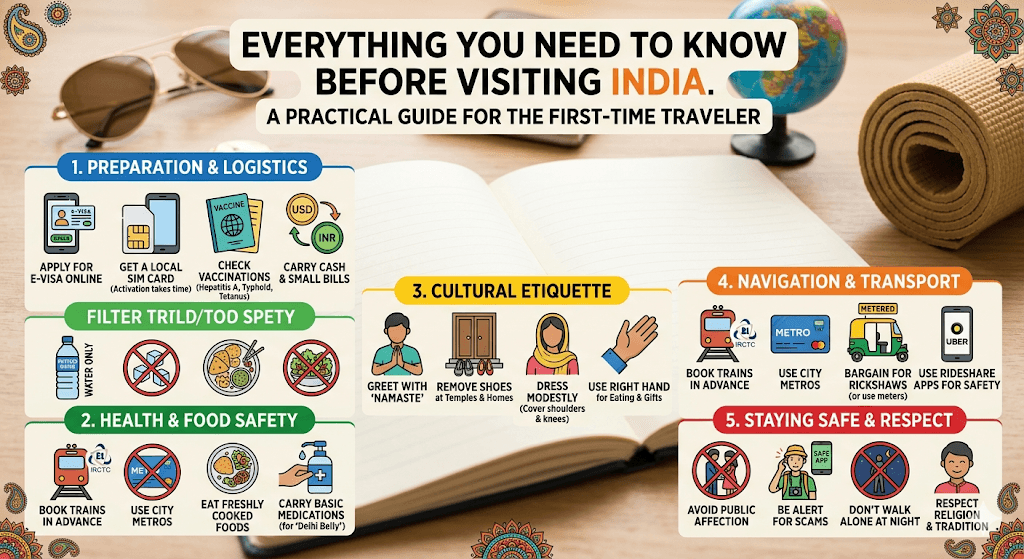
Most nationalities can apply for an e-Visa online before departure — a straightforward process that typically takes 3–5 business days. The tourist e-Visa allows stays of up to 90 days and multiple entries. Apply through India’s official government portal, and avoid third-party sites that charge inflated fees.
Apply for your e-Visa at least a week before departure. Print a copy to present at the immigration counter — digital copies on your phone aren’t always accepted.
Getting around
India has one of the world’s largest rail networks, and train travel is one of the best ways to experience the country. Overnight sleeper trains connect major cities comfortably, while the high-speed Shatabdi Express services handle same-day routes. Book tickets well in advance on the IRCTC website — popular routes sell out fast.
For shorter distances, auto-rickshaws and app-based taxis (Ola, Uber) are widely available in cities. Domestic flights are affordable and save significant time when crossing long distances. Luxury tourist trains like the Palace on Wheels or Maharajas’ Express offer an opulent way to tour multiple destinations, running from September through April.
Book Tatkal tickets (released 1 day before) if trains are full — available at 10am online or at stations.
Use Ola or Uber for metered, haggle-free rides. Negotiate fares in advance for auto-rickshaws.
Road travel always takes longer than expected. Build buffer time into every day.
Health & safety
Consult a travel doctor 4–6 weeks before your trip. Recommended vaccinations typically include typhoid, hepatitis A, tetanus, and depending on your itinerary, rabies and Japanese encephalitis. Malaria precautions are advised for rural and jungle areas.
The golden rule: drink only bottled or purified water. Tap water is not safe for most visitors. Carry hand sanitizer, be cautious with street food (choose busy stalls with high turnover), and pack a basic medical kit including anti-diarrheal tablets and oral rehydration salts.
Medical care in India is affordable by Western standards, but private hospitals — which offer the best care — can still be costly. Comprehensive travel insurance covering medical evacuation is strongly advised.
Culture & etiquette
India is a deeply spiritual country with hundreds of living traditions. Showing cultural sensitivity goes a long way. Dress modestly when visiting places of worship — cover shoulders and knees, remove shoes before entering temples and mosques, and women should carry a scarf to cover their heads when required.
Inside a Sikh gurudwara, both men and women must cover their heads. Jain temples require you to leave all leather items — including wallets and belts — outside. Photography is prohibited in some Hindu temples; always check with a guide first.
“Namaste” with hands pressed together is universally appreciated and shows respect.
Always use your right hand to give and receive items, eat, and greet — the left is considered unclean.
Haggling is expected in markets. Start at half the asking price and meet in the middle with a smile.
Food & drink
Indian cuisine is one of the greatest in the world — and its diversity will surprise you. Food varies enormously by region: the rich Mughal-inspired curries of the north, the coconut-laced seafood dishes of Kerala, the fiery biryanis of Hyderabad, and the vegetarian thalis of Gujarat. Street food vendors serving chaat, dosa, and pani puri can rival any restaurant.
Money & budget
India caters to every budget. The currency is the Indian Rupee (INR). ATMs are widely available in cities but can be unreliable in rural areas — carry some cash. Inform your bank before traveling to avoid cards being blocked.
~₹2,000–3,500/day covering hostel, local food, and transport.
~₹5,000–10,000/day for comfortable hotels and restaurants.
India’s palace hotels and heritage properties offer world-class luxury at relative value.
The bottom line
India will challenge you, delight you, exhaust you, and fill you with wonder — often all in the same afternoon. The key is to go slow, stay curious, and give yourself permission to let plans unravel. The most memorable moments in India are rarely the ones you planned. Pack patience alongside your sunscreen, and you’ll be rewarded with one of the richest travel experiences on the planet.


Comments are closed.