
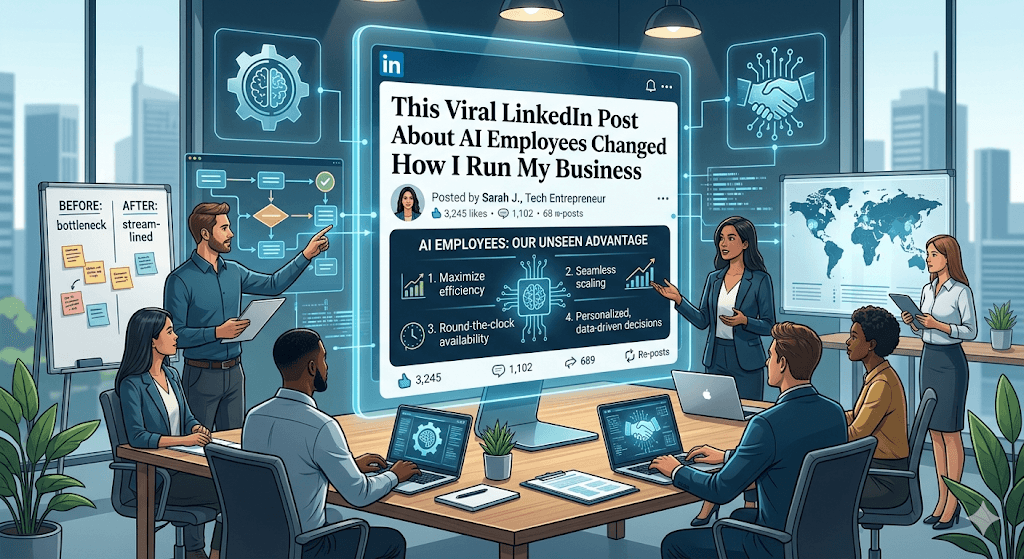
This Viral LinkedIn Post About AI Employees Changed How I Run My Business
How a stranger’s 400-word post on LinkedIn made me rethink everything I thought I knew about building a team — and why it might change your mind, too.
I almost scrolled past it. It was a Tuesday morning. I was doing what most of us do — half-awake, coffee in hand, mindlessly thumbing through LinkedIn before my first meeting. Then I saw a post that stopped me cold. Not because it was loud. Not because it was clickbait. But because, in about 400 words, a founder I’d never heard of described something that felt like she’d been sitting in my office for the last six months, watching me struggle.
The post was about AI employees. Not robots. Not some dystopian vision of the future. Just a simple, almost uncomfortably honest account of how she’d started treating AI tools less like software and more like actual members of her team — with roles, responsibilities, and real expectations.
And it completely changed the way I run my business.
The Post That Stopped My Scroll
I wish I could say I was already ahead of the curve. That I’d been experimenting with AI for years and had some cutting-edge system in place. The truth? I was drowning. I run a 14-person content and marketing agency. We were stretched so thin that every week felt like triage. New client onboarding was messy. Reporting was late. My best people were burning out on tasks that, honestly, didn’t need a human brain in the first place.
Then came that LinkedIn post.
The founder — let’s call her Priya — wrote about how she’d stopped thinking of AI as a “tool” and started thinking of it as a “team member.” She gave her AI systems actual job descriptions. She onboarded them the way she’d onboard a new hire. She even described a weekly “check-in” where she reviewed what her AI workflows had handled, what went wrong, and what needed tweaking.
It sounds so simple when you read it. Almost too simple. But that reframing hit me like a freight train. I’d been approaching AI the way most small business owners do: dabbling. Trying a tool here, canceling a subscription there. Never committing. Never thinking about it structurally.
Priya’s post made me realize I wasn’t failing at AI — I was failing at management. I was trying to use AI without ever defining what I actually needed it to do.
What I Did the Very Next Week
The Monday after I read that post, I blocked off two hours — no meetings, no Slack — and did something I’d never done before. I sat down and wrote job descriptions for the AI tools I wanted to bring into my business. Not feature lists. Not comparison spreadsheets. Actual job descriptions, the same way I’d write one for a human hire.
Here’s what that looked like:
- Client Onboarding Coordinator — an AI workflow that takes new client intake forms, generates a kickoff brief, builds a project timeline, and drops everything into our project management system.
- Research Analyst — a system that monitors industry news for each client’s vertical and delivers a weekly briefing document my strategists actually want to read.
- First-Draft Writer — an AI that produces initial drafts for blog posts, email sequences, and social captions based on approved content briefs.
- Reporting Assistant — a tool that pulls analytics from five platforms, compiles the data, and generates a client-ready report every Friday morning at 7 AM.
Notice what I didn’t do. I didn’t buy four new subscriptions. I didn’t sign up for some all-in-one AI platform. I started with the job. The role. The outcome I needed. Then I figured out which tools could fill that role — and most of the time, it was a combination of things I was already paying for but barely using.
The Mindset Shift That Actually Matters
Here’s the part that most “AI in business” articles skip over, and it’s the part that matters most.
The biggest change wasn’t technological. It was psychological. When I started treating AI like a team member, I also started holding it to a standard. I started doing quality checks. I started iterating. I stopped expecting perfection on the first try — the same way I wouldn’t expect a new hire to nail everything on day one.
What Changed in My Business — Concretely
I know you want specifics. So here they are, straight up, no fluff.
Within three months of adopting the “AI as employee” framework, my agency saw real, measurable differences. Client onboarding went from a chaotic seven-day process to a structured two-day workflow. Our weekly reporting, which used to eat up an entire Friday afternoon for two team members, now generates automatically and just needs a 20-minute human review. First-draft turnaround for content dropped from three days to same-day, giving our editors and strategists more time to do the thinking work that actually moves the needle for clients.
And here’s the thing nobody tells you about: my team’s morale went up. People started coming to Monday meetings with energy instead of dread. One of my senior strategists told me — and I’ll never forget this — “I finally feel like I’m using my brain again instead of just managing spreadsheets.”
That sentence alone was worth the whole experiment.
The Hard Truths I Learned Along the Way
I’d be lying if I told you it was all smooth sailing. It wasn’t. Let me save you some of the headaches I gave myself.
AI is not a set-it-and-forget-it solution. You can’t just plug it in and walk away. It needs management. It needs oversight. Some weeks, the AI-generated reports had errors. Some first drafts were way off-tone. That’s normal. The question isn’t whether AI will make mistakes — it will. The question is whether you’ve built a system that catches those mistakes before they reach your clients.
Not everything should be automated. I learned this the hard way when I tried to use AI for client communication. Quick answer: don’t. Clients can tell. The nuance, the empathy, the relationship — that’s human territory, and it needs to stay that way. AI is brilliant at the work that happens behind the curtain. It’s not great at being the face of your business.
You will face resistance. Some people on your team will feel threatened. Some will be skeptical. That’s not a reason to stop — it’s a reason to be transparent. I sat my team down and told them exactly what I was doing and why. I told them that nobody’s job was at risk, that we were adding capacity, not cutting heads. And I meant it. That honesty made all the difference.
Why This Matters Right Now
We’re at a strange point in time. AI is everywhere, but most businesses are still using it like it’s a novelty. A toy. Something to play with during a slow afternoon. The companies that figure out how to operationalize AI — how to make it a real, functioning part of their workflow — are going to have an enormous advantage over the ones that keep treating it as optional.
That viral LinkedIn post didn’t teach me anything revolutionary about technology. It taught me something revolutionary about leadership. It reminded me that every tool is only as good as the intention behind it. That “hiring” an AI employee means doing the same hard thinking you’d do when hiring a human: defining the role, setting expectations, providing feedback, and measuring results.
That’s not a tech problem. That’s a management problem. And most of us already know how to solve it — we just haven’t applied that thinking to AI yet.
Where I’d Start If I Were You
If you’re reading this and thinking, “Okay, but where do I actually begin?” — here’s what I’d tell you over coffee.
Start by looking at your week. Not your software stack. Not the latest AI tool that just launched. Look at your actual week. Where are you or your team spending time on work that’s repetitive, structured, and doesn’t require creative judgment? That’s your first AI hire.
Write a job description for that role. Be specific. What inputs does it need? What output do you expect? How will you know if it’s doing a good job? Then — and only then — go find the tool that fits.
Give it two weeks. Treat it like a new hire’s trial period. Check in on the work. Give feedback. Adjust. At the end of those two weeks, ask yourself one question: did this save us time, improve quality, or free someone up to do more important work? If the answer is yes to any of those, you’ve got your first AI employee. Now write the next job description.
I never did reach out to Priya. I probably should. Her post now has over 40,000 reactions and has been reshared thousands of times. But what stays with me isn’t the virality — it’s the simplicity. She didn’t sell me anything. She didn’t pitch a course. She just shared how she thinks about AI, and it happened to be exactly what I needed to hear at exactly the right time.
That’s the thing about the best advice. It doesn’t feel revolutionary when you first hear it. It just feels obvious — like something you already knew but hadn’t given yourself permission to act on.
So here’s your permission. Go write that first job description. Your business will thank you for it.
Enjoyed this article?
Subscribe to get weekly insights on AI, business strategy, and building smarter teams — no spam, just the good stuff.