
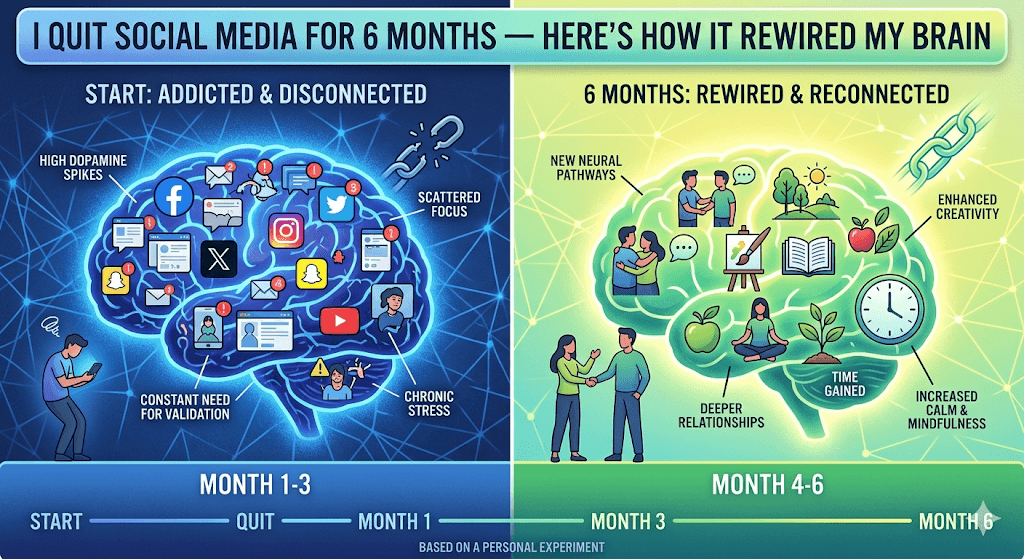
I Quit Social Media for 6 Months — Here’s How It Rewired My Brain
After six months away from every feed, every notification, and every scroll hole, I discovered something unexpected about my attention, my relationships, and the voice inside my head.
Let me be honest with you right from the start. I didn’t quit social media because I had some grand vision of becoming a better person. I quit because I was sitting on the bathroom floor at 1:47 a.m., watching a stranger’s grocery haul on TikTok, and a thought hit me so hard it almost felt physical: I don’t know what my own thoughts sound like anymore.
That was October 2025. By the next morning, I’d deleted Instagram, TikTok, X, Facebook, and Snapchat from my phone. No dramatic announcement. No “taking a break” post. I just… stopped. And what happened over the next six months genuinely surprised me — not because it was all sunshine and journaling and morning walks (though there was some of that), but because the withdrawal was real, the loneliness was brutal, and the clarity that eventually came felt almost unsettling.
Here’s my unfiltered account of what happens when you remove the thing your brain has been feasting on for a decade.
The First Two Weeks Were Genuinely Awful
I want to get this out of the way because most “I quit social media” articles skip straight to the part where the author is meditating on a hilltop. That wasn’t my reality. My reality was reaching for my phone roughly 80 times a day and finding… nothing. My thumb literally twitched toward the spot where Instagram used to be. That muscle memory is no joke.
I felt anxious. Not in a poetic way. In a sweaty-palms, what-am-I-missing, something-is-wrong way. There’s a term researchers use — phantom notification syndrome — and I had it bad. I’d feel a buzz in my pocket when my phone was sitting on the kitchen counter across the room.
The evenings were the hardest. Social media had been my decompression tool for years. Bad day at work? Scroll. Bored waiting for pasta water to boil? Scroll. Can’t sleep? You already know. Without it, I was forced to just… sit with myself. And honestly? I didn’t love the company. Not at first.
My Attention Span Came Back — Slowly, Then All at Once
Around week three, something started to shift. I picked up a book — an actual, physical, 300-page book — and read for forty-five minutes without checking my phone. That might sound unremarkable, but I genuinely couldn’t remember the last time I’d done that. For years, I’d been reading the same paragraph three times, losing the thread, getting frustrated, and giving up.
By month two, I was finishing a book every week and a half. Not because I was forcing myself, but because my brain was hungry for the kind of long-form engagement it had been starved of. It’s like my attention span had been sitting in a cramped little box, and once I let it out, it stretched in ways I didn’t expect.
I noticed it at work too. I could write for two hours straight without that nagging itch to check something, anything. My ideas got deeper. Instead of thinking in caption-length snippets, I was thinking in full paragraphs again. Conversations got better because I could actually follow a story without my mind wandering halfway through to something I’d seen that morning on Twitter.
I Discovered How Much of My Inner Voice Wasn’t Mine
This was the part that genuinely shook me.
About two months in, I started journaling — mostly out of boredom, if I’m being honest. And as I wrote, I noticed something strange. The opinions I’d always assumed were mine started to feel unfamiliar. My thoughts about my body, my career, what success should look like, what my apartment should look like, what kind of partner I should want — so many of these ideas had been quietly downloaded from thousands of posts and stories and reels I’d absorbed over the years.
Here’s a small example that stuck with me. I’d been convinced I needed to become a morning person. I’d felt guilty about it for years. Bought sunrise alarm clocks. Tried those “5 AM Club” routines. Failed every time and felt worse about myself. Without social media reinforcing that narrative every single day, the pressure just… evaporated. Turns out I do my best thinking at 10 p.m. Always have. I’d just been too busy comparing myself to people who peak at dawn to notice.
That pattern repeated itself in a dozen areas of my life. Opinions about hustle culture. Opinions about what my body should look like at 30. Opinions about which hobbies are “worth” having. Strip away the daily reinforcement, and you find out real fast which beliefs actually belong to you and which ones you’ve been renting from strangers.
The Loneliness Was Real — and Important
I’m not going to pretend this was all breakthroughs and personal growth. Month three was lonely. Really lonely. I hadn’t realized how much of my social life was performative until the stage disappeared.
Without Instagram stories, I had no idea what my friends were doing. And they had no idea what I was doing. It sounds obvious, but the impact was massive. I felt invisible. I’d go to a beautiful place and feel a weird emptiness because I couldn’t share it. I made a great meal and felt almost sad eating it alone without posting it.
But here’s what that loneliness forced me to do: I started actually calling people. Not texting. Calling. Sometimes I’d just show up. “Hey, want to grab coffee? I’m near your place.” The initial awkwardness faded fast. And the conversations we had — without the performance of an audience, without the curated highlight reels — were the most honest I’d had in years. Three friendships deepened significantly during this time. Two others, honestly, faded away. And I think that tells you everything about which ones were real.
What Changed Inside My Brain — In Real Terms
By month four, the changes were no longer subtle. Here are the five that hit hardest:
My baseline mood lifted. Not dramatically, not like medication — but the low-grade anxiety I’d been carrying for years, the kind I assumed was just “being an adult,” started fading. Turns out a huge portion of it was comparison-driven stress I was absorbing passively, dozens of times a day.
I became comfortable with boredom. This sounds small but it changed everything. Instead of immediately reaching for stimulation, I’d just… wait. And in that space, ideas came. Solutions to problems that had been stuck for weeks would surface while I was standing in line at the grocery store, doing absolutely nothing.
My memory improved noticeably. I started remembering conversations, names, details from books. My theory? My brain had been so busy processing a firehose of irrelevant information every day that it couldn’t hold onto the stuff that actually mattered.
I stopped thinking in “content.” I’d catch myself framing a sunset or a funny moment as a potential post — then realize there was no post to make. Over time, that reflex died, and I started just experiencing things. This was quietly the most profound shift of all.
My sleep transformed. Without the late-night scroll sessions, I was falling asleep faster and waking up more rested. I wasn’t going to bed with a head full of arguments, outrage, and strangers’ lives. I was going to bed with my own thoughts, and they were a lot quieter.
The Hard Question: Did I Go Back?
Six months to the day, I reinstalled Instagram. Just Instagram. I wanted to see how it felt.
It felt loud.
Within ten minutes, I could physically feel the shift in my nervous system. The speed. The color. The dopamine hits. My brain lit up like a pinball machine. And I understood, viscerally, what I’d been living inside of for years without noticing. It’s like leaving a noisy bar and stepping outside into silence — you don’t realize how loud it was until you’ve been away.
I kept Instagram, but with guardrails. I unfollowed everyone except close friends and a handful of accounts that teach me something useful. I set a 20-minute daily timer. I deleted the app every Friday evening and reinstall it Monday morning. I never reinstalled TikTok. That one, for me, was the real thief of time and thought.
The other platforms? Haven’t missed them. Not once.
What I’d Tell You if You’re Thinking About Doing This
I’m not here to preach. Social media isn’t inherently evil, and I know it’s a genuine lifeline for people who are isolated, marginalized, or building businesses. I’m not one of those people who thinks everyone should live like a monk.
But if you’ve been feeling like your brain isn’t quite yours anymore — if your attention is fractured, your mood is mysteriously low, your inner voice sounds suspiciously like a comment section — I’d gently say: try it. Even for 30 days. You don’t have to announce it. You don’t have to make it an identity. Just quietly step away and see who you are without the noise.
The first two weeks will be hard. Week three will feel boring. And somewhere around week four, you’ll be sitting somewhere ordinary — a park bench, your kitchen table, a quiet room — and you’ll have a thought that is so clearly, undeniably yours that it might actually make you emotional.
That’s not dramatic. That happened to me. I was washing dishes, thinking about a story my grandfather used to tell, and it hit me that I hadn’t thought about him in months because there was never space to. I cried a little. Then I finished the dishes. And it felt like the most human I’d been in years.
Your brain is still in there. It’s just been waiting for you to come back.
If this resonated with you, share it with someone who needs to read it.
No algorithm is going to show them this at the right time. You might be the one who does.