
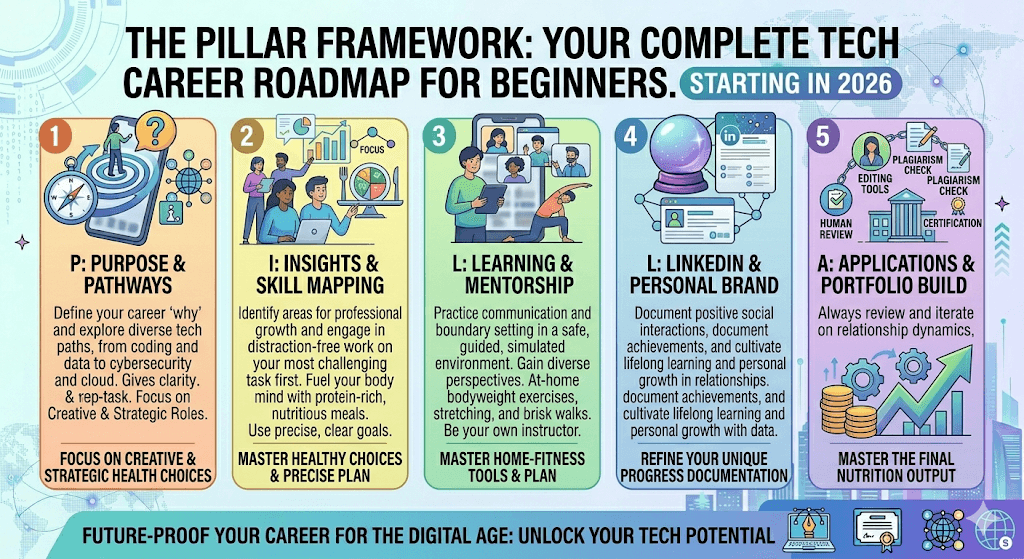
From zero experience to job-ready — the certifications, skills, and realistic timeline that actually work in today’s market.
Let’s be honest. You’ve probably Googled “how to start a tech career” and found yourself drowning in contradicting advice — one blog tells you to learn Python, another says start with networking, a Reddit thread insists you need a CS degree, and some influencer swears a 12-week bootcamp is all you need.
Here’s the truth: there is no single magic path. But there is a structured, logical framework that thousands of beginners have used to break into tech — with or without a degree, regardless of their background. I call it the PILLAR framework: a step-by-step methodology that maps your foundations, certifications, and career timeline into one coherent plan.
Let’s walk through it — from the first day you decide to make the switch, all the way to landing your first real tech role.
What is the PILLAR framework?
PILLAR stands for: Pick a path, Install foundations, Learn certifications, Lab everything, Apply strategically, Repeat for advancement. It’s not a rigid checklist — it’s a thinking model. Each pillar is a phase in your journey, and understanding them helps you avoid the #1 mistake beginners make: collecting random certifications with no coherent story.
Pick a path
Choose between Cloud, Cybersecurity, Networking, Data, or Support before you touch a single exam.
Install foundations
Build the baseline technical literacy every path requires — hardware, OS, basic networking.
Learn certifications
Pursue industry-recognized credentials in logical order, not by popularity or random YouTube advice.
Lab everything
Hands-on practice in virtual labs is not optional. Employers can tell who has real experience.
Apply strategically
Target roles aligned to your cert stack. Don’t apply randomly — build a coherent resume narrative.
Repeat for advancement
Stack advanced certs after your first role. Treat learning as a lifelong cycle, not a finish line.
Pillar 1: Pick a path — before you do anything else
This is the step most beginners skip. They jump straight into studying CompTIA A+ because it’s “the most recommended” without asking: is this the right credential for where I actually want to go?
In 2026, tech careers have four major entry lanes for beginners. Each has different certification sequences, salary trajectories, and day-to-day realities. Pick the one that matches your interests and risk tolerance — not just the one with the highest starting salary.
Cybersecurity
Fastest-growing field. High demand, but requires strong foundation. Best for analytical, detail-oriented thinkers.
Cloud computing
Most heavily invested IT domain in 2025. AWS dominates job postings; Azure growing fastest in enterprise.
Networking
The backbone skill. Often a stepping stone to cloud or security. Perfect if you love how systems connect.
Data & analytics
SQL, Python, and visualization tools. Bridges tech and business. High demand across every industry.
IT support
The most accessible entry point. Help desk roles are your foot in the door. Build from here into specialization.
Quick decision rule: If you’re targeting corporate, healthcare, or finance companies, lean Azure. If you’re targeting tech startups or e-commerce, lean AWS. If you’re not sure — AWS has broader job market coverage, but Azure is growing faster in enterprise environments.
Pillar 2 & 3: Foundations + certifications by path
Here’s the honest truth about the certification landscape in 2026: vendor-neutral credentials (CompTIA, ISACA) and vendor-specific credentials (AWS, Microsoft, Cisco) are both valuable, but they serve different purposes. Vendor-neutral certs build transferable fundamentals. Vendor-specific certs signal readiness for a specific platform ecosystem.
The smartest beginners stack them together. Here’s the recommended sequence by path:
The universal foundation (everyone starts here)
Regardless of which path you choose, most IT careers benefit from a shared foundation. The recommended order for absolute beginners in 2026 is: CompTIA Tech+ (optional) → CompTIA A+ → CompTIA Network+. After Network+, you branch into your chosen specialization. If you already work in IT and have 1–3 years of experience, skip A+ and go directly to Network+ or Security+.
| Certification | Path | Level | Why it matters in 2026 |
|---|---|---|---|
| CompTIA A+ | IT Support / Foundation | Beginner | Industry baseline for help desk & support roles. Often a hiring requirement. |
| CompTIA Network+ | All paths | Beginner | OSI model, TCP/IP, routing — foundational knowledge that makes cloud & security easier. |
| CompTIA Security+ | Cybersecurity | Mid | Most popular CompTIA cert. Meets DoD 8570 requirements. Essential for government roles. |
| AWS Cloud Practitioner | Cloud | Beginner | Best starting point for cloud. No deep technical background required. High-value foundation cert. |
| Microsoft AZ-900 | Cloud (Enterprise) | Beginner | Target if you’re aiming at corporate, healthcare, or finance sectors. Azure growing fastest in enterprise. |
| Google Data Analytics | Data | Beginner | Updated in 2025 with AI-assisted analysis tools. Top entry-level option for data careers. |
| AWS Solutions Architect – Associate | Cloud | Mid | One of the most respected cloud credentials. Updated in 2025 with AI-driven cost optimization coverage. |
| CompTIA CySA+ / PenTest+ | Cybersecurity | Mid | Next step after Security+. CySA+ for defensive security; PenTest+ for offensive/ethical hacking. |
| CISSP | Cybersecurity | Advanced | Gold standard for senior security roles. Requires 5 years of experience. Long-term target. |
| Google AI Professional Certificate | AI/ML | Mid | Now includes hands-on LLM training & deployment. AI fluency is an expectation in 2026, not a bonus. |
Pillar 4: Lab everything — because paper certs alone won’t get you hired
Here’s what most certification guides won’t tell you: employers have gotten very good at distinguishing candidates who studied for tests from candidates who actually know how things work. The difference shows up immediately in any technical interview or skills assessment.
The good news is that building hands-on experience has never been cheaper or more accessible. AWS, Azure, and Google Cloud all offer free-tier accounts. CompTIA has its own virtual lab environment. Cisco’s Packet Tracer is free. You can spin up a full home lab — virtual machines, networked environments, simulated security scenarios — on almost any modern laptop.
The lab minimum: For every certification you earn, spend at least as many hours in hands-on practice as you do in study. If you studied 40 hours for Network+, practice for 40 hours in a lab environment. This is non-negotiable if you want to pass technical interviews.
Specific lab resources by path: AWS Free Tier (cloud), TryHackMe and Hack The Box (cybersecurity), Cisco Packet Tracer (networking), Google Colab and Kaggle (data and AI). These are free or low-cost, and employers recognize them.
Your realistic timeline: month by month
Let’s stop pretending you can “break into tech in 30 days.” Here’s an honest, part-time study timeline (roughly 10–15 hours per week) for someone starting from zero.
Orientation & A+ foundations
Choose your path. Study CompTIA A+ or start directly with your chosen path’s foundational cert (e.g., AWS Cloud Practitioner if you know you want cloud). Set up your first lab environment.
First certification exam
Sit your first exam. A+, Cloud Practitioner, or AZ-900 are realistic 90-day targets for focused part-time learners. This milestone proves you can execute, not just plan.
Network+ or vendor specialization
Build on your first cert. Network+ for those on infrastructure/security paths. AWS or Azure associate-level for cloud-focused learners. Begin applying for entry-level roles with your first cert in hand.
Security+ or path specialization cert
The A+ → Network+ → Security+ trio can realistically be completed in 12–18 months of part-time study. This combination makes you competitive for a wide range of positions and is specifically sought by many employers.
First job + associate-level advancement
Aim for associate-level cloud certifications (AWS SAA, Azure Administrator) or analyst-level security certs (CySA+). Most career changers land their first tech role somewhere in this window.
Professional-level credentials
CISSP, CISM, AWS Solutions Architect Professional, or Google Cloud Professional Cloud Architect. These require years of hands-on experience and are long-term targets — not beginner goals.
Pillar 5: The AI factor — what beginners need to know for 2026
If you’re starting your tech career in 2026, you cannot afford to be AI-illiterate. This doesn’t mean you need to become a machine learning engineer. It means you need baseline fluency with how AI tools fit into the technology landscape you’ll be working in.
AI saw explosive growth in 2025, with companies adopting AI copilots, LLM-based automation, and AI-driven business processes across every industry. As a result, certifications that touch AI — even at a foundational level — carry more weight than they did 18 months ago.
For beginners, the Google AI Professional Certificate is now a strong complement to any core certification path. It includes hands-on LLM training and deployment. Microsoft’s Azure AI Engineer Associate is ideal if you’re on the Azure cloud track. Neither of these replaces your foundational certs — they extend them.
The 2026 expectation shift: AI fluency, cloud expertise, and security awareness are no longer competitive advantages — they are baseline expectations. A candidate with Security+ and zero understanding of how AI-powered threats work is less competitive than one who has both. Build awareness early.
Pillar 6: 7 things beginners consistently get wrong
- 1 Cert hoarding without a narrative. Collecting A+, Security+, an AWS cert, and a Python course all at once tells employers nothing coherent. Every cert on your resume should answer: “how does this support the role I’m applying for?”
- 2 Skipping the lab phase. Studying and passing exams is not the same as knowing how to do the job. Employers screen for this. Build the lab habit early and do it consistently.
- 3 Waiting to be “ready” before applying. You will never feel 100% ready. Apply for entry-level roles after your first certification and while you’re pursuing your second. Interviews themselves are learning experiences.
- 4 Choosing certs by salary alone. CISSP has a median salary above $120K — but it also requires 5 years of experience and is irrelevant to someone with zero experience. Focus on what’s appropriate for your current stage.
- 5 Ignoring vendor fit. Most enterprises lean Azure; most startups lean AWS. Research where your target employers sit before committing to a cloud certification path.
- 6 Undervaluing IT support as an entry point. Help desk roles are not a consolation prize — they are one of the fastest ways to get real-world exposure, build a professional network inside a tech organization, and position yourself for lateral moves into cloud, security, or networking.
- 7 Treating certifications as a finish line. The tech industry evolves faster than any single certification can capture. The PILLAR framework’s final letter — Repeat — exists for a reason. Your learning cycle never ends, and that’s actually a feature, not a bug.
The path forward is clearer than you think
Starting a tech career in 2026 isn’t about finding the perfect certification or the fastest bootcamp. It’s about building a coherent, stacked skill set that tells a consistent story to employers — and being willing to put in the lab hours to back it up. The PILLAR framework isn’t magic. It’s just a map. You still have to do the walking.