
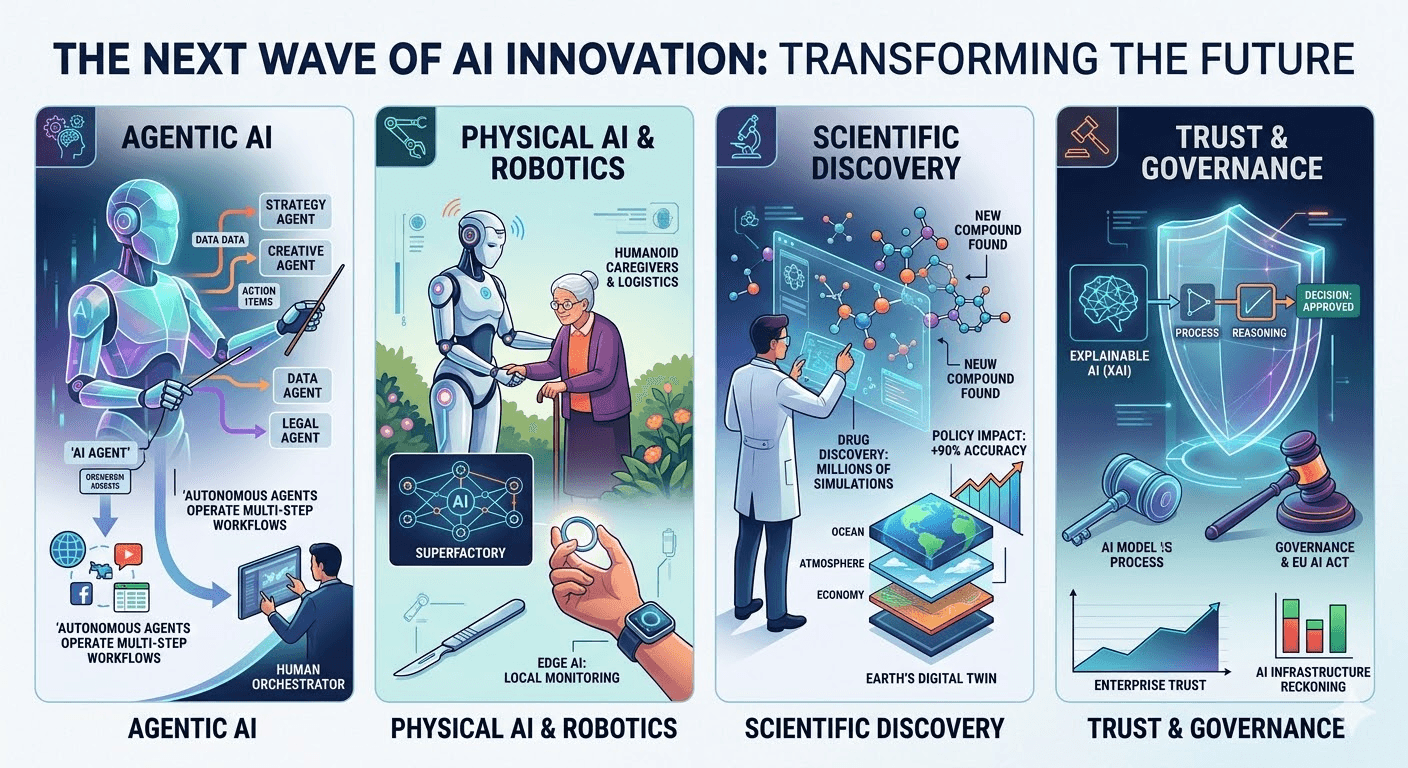
Introduction:
Artificial Intelligence is no longer just a buzzword—it’s rapidly becoming the operating system of the modern world. From autonomous agents to intelligent robots and multimodal systems, we are entering a new era where AI doesn’t just assist—it acts, decides, and evolves.
Artificial Intelligence (AI) is evolving at an unprecedented pace, reshaping industries, redefining the nature of work, and unlocking new possibilities. The next wave of AI innovation will not only enhance efficiency but also drive creative breakthroughs and foster deeper human-machine collaboration.
Welcome to the next wave of AI innovation.
🌐 1. From Tools to Teammates: The Rise of AI Agents
The biggest shift in AI today is the transition from passive tools to autonomous agents.
Unlike traditional chatbots, AI agents can:
- Plan multi-step tasks
- Interact with apps and systems
- Make decisions with minimal human input
Experts predict that AI agents will become embedded in a large percentage of enterprise software by 2026 .
💡 Think of it this way:
Instead of asking AI for help, you’ll assign it goals—and it will execute them.
👉 Real-world example: Companies are already deploying AI agents that can automate IT tasks, customer support workflows, and even research processes end-to-end .
🤖 2. Physical AI: When Intelligence Meets the Real World
AI is breaking out of screens and entering the physical world.
We’re seeing the rise of:
- Humanoid robots
- AI-powered manufacturing systems
- Smart devices with embedded intelligence
Recent developments show AI “brains” being deployed in real-world robots capable of performing diverse industrial tasks, replacing rigid automation with adaptable intelligence .
🔍 This shift is often called “Embodied AI”—where machines don’t just think, they act.
🧠 3. Multimodal AI: Understanding the World Like Humans
Next-gen AI systems are no longer limited to text.
They can now process:
- Images
- Video
- Audio
- Real-world sensor data
This is known as multimodal AI, and it’s quickly becoming the default standard for innovation .
📌 Why it matters:
- AI can “see” and “hear,” not just read
- Enables smarter assistants, medical diagnostics, and creative tools
- Powers immersive experiences in gaming and virtual environments
⚙️ 4. AI-Native Workflows and Digital Labor
AI is transforming how work gets done—not just what gets done.
We’re moving toward:
- AI copilots in every app
- Automated software development pipelines
- AI-driven decision-making systems
By 2026, AI copilots are expected to be integrated into most workplace applications, enhancing productivity across industries .
💼 The result?
A new kind of workforce where humans manage, guide, and collaborate with AI systems rather than doing repetitive tasks themselves.
🔗 5. Multi-Agent Systems: AI Teams Working Together
The future isn’t one AI—it’s many AIs working together.
These systems include:
- Planner agents (strategy)
- Worker agents (execution)
- Critic agents (quality control)
This orchestration creates digital teams capable of solving complex problems with higher reliability and efficiency .
🏥 6. Industry-Specific AI: Precision Over Generalization
Generic AI is giving way to domain-specific intelligence.
Examples include:
- Healthcare AI for diagnosis and drug discovery
- Financial AI for trading and fraud detection
- Retail AI for personalized shopping
This “vertical AI” trend is expected to dominate enterprise adoption in the coming years .
🔒 7. Privacy, Ethics, and AI Governance
With great power comes serious responsibility.
Key challenges shaping AI’s future:
- Data privacy concerns
- Copyright and intellectual property debates
- AI bias and fairness
In fact, regulation and governance frameworks are becoming essential as AI systems grow more autonomous .
🎮 8. Creative and Immersive AI Experiences
AI is revolutionizing creativity:
- AI-generated videos and films
- Dynamic video game worlds
- Personalized content creation
Games, for instance, are evolving into living worlds where characters respond intelligently and stories adapt in real time .
🌍 9. The Bigger Picture: Toward Autonomous Intelligence
All these trends point to one ultimate direction:
👉 AI systems that can think, act, collaborate, and learn independently.
From autonomous agents to robotic systems and multimodal intelligence, we are approaching a future where AI becomes:
- A co-worker
- A creator
- A decision-maker
🔮 Final Thoughts: What This Means for You
The next wave of AI innovation isn’t just technological—it’s transformational.
Here’s what to expect:
- Jobs will evolve, not disappear
- New opportunities will emerge in AI management and strategy
- Businesses that adopt AI early will gain a massive competitive edge
💡 The key takeaway:
AI won’t replace humans—but humans using AI will replace those who don’t.
 What’s Coming Next?
The next wave isn’t about AI replacing humans—it’s about augmenting us in unprecedented ways. By 2026, AI is evolving into a true collaborator: reasoning deeply, perceiving richly, acting autonomously, and accelerating discovery across domains.
This isn’t distant science fiction; it’s unfolding now in labs, enterprises, and products worldwide. The organizations and individuals who embrace these shifts thoughtfully—balancing innovation with responsibility—will help shape a future where AI amplifies human potential rather than diminishing it.
The question isn’t whether AI will transform everything. It’s how we’ll guide that transformation to benefit society as a whole. The next wave is here—let’s ride it wisely.