
The 2026 India AI Impact Summit in New Delhi (Feb 16–20) marked a pivotal moment, positioning India as a global AI leader with a focus on development, economic, and inclusive growth. As the first major AI summit in the Global South, it gathered world leaders, including France’s Macron, and tech executives to discuss AI governance, ethical AI, and local, voice-based AI solutions.
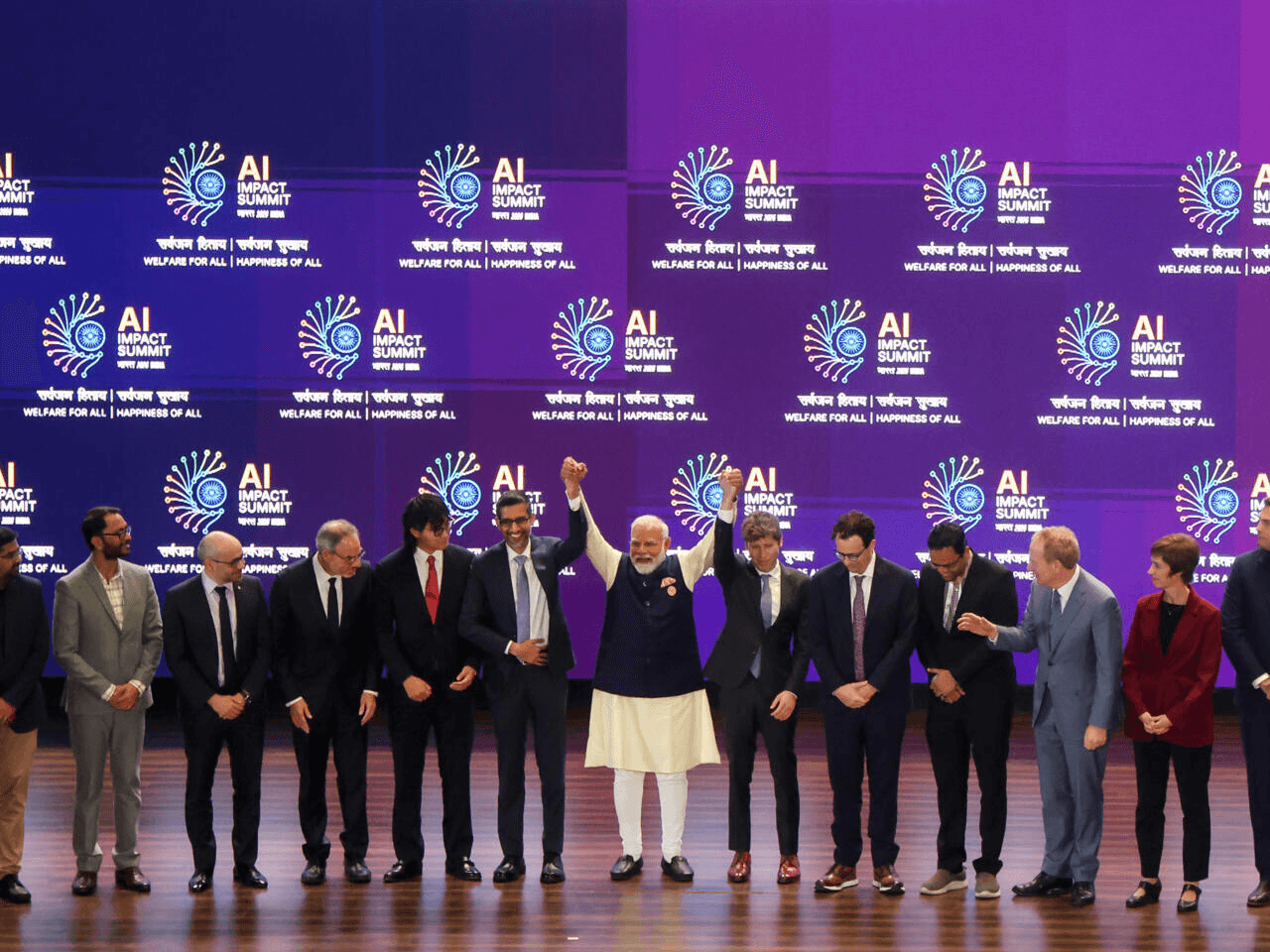
IIndia is currently in the spotlight of the global AI landscape this week, as New Delhi hosts the India AI Impact Summit 2026 from February 16 to 21 at Bharat Mandapam. This marks the first time a major international AI summit has been held in the Global South, following previous editions in Bletchley Park (2023), Seoul (2024), and Paris (2025). The event shifts the focus from AI “safety” and “action” to tangible impact, emphasizing how AI can drive economic growth, social development, and inclusive progress for developing nations.
Key highlights from the summit include:
- Global South Focus: The summit shifted the AI conversation from primarily safety/doomsday scenarios to developmental opportunities, emphasizing “AI for All“.
- Massive Participation: Over 300 exhibitors and 250,000 visitors were expected at the 120-acre venue, Bharat Mandapam, with 118 countries represented.
- Key Tech & Policy Moves: India signed the Pax Silica Declaration, joined the U.S.-led initiative for AI supply chain protection, and unveiled indigenous multilingual and voice-based AI models.
- Discussions on Impact: The event addressed AI’s effect on jobs, with a strong emphasis on re-skilling programs.
- International Presence: Key figures included French President Emmanuel Macron and Brazilian President Luiz Inácio Lula da Silva.

The summit followed previous gatherings in the UK, Seoul, and Paris, but was noted for its focus on practical, real-world applications.
Prime Minister Narendra Modi has positioned India as a bridge between advanced economies and the Global South. In his address, he emphasized: “Design and develop in India. Deliver to the world. Deliver to humanity.” This reflects India’s ambition to build sovereign AI capabilities at home while deploying solutions globally, particularly in sectors like agriculture, healthcare, education, and climate resilience.
The summit has drawn massive participation, with over 250,000 delegates expected, including top executives from OpenAI (Sam Altman), Google (Sundar Pichai), Anthropic (Dario Amodei), and others. High-profile moments included Modi inviting tech leaders onstage for a symbolic hand-raise, though some awkward photo dynamics made headlines. Global figures like UN Secretary-General António Guterres called for a $3 billion Global Fund on AI to build capacity in developing countries, while IMF Managing Director Kristalina Georgieva praised India’s focus on democratizing AI through digital interfaces and human ingenuity.
Key announcements and partnerships are accelerating India’s AI push:
- OpenAI partnered with Tata Group to secure 100 megawatts of AI-ready data center capacity initially, scaling to 1 gigawatt. This includes deploying ChatGPT Enterprise across Tata’s workforce and using OpenAI tools for software development — one of OpenAI’s largest infrastructure investments outside the US.
- Leaders like Google CEO Sundar Pichai highlighted India’s “extraordinary trajectory” in AI, committing to partnerships for transformation across sectors.
- Discussions emphasized a “third way” in AI governance — distinct from US innovation-driven and China state-led models — focusing on sovereign, multilingual, and ethical AI via initiatives like the IndiaAI Mission ($1.2 billion investment).
The summit also spotlights practical applications, with an extended expo running through February 21 showcasing deployable AI solutions. UNESCO launched the ‘Resilient AI Challenge’ for energy-efficient models in resource-constrained environments, while calls for collective action stress that AI’s “once-in-a-generation” shift requires concerted efforts to ensure net-positive human development.
India’s bullish outlook contrasts with earlier safety-focused summits, prioritizing economic turbocharging and social impact. With surging investments in data centers and compute, India eyes a $400 billion IT market boom and aims to rival the US and China in AI capabilities.
This week underscores India’s rising role: not just adopting AI, but shaping its global future with a human-centric, inclusive approach. As the summit concludes, expect more announcements on partnerships, governance guidelines, and initiatives that could redefine AI for the developing world.
This year’s summit is historic for two reasons. First, it is the first major AI summit to be hosted by a nation in the Global South, marking a shift in the global tech dialogue. Second, the scale is immense, with expectations of 250,000 participants, including 20 world leaders and ministerial delegations from 45 countries .
- The ‘Make in India’ AI Rulebook: Governance Guidelines Released
The most significant policy announcement came right at the start of the summit. The government unveiled the India AI Governance Guidelines, a comprehensive framework designed to enable “safe and trusted AI innovation” .
Moving away from the heavy-handed regulation seen in some Western nations, India has adopted a principle-based, techno-legal approach. The framework is anchored in seven key principles (Sutras) : Trust is the Foundation, People First, Innovation over Restraint, Fairness and Equity, Accountability, Understandable by Design, and Safety, Resilience, and Sustainability .
The message is clear: India prioritizes innovation over restraint. The goal is to use AI as a catalyst for inclusive growth, aligning with the national vision of Viksit Bharat 2047 (Developed India). To oversee this, the guidelines recommend setting up new institutions like the AI Governance Group and an AI Safety Institute to ensure a whole-of-government approach to risk mitigation .
- Supercharging the Ecosystem: Mission 2.0 and Massive Investments
If the guidelines provide the software, the government is also building the hardware. Union IT Minister Ashwini Vaishnaw outlined the contours of the IndiaAI Mission 2.0, which bets big on sovereign AI and deep-tech research .
· Compute Power Explosion: India is aggressively building its high-performance computing (HPC) capacity. The government announced it will add 20,000 more GPUs to the existing base of 38,000 GPUs already onboarded under the IndiaAI Mission. This subsidized compute facility, available at rates as low as ₹65 per hour, aims to democratize AI access, ensuring it isn’t concentrated in the hands of a few large companies .
· Semiconductor Mission 2.0: With a fresh outlay, the focus is now on semiconductor design. The government expects at least 50 chip design houses to emerge from India, moving beyond just manufacturing to creating intellectual property .
· Investment Tsunami: Minister Vaishnaw revealed that India expects over $200 billion in investments in the AI ecosystem over the next two years, with roughly $90 billion already committed. This influx is expected to fuel everything from deep-tech startups to large-scale infrastructure .
- Global Giants Bet on India: TCS-OpenAI and NVIDIA Tie-ups
The summit has become a magnet for global tech giants, who are announcing major commitments on Indian soil.
In the biggest corporate news of the week, OpenAI announced a blockbuster partnership with Indian IT giant Tata Consultancy Services (TCS) . They will jointly build hyperscale data centre infrastructure in India. Starting with a 100-megawatt capacity, the project has the option to scale to 1 gigawatt, designed to power next-generation AI workloads and position India as a global AI hub. The partnership also includes providing AI training and resources to Indian youth .
Simultaneously, NVIDIA unveiled new tie-ups with Indian computing firms to provide advanced processors for AI data centres, while Google announced it would build new subsea cables from India .
- ‘UPI-ification’ of AI: A Playbook for the World
India’s success with the Unified Payments Interface (UPI) is serving as a blueprint for its AI strategy. The government plans to package AI into ready-to-use, vetted solutions for small businesses and the public sector. Just as UPI became a global model for digital payments, India aims to create a “UPI-style playbook” for AI diffusion. This involves curating a bouquet of trusted, sovereign AI tools that can be adopted at scale, with countries like Japan already expressing interest in the model .
- AI for All: From Farms to Schools
The announcements this week weren’t just about high-level policy; they were deeply rooted in grassroots application:
· Agriculture: A new multilingual AI tool called ‘Bharat-VISTAAR’ was proposed to be integrated with the Agri-Stack portal. This will provide customized advisory support to farmers, enhancing productivity and reducing risk .
· Education and Skilling: To prepare the next generation, the government is establishing AVGC (Animation, Visual Effects, Gaming, and Comics) content-creator labs in over 15,000 secondary schools and 500 colleges .
· Governance: AI-powered, non-intrusive imaging tools will be rolled out at major ports to scan containers, streamlining customs processes .


Comments are closed.