
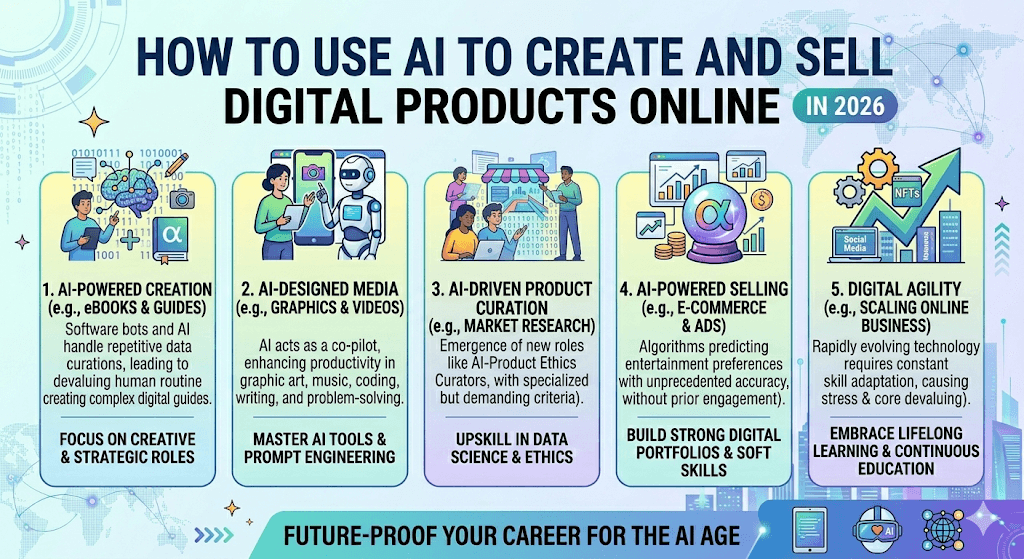
Blog post: How to use AI to create and sell digital products online
A practical, no-fluff guide to building a digital product business with AI — from ideation to launch to passive income.
“The creator economy has crossed $500 billion globally. For the first time in history, one person with a good idea and the right AI tools can compete with an entire production team.”
A few years ago, creating a polished digital product — an online course, a beautifully designed template pack, a comprehensive ebook — took weeks of skilled labor and serious upfront investment. Today, AI has compressed that timeline to days, sometimes hours. The barrier to entry has never been lower, and the opportunity has never been bigger.
This guide walks you through exactly how to use AI at every stage of the digital product business: finding the right idea, creating the product, building your brand, and selling at scale.
Find a Profitable Idea — With AI’s Help
Before you create anything, you need to find a problem worth solving. AI is remarkably good at this research phase. Start by using ChatGPT, Claude, or Gemini to brainstorm niches based on your existing skills or interests. Then cross-reference those ideas with real data.
Prompts that actually work for ideation:
- “List 20 specific pain points that [your audience] struggles with, ranked by how much they’d pay to solve them.”
- “What digital products sell well in [niche] on Etsy, Gumroad, and Teachable? Include price ranges.”
- “Analyze the top reviews of [competitor product] on Amazon and identify what buyers wish it included.”
Use Google Trends alongside AI research. Ask the AI to generate a list of trending topics in your niche, then validate each one using Trends data to confirm real search demand before investing time in creation.
Choose Your Digital Product Type
Not all digital products are created equal. The right format depends on your skills, your audience’s learning preferences, and the time you can invest. Here are the most viable categories in 2026:
The fastest-growing category right now? AI prompt packs and automation templates. As more businesses adopt AI workflows, curated, task-specific prompts — for marketing, HR, real estate, legal writing — command prices between $15 and $200 per pack.
Create the Product — AI as Your Co-Creator
This is where the real leverage kicks in. AI doesn’t replace your expertise — it amplifies it. Your knowledge of the subject, your unique voice, and your understanding of the audience remain irreplaceable. AI handles the heavy lifting of drafting, structuring, and polishing.
Writing & content (ebooks, guides, courses)
Use Claude or ChatGPT to generate a detailed outline first. Then work chapter by chapter, prompting the AI to expand each section. Always rewrite in your own voice — AI-generated content that sounds robotic won’t convert. A good workflow: AI drafts → you edit, personalize, add real examples → AI polishes for clarity and flow.
Visual design (templates, art, graphics)
Midjourney, Adobe Firefly, and DALL·E 3 can generate stunning visual assets in seconds. Canva’s Magic Studio lets you build entire template packs starting from AI-generated layouts. For digital art prints, tools like Ideogram are particularly strong for text-heavy designs.
Video & audio (courses, podcasts, music)
ElevenLabs for voiceovers. Suno or Udio for background music. Descript for editing video and removing filler words automatically. HeyGen for creating talking-head videos without recording yourself. These tools alone can cut video production time by 80%.
Code & apps (plugins, templates, tools)
GitHub Copilot and Claude’s coding capabilities mean you don’t need to be a senior developer to build a useful Chrome extension, WordPress plugin, or Notion template. Describe what you want to build, iterate on the code, and ship.
Claude / ChatGPT
Writing, editing, outlines, course content, sales copy
Midjourney / Firefly
Digital art, product mockups, cover images
ElevenLabs
Realistic voiceovers for courses and video content
Descript / HeyGen
Video editing, AI avatars, talking head videos
Canva Magic Studio
Template packs, social graphics, ebook layouts
GitHub Copilot
Code generation for plugins, tools, and web apps
Where to Sell: Platform Comparison
Choosing the right platform affects your profit margins, your audience reach, and how much control you have over your brand. Here’s a practical breakdown:
| Platform | Best For | Fee | Audience |
|---|---|---|---|
| Gumroad | Ebooks, templates, prompt packs | 10% flat | Built-in |
| Etsy | Printables, art, templates | 6.5% + listing | Built-in |
| Teachable / Kajabi | Online courses, memberships | 5–10% or flat | Bring your own |
| Lemon Squeezy | SaaS, software, code tools | 5% + $0.50 | Bring your own |
| Your own store (Shopify) | Scaling an established brand | ~2.9% (payment) | Full control |
| Patreon / Substack | Subscriptions, newsletters | 8–12% | Built-in |
The smart move for most beginners: start on Gumroad or Etsy to validate the idea and get early sales, then migrate to your own store once you have a proven product and audience.
Market and Sell — AI-Powered Marketing
Creating the product is only half the battle. The other half is getting it in front of the right people. AI can dramatically cut the time and cost of content marketing.
Sales page copywriting
Use AI to write your entire sales page: headline, problem statement, feature bullets, testimonials section scaffold, FAQ, and call-to-action. Give the AI your product details and target audience, and ask it to follow proven frameworks like AIDA or PAS. Then humanize it with your own voice and specific results.
Content marketing & SEO
Tools like Surfer SEO + AI writing can produce SEO-optimized blog posts that rank for your target keywords and drive organic traffic to your product page. Publish consistently — even two posts per week built with AI assistance compounds significantly over 6–12 months.
Social media content
Use AI to repurpose your product content into carousels, threads, TikTok scripts, and short-form videos. One ebook chapter can become five LinkedIn posts, three Instagram carousels, and a YouTube short. AI makes this repurposing frictionless.
Email sequences
Build a lead magnet (another small AI-created product), grow your list, and use AI to write a nurture sequence that warms prospects and converts them into buyers. A 5–7 email automated sequence can run indefinitely and pay dividends long after you’ve moved on to the next product.
Your personal story is your biggest differentiator. AI can write compelling copy, but only you can share the real experience that gave you the insight behind the product. Weave that into every piece of marketing content and watch conversions climb.
Scale: From One Product to a Portfolio
The real power of an AI-assisted business model is speed of iteration. Once your first product makes its first sale, you have proof of concept. Now you can build a complementary product — a deeper version, a bundle, a follow-on resource — in a fraction of the time it took you to build the first.
- Use customer feedback and reviews to identify gaps → prompt AI to research and outline the follow-up product
- Create bundles combining 2–3 related products at a premium price point — bundles consistently outperform single products in average order value
- Add a recurring membership or subscription component for predictable monthly revenue
- License your AI-created content to other creators or businesses in adjacent niches
- Build an affiliate program and let your own customers become your marketing team
Important: Always disclose AI usage transparently where relevant, follow platform terms of service, and ensure your products provide genuine value — the AI creates faster, but quality and trust are what keep customers coming back and referring others.
The Honest Reality Check
AI is not a magic money machine. Plenty of people create products with it and never make a sale. The difference is almost always the same: they skipped validation, built for themselves instead of a real audience, or created something generic that didn’t stand out in a crowded market.
The creators winning with AI are treating it as a skilled collaborator, not a vending machine. They bring deep knowledge of their niche, genuine care for their audience, and a willingness to iterate based on real feedback. The AI just helps them move faster and execute better than they could alone.
Start with one product. Validate it. Improve it. Then build the next one. That’s the whole game.
Ready to build your first AI-powered digital product?
Start with what you already know. Pick one problem your audience has, use AI to help you solve it beautifully, and put it in front of real people. The first sale changes everything.