
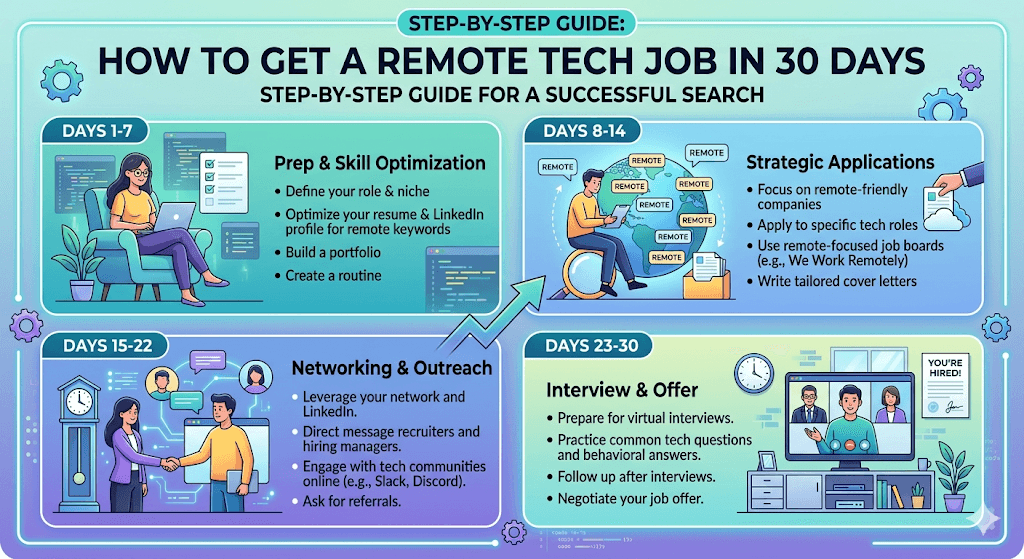
Remote tech jobs are no longer limited to senior developers working for Silicon Valley startups. In 2026, thousands of companies are hiring remote workers across software development, cybersecurity, cloud computing, UI/UX design, data analytics, technical support, AI operations, and digital marketing.
The challenge is not whether remote jobs exist. The real challenge is standing out among thousands of applicants.
Many people spend months applying online without getting interviews because they skip the basics: building proof of skills, optimizing their resume, networking correctly, and targeting the right roles.
The good news? You do not need a computer science degree or 10 years of experience to land a remote tech job.
With the right strategy and focused effort, you can position yourself for interviews in just 30 days.
This guide breaks down exactly what to do week by week.
Why Remote Tech Jobs Are Growing Fast
Companies increasingly prefer remote hiring because it helps them:
- Access global talent
- Reduce office costs
- Hire faster
- Improve employee flexibility
- Operate across time zones
At the same time, many professionals prefer remote work because it offers:
- Better work-life balance
- Location independence
- Reduced commuting stress
- Access to higher-paying global jobs
- Flexible schedules
Some of the most in-demand remote tech roles include:
- Frontend Developer
- Backend Developer
- Cloud Engineer
- Cybersecurity Analyst
- Data Analyst
- DevOps Engineer
- Technical Writer
- QA Tester
- Product Designer
- AI Prompt Engineer
- IT Support Specialist
Even entry-level positions are becoming more accessible if candidates can demonstrate practical skills.
Can You Really Get a Remote Tech Job in 30 Days?
Yes — but only if you focus on high-impact actions.
You are unlikely to become a senior software engineer in one month. However, you can:
- Build a strong online profile
- Learn marketable beginner-friendly skills
- Create portfolio projects
- Start networking effectively
- Apply strategically
- Land interviews for junior or freelance roles
Consistency matters more than perfection.
Week 1: Choose the Right Tech Career Path
The biggest mistake beginners make is trying to learn everything.
Instead, choose one clear direction.
Beginner-Friendly Remote Tech Careers
| Role | Skills Needed | Average Entry Salary |
|---|---|---|
| Frontend Developer | HTML, CSS, JavaScript | $60k–$90k |
| Data Analyst | Excel, SQL, Python | $55k–$85k |
| Technical Support | Networking, troubleshooting | $45k–$70k |
| QA Tester | Testing tools, bug reporting | $50k–$80k |
| UI/UX Designer | Figma, design principles | $60k–$95k |
| Technical Writer | Documentation, communication | $55k–$90k |
Pick one role based on:
- Your interests
- Learning speed
- Existing experience
- Long-term goals
Day 1–3: Learn the Core Skills
You do not need expensive bootcamps to get started.
Use free and affordable platforms like:
Focus only on practical concepts employers actually care about.
For example, if you choose frontend development:
- Build responsive websites
- Learn Git and GitHub
- Understand APIs
- Practice JavaScript basics
Avoid tutorial overload. Build while learning.
Day 4–7: Build Your First Portfolio Project
A portfolio matters more than certificates.
Even a simple project can impress recruiters if it solves a real problem.
Project Ideas
For Frontend Developers
- Personal portfolio website
- Weather app
- To-do app
- Blog homepage clone
For Data Analysts
- Sales dashboard
- Netflix data analysis
- Budget tracker
For UI/UX Designers
- Mobile app redesign
- Landing page prototype
- SaaS dashboard design
For Technical Writers
- Software documentation sample
- API guide
- Beginner tutorials
Upload your work to:
Week 2: Create a Professional Online Presence
Recruiters search online before scheduling interviews.
Your digital presence should instantly communicate:
- Who you are
- What skills you have
- What projects you built
Optimize Your LinkedIn Profile
Your profile should include:
- Professional headline
- Clear profile photo
- Strong summary
- Skills section
- Project links
- Certifications
- Remote work keywords
Example headline:
Frontend Developer | JavaScript & React Enthusiast | Open to Remote Opportunities
Use keywords recruiters search for:
- Remote Developer
- Cloud Engineer
- Python Developer
- Data Analyst
- AWS Certified
- React Developer
Create a Resume That Actually Gets Interviews
Most resumes fail because they:
- Are too generic
- Lack measurable results
- Have poor formatting
- Include irrelevant information
Keep Your Resume Simple
Use:
- One page
- Clean layout
- Action verbs
- Real projects
- Skill-focused achievements
Example:
Built a responsive portfolio website using HTML, CSS, and JavaScript that improved page speed by 40%.
Even personal projects count if presented professionally.
Week 3: Start Networking the Smart Way
Many remote jobs are never publicly posted.
Networking helps you discover hidden opportunities.
Where to Network
Join tech communities and contribute consistently.
Do not immediately ask strangers for jobs.
Instead:
- Share projects
- Ask thoughtful questions
- Help others
- Comment on industry posts
- Build visibility gradually
Reach Out to Recruiters Properly
Most people send cold messages like:
“Hi, can you give me a job?”
That rarely works.
Instead, send concise and professional messages.
Example:
Hi Sarah, I recently completed several frontend projects using React and JavaScript. I admire your company’s remote engineering culture and would love to connect regarding future opportunities.
Short, respectful, and professional messages perform better.
Week 4: Apply Strategically
Mass-applying to 500 jobs usually fails.
Targeted applications work better.
Best Remote Job Platforms
Apply to:
- Startups
- Small remote companies
- Freelance gigs
- Contract roles
- Junior positions
Entry-level remote jobs are competitive, so volume still matters — but quality matters more.
Aim for:
- 10–15 high-quality applications daily
- Customized resume for each role
- Personalized cover letters when possible
Prepare for Remote Job Interviews
Remote interviews test more than technical skills.
Companies also evaluate:
- Communication
- Reliability
- Self-management
- Internet setup
- Problem-solving ability
Common Interview Questions
- Tell me about yourself
- Why do you want remote work?
- Describe a project you built
- How do you manage deadlines?
- How do you solve technical problems?
Practice speaking clearly and confidently.
Record mock interviews if possible.
Important Skills Remote Employers Want
Even technical jobs require soft skills.
High-Value Remote Skills
- Communication
- Time management
- Self-discipline
- Problem-solving
- Collaboration
- Adaptability
Candidates who communicate well often outperform technically stronger applicants.
Biggest Mistakes to Avoid
1. Waiting Until You Feel “Ready”
You learn faster by applying while improving.
2. Taking Too Many Courses
Projects matter more than endless certificates.
3. Ignoring Networking
Referrals dramatically improve interview chances.
4. Sending Generic Applications
Tailored resumes perform better.
5. Having No Portfolio
Employers need proof of ability.
Best Certifications for Remote Tech Jobs
Certifications can strengthen credibility.
Popular beginner-friendly certifications include:
- Amazon Web Services Certified Cloud Practitioner
- Google Data Analytics Certificate
- Microsoft Azure Fundamentals
- CompTIA A+
- Cisco CCNA
These help especially for:
- IT support
- Cloud computing
- Networking
- Cybersecurity
A Realistic 30-Day Action Plan
Week 1
- Choose a tech role
- Learn core fundamentals
- Start your first project
Week 2
- Finish portfolio project
- Build LinkedIn profile
- Create resume
- Upload projects online
Week 3
- Network daily
- Join communities
- Reach out to recruiters
- Practice interview questions
Week 4
- Apply aggressively
- Customize applications
- Attend interviews
- Improve based on feedback
Final Thoughts
Getting a remote tech job in 30 days is possible if you stay focused and avoid distractions.
The internet is filled with people endlessly consuming tutorials without building anything real. Employers care more about practical skills, consistency, communication, and proof of work than perfect credentials.
Start small. Build projects. Show your work publicly. Network genuinely. Apply consistently.
Your first remote tech job may not be your dream role — but it can completely change your career direction and open opportunities worldwide.
The most important step is starting today.