
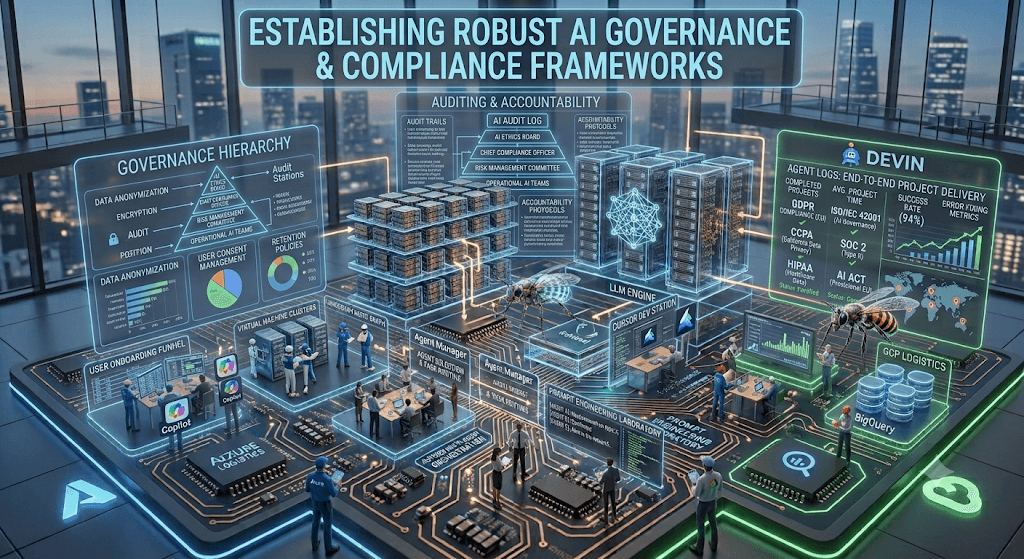
A strong answer should show that AI governance is built into the architecture—not added after deployment. Here’s a comprehensive interview-ready response.
Interview Answer
“I approach AI governance as a combination of people, processes, and technology to ensure AI systems are secure, compliant, transparent, and trustworthy throughout their lifecycle.”
1. Establish AI Governance Framework
I begin by defining governance policies aligned with business objectives and regulatory requirements.
Key areas include:
- AI ethics and responsible AI principles
- Data governance
- Model governance
- Security and privacy
- Risk management
- Human oversight
- Compliance monitoring
I typically align governance with industry standards such as:
- NIST AI Risk Management Framework
- ISO 42001 (AI Management System)
- ISO 27001
- OWASP Top 10 for LLM Applications
- Relevant regulations depending on geography and industry
2. Data Governance
AI is only as good as its data.
I ensure:
- Data lineage
- Data quality validation
- Data cataloging
- Access controls
- Encryption
- Data masking
- PII detection
- Data retention policies
- Consent management
For healthcare projects:
- HIPAA compliance
- PHI protection
- Audit trails
3. Secure AI Architecture
For cloud deployments (AWS):
- Private networking
- IAM least privilege
- Encryption using KMS
- Secrets management
- VPC Endpoints
- Network isolation
- Zero Trust principles
Typical services include:
- IAM
- KMS
- Secrets Manager
- CloudTrail
- GuardDuty
- Security Hub
- Config
- CloudWatch
4. Model Governance
Every model should be versioned and traceable.
I maintain:
- Model registry
- Version control
- Training datasets
- Hyperparameters
- Approval workflows
- Performance metrics
- Rollback capability
Typical lifecycle:
Development
↓
Validation
↓
Approval
↓
Deployment
↓
Monitoring
↓
Retraining
↓
Retirement
5. Responsible AI
I evaluate:
- Bias
- Fairness
- Explainability
- Transparency
- Accountability
Questions include:
- Is the model biased?
- Can we explain predictions?
- Can users challenge decisions?
- Is there human review for high-impact outcomes?
6. LLM Governance
For Generative AI applications, I implement additional safeguards:
Prompt Management
- Prompt versioning
- Prompt testing
- Prompt approvals
- Prompt templates
Prompt Injection Protection
- Input validation
- Prompt sanitization
- Context isolation
- Guardrails
Output Validation
- Toxicity detection
- Hallucination detection
- PII filtering
- Content moderation
- Confidence thresholds
7. RAG Governance
For Retrieval-Augmented Generation (RAG):
- Approved knowledge sources only
- Document versioning
- Metadata tracking
- Source attribution
- Access control
- Retrieval logging
This ensures responses are grounded in trusted enterprise content.
8. Monitoring
Production monitoring includes:
Technical metrics:
- Latency
- Token usage
- API failures
- Cost
- Throughput
AI metrics:
- Hallucination rate
- Response quality
- Accuracy
- Drift detection
- Bias indicators
Business metrics:
- User adoption
- Customer satisfaction
- Productivity improvements
- ROI
9. Compliance & Auditability
I ensure every AI interaction is auditable by logging:
- User identity
- Prompt
- Retrieved documents
- Model version
- Output
- Timestamp
- Approval status
- Feedback
This supports investigations, regulatory reporting, and continuous improvement.
10. Human-in-the-Loop (HITL)
For high-risk decisions, AI should assist—not replace—humans.
Examples:
- Healthcare diagnoses
- Financial approvals
- Insurance claims
- Legal recommendations
The AI provides recommendations, while a qualified reviewer makes the final decision.
Real-World Example (Healthcare)
Project: Global Life Sciences Healthcare Platform
I designed an AI-enabled AWS architecture with governance embedded from the start. Sensitive healthcare data remained encrypted both at rest and in transit, access was enforced through least-privilege IAM policies, and all AI interactions were logged for auditability. For RAG-based applications, retrieval was limited to approved medical documentation, and outputs were validated to reduce hallucinations before being presented to users. We also implemented continuous monitoring for model performance, security events, and operational metrics, ensuring compliance while maintaining reliable AI-assisted workflows.
Common Interview Follow-up
Q: How do you prevent LLM hallucinations?
I use a layered approach:
- Ground responses with RAG using trusted enterprise data
- Restrict retrieval to approved sources
- Apply prompt engineering and guardrails
- Validate outputs against business rules
- Require citations or evidence where appropriate
- Route low-confidence or high-impact responses to human review
- Continuously evaluate model performance and refine prompts and retrieval quality
This response demonstrates experience across governance, security, compliance, MLOps, and enterprise AI architecture—topics that are frequently assessed for senior AI Architect and AI Platform roles.
Addressing AI governance and compliance means building a system that proactively manages risk, ensures accountability, and stays ahead of a fast-changing regulatory landscape. The core challenge is that accountability for AI’s actions ultimately remains with your organization, even when you’re using third-party tools .
Here is a breakdown of the key strategies and areas of focus.
🧱 Core Pillars of an AI Governance Framework
A robust governance framework is built on translating high-level principles into concrete actions. The Stanford Law School, for example, outlines a system of 48 actionable controls across various domains (like technical, governance, and monitoring) that can make responsible AI “auditable, defensible, and actionable” . The Australian government’s “10 Guardrails” provide a practical checklist for implementation .
Key pillars include:
- Accountability and Oversight: Assign an AI compliance officer or team. Ensure C-suite and board-level oversight to set the right “tone at the top” .
- Risk Management: Implement a risk management process to identify, assess, and mitigate risks across the AI lifecycle. This should be an ongoing process, not a one-time activity .
- Vendor Management: Since many AI systems come from third parties, you need to conduct tailored due diligence and negotiate contracts with AI-specific protections. Do not rely solely on vendor representations .
- Transparency: Be open with users about when and how they are interacting with AI. This builds trust and is a growing legal requirement .
- Testing and Monitoring: Continuously test AI models before deployment and monitor them afterwards to evaluate performance and catch issues like bias or model drift .
- Recordkeeping: Maintain thorough records of your AI systems, risk assessments, and compliance reviews. This is critical for demonstrating compliance to regulators .
📊 Governance Models for Regulation and Compliance
A key question is how these frameworks are enforced. The RAND Corporation identifies four distinct governance models that range from strict government oversight to industry self-regulation .
⚖️ Navigating the Global Regulatory Patchwork
As there is currently no single federal AI law in the U.S., compliance means navigating a patchwork of regulations.
- U.S. State Laws: States like Colorado, California, and New York have passed laws focusing on specific issues, such as preventing algorithmic discrimination in high-risk areas (like employment and credit) or requiring transparency when users interact with AI .
- International Frameworks: If you operate globally, you must comply with laws like the EU AI Act, which has a strict, risk-based system (from “minimal risk” to “high-risk” with significant penalties), and regulations in China that require security assessments and data governance filings .
- Federal Guidance: While legislation lags, federal agencies are active. The FTC enforces against “AI washing” and deceptive marketing . The SEC and FINRA expect firms to have supervisory procedures in place that address the risks of AI, emphasizing human oversight and robust testing .
🛡️ Managing Key AI-Specific Risks
Third-party AI tools introduce risks that require specific mitigation strategies .
- Risk of Accountability: You are legally accountable for the outcomes of an AI system, even if it was developed by a vendor. Recent FTC actions against companies like Rite Aid show that you cannot outsource this responsibility .
- IP and Confidentiality Risks: Using AI tools can lead to unintentional copyright infringement, disputes over ownership of AI-generated outputs, and the loss of trade secrets if proprietary data is ingested by a vendor’s model .
- Privacy and Security: AI systems are vulnerable to novel attack vectors (like prompt injection) and can create data protection challenges if personal data is processed outside your direct control .
In short, effective AI governance is about taking a proactive, risk-based approach that integrates these core pillars. It involves clear internal accountability, robust vendor management, and continuous monitoring to keep pace with both technology and the evolving regulatory environment.