
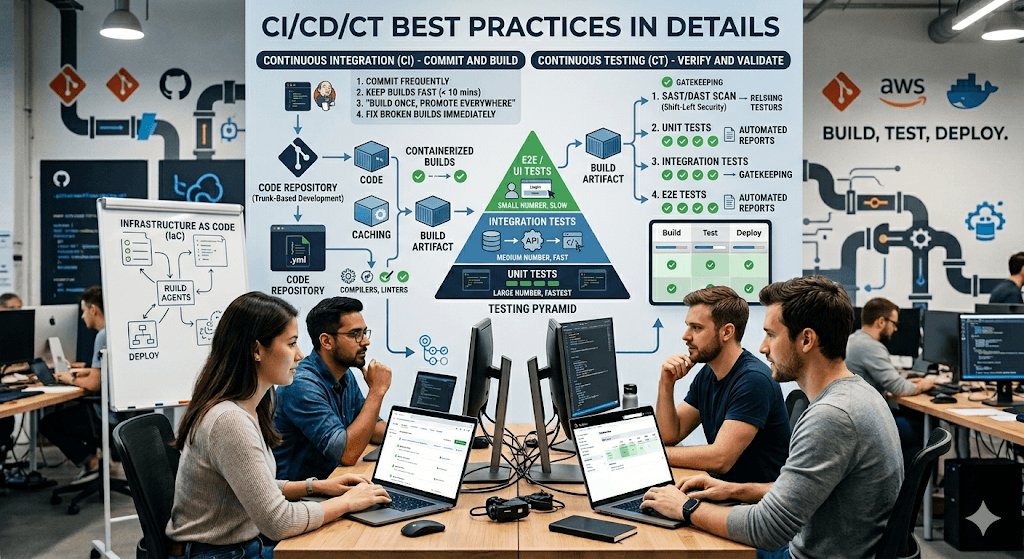
Mastering CI/CT/CD (Continuous Integration, Continuous Testing, and Continuous Deployment/Delivery) streamlines your software development lifecycle by catching bugs early, automating testing suites, and safely delivering high-quality releases to production. [1, 2]
Adopting these detailed, phase-specific best practices will drastically improve pipeline efficiency and system reliability. [1]
1. Continuous Integration (CI) Best Practices
- Commit Early and Often: Encourage trunk-based development, where all developers commit small, incremental changes to the main branch daily. This prevents merge hell and keeps feature branches short-lived. [1, 2, 3, 4]
- Build Only Once: Compile, package, and containerize your application exactly once. Store this immutable artifact in a repository (e.g., Docker Hub, AWS ECR) and promote the exact same binary through all stages. [1, 2, 3, 4, 5]
- Keep Builds Fast: Target a feedback loop of 5-10 minutes. Utilize caching for dependencies, split up massive build jobs, and fail pipelines immediately if a step breaks. [1, 2]
- Automate Everything: Pipelines should run automatically upon every pull request and commit. Avoid manual trigger steps wherever possible. [1, 2, 3]
2. Continuous Testing (CT) Best Practices
- The Testing Pyramid: Structure your tests logically to maximize speed and efficiency:
- Unit Tests (70%): Fast, isolated checks on specific business logic or functions. Run these first on every commit.
- Integration & Component Tests (20%): Check how services and databases interact with each other.
- End-to-End & UI Tests (10%): Simulate real user journeys. These are slow and expensive, so run them sparingly. [1, 2, 3, 4, 5]
- Shift Left: Test your code early by running automated tests on local machines and feature branches before merging them into the mainline. [1, 2]
- Mirrored Environments: Ensure staging and testing environments mirror production as closely as possible in terms of configurations, scale, and data. [1, 2, 3, 4, 5]
- Read the Pipeline: Use the test results as the single source of truth; do not merge or deploy if a test fails, and use pipeline alerts to fix issues immediately. [1, 2, 3, 4, 5]
3. Continuous Delivery/Deployment (CD) Best Practices
- Automated Rollbacks: Define clear criteria (e.g., increased 500 error rate, failing health checks) for your system to automatically revert to the previous working artifact. [1, 2]
- Progressive Delivery: Mitigate risks by rolling out updates gradually. Use blue/green deployments (swapping traffic between two identical environments) or canary releases (testing new code on a small percentage of users before rolling out completely). [1, 2]
- Immutable Deployments: Do not alter server configurations manually in production. Deploy Infrastructure as Code (IaC) using tools like Terraform or Ansible to guarantee reproducible and predictable deployments. [1, 2, 3, 4, 5]
- Feature Flags: Decouple feature deployment from feature release. Wrap new features in flags so you can turn them on or off in production without having to deploy new code. [1, 2, 3, 4, 5]
4. Pipeline Security and Maintenance
- Secrets Management: Never hardcode credentials in source code. Use secure managers like HashiCorp Vault, AWS Secrets Manager, or built-in CI/CD secrets.
- Shift-Left Security: Embed SAST (Static Application Security Testing) and DAST (Dynamic Application Security Testing) directly into the automated build step to catch vulnerabilities prior to deployment.
- Monitor Pipelines: Use tools like Datadog or Prometheus to monitor pipeline metrics over time. Track your DORA metrics (e.g., deployment frequency, lead time for changes, mean time to recovery) to spot bottlenecks