
Boto3 is the official Amazon Web Services (AWS) Software Development Kit (SDK) for Python. It allows Python developers to write software and scripts to automate, create, configure, and manage AWS services directly from their Python code. [1, 2]
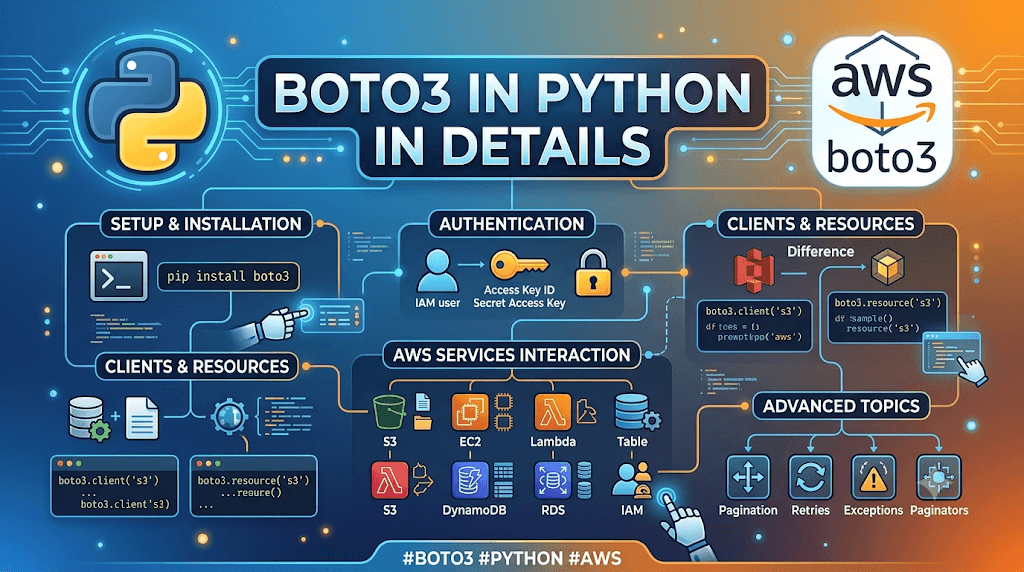
💡 Core Capabilities
Instead of manually clicking through the AWS Management Console or writing bash scripts for the AWS CLI, you can import Boto3 into your Python application to handle infrastructure programmatically. You can find the latest version on the official
boto3 – PyPI directory. [1, 2, 3, 4]
Common tasks automated with Boto3 include:
- Uploading, downloading, and managing files in Amazon S3.
- Starting, stopping, and provisioning Amazon EC2 virtual servers.
- Querying or updating database records in Amazon DynamoDB.
- Deploying and triggering serverless functions via AWS Lambda. [1, 2, 3, 4, 5]
🛠️ Client vs. Resource Interfaces
Boto3 provides two distinct ways to interact with AWS services, giving you flexibility depending on your coding preferences: [1, 2, 3, 4, 5]
- Client (Low-level):
- Resource (High-level):
🐍 Code Example: Uploading a File to S3 [1]
To understand how it functions in practice, here is a basic example of uploading a file using a Boto3 client: [1, 2]
python
import boto3

# Initialize a low-level client for the Amazon S3 service
s3_client = boto3.client('s3')

# Upload a local file to a specific S3 bucket
s3_client.upload_file('my_local_report.pdf', 'my-company-bucket', 'reports/report.pdf')

print("Upload successful!")
Use code with caution.
⚙️ How it Handles Credentials [1]
Boto3 does not require you to hardcode your secret API keys into your scripts. Instead, it automatically looks for credentials in standard environments, following the official
AWS SDK and Tools Reference Guide guidelines. It looks for: [1, 2, 3, 4]
- Environment variables (
AWS_ACCESS_KEY_IDandAWS_SECRET_ACCESS_KEY). - The shared credentials file created via the AWS CLI (
~/.aws/credentials). - IAM roles assigned directly to an EC2 instance or AWS Lambda execution environment. [1, 2, 3, 4, 5]
💭 Why is it called “Boto”?
The library was named by its original community author after the fresh-water dolphin native to the Amazon River. The “3” signifies that it is the third major iteration of the SDK package. [1, 2]
If you are just getting started, you can reference the comprehensive
Boto3 Documentation to find installation steps and service APIs. [1, 2, 3]
If you’d like to dive deeper, let me know: