Artificial Intelligence is evolving rapidly. What started as individual AI models performing isolated tasks is now transforming into collaborative AI ecosystems where multiple intelligent agents work together.
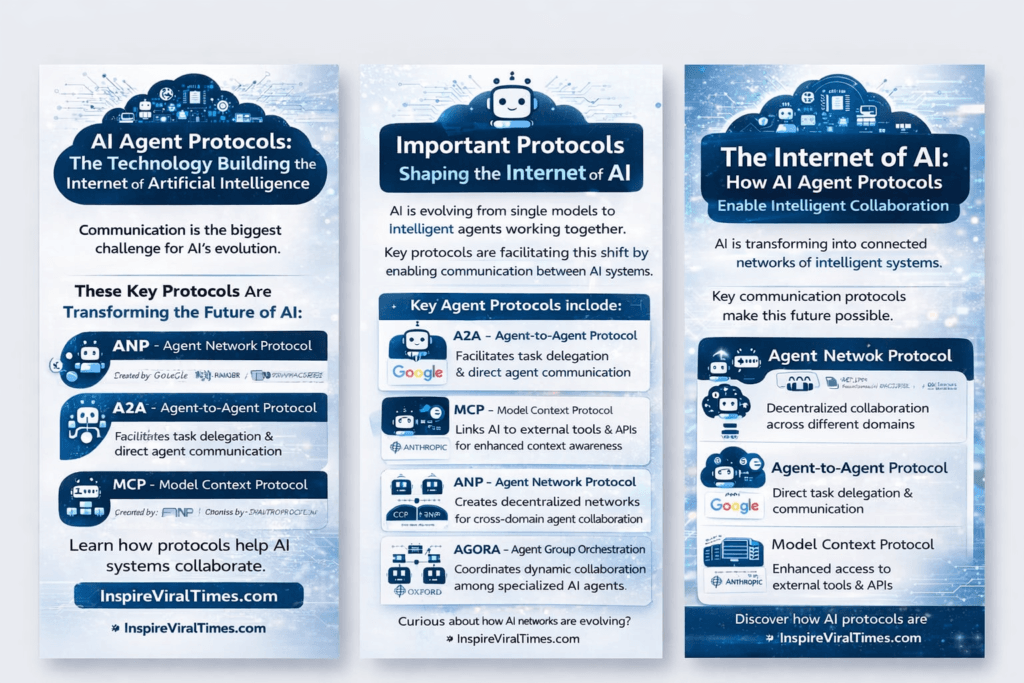
But as AI grows more powerful, experts believe the biggest challenge is no longer intelligence itself. The real challenge is communication and coordination between AI agents.
Just like the modern internet depends on protocols such as HTTP and TCP/IP, the emerging Internet of AI requires its own set of communication frameworks. These frameworks are known as AI Agent Protocols, and they are quietly becoming the backbone of next-generation artificial intelligence.
Below are some of the most important protocols shaping the future of AI collaboration.
Why AI Needs Communication Protocols
In the early days of AI, systems worked independently. A single model could answer questions, generate images, or analyze data.
Today, however, complex tasks require multiple AI agents working together. For example:
- One agent collects data
- Another analyzes it
- A third makes decisions
- A fourth communicates results
Without clear communication standards, these systems would struggle to cooperate. This is where AI agent protocols come in — they define how AI systems communicate, exchange data, and collaborate efficiently.
Key AI Agent Protocols Transforming the AI Ecosystem
1. ANP — Agent Network Protocol
The Agent Network Protocol (ANP) focuses on building decentralized networks of AI agents.
In this system, different agents specialize in specific roles such as:
- Master agent (coordination)
- Data analysis agent
- Risk detection agent
- Feedback agent
Instead of relying on a central system, ANP allows agents to collaborate across distributed environments. This architecture is particularly useful for large-scale AI networks operating across different domains.
2. A2A — Agent-to-Agent Protocol
The Agent-to-Agent Protocol (A2A) enables direct communication between AI agents.
Developed by Google, this protocol allows AI systems to:
- Send task requests
- Delegate work to other agents
- Process tasks collaboratively
- Interact with remote agents
A2A makes it possible for AI agents to share workloads dynamically, creating systems that are faster and more efficient.
3. MCP — Model Context Protocol
The Model Context Protocol (MCP) helps AI systems interact with external tools, cloud services, and APIs.
Developed by Anthropic, MCP acts as a bridge between AI models and real-world digital infrastructure.
With MCP, AI agents can:
- Access databases
- Use APIs
- Retrieve contextual information
- Execute external operations
This protocol significantly expands what AI agents can do beyond their internal training data.
4. AGORA — Agent Group Orchestration Protocol
The AGORA Protocol focuses on coordinating groups of specialized AI agents.
Researchers at the University of Oxford developed this concept to enable dynamic collaboration between multiple AI agents.
Instead of a single AI handling everything, AGORA allows:
- Master agents to coordinate tasks
- Specialized agents to handle specific jobs
- Collaborative workflows across AI teams
This approach mirrors how human organizations operate, with teams working together to achieve complex goals.
5. ACP — Agent Communication Protocol
The Agent Communication Protocol (ACP) standardizes how agents communicate inside multi-agent systems.
Developed by IBM, ACP introduces a structured system including:
- ACP clients
- ACP servers
- ACP agents
These components ensure that communication between agents is consistent, reliable, and scalable.
The Rise of the “Internet of AI”
Just as internet protocols enabled billions of computers to connect globally, AI agent protocols are laying the foundation for an interconnected network of intelligent systems.
Experts often call this emerging ecosystem the Internet of AI.
In this future:
- AI agents will collaborate across industries
- Systems will solve problems collectively
- Autonomous decision-making networks will emerge
The result could be smarter automation, faster innovation, and entirely new digital ecosystems.
Why This Matters for the Future
AI is no longer just about building smarter algorithms. The real transformation lies in how AI systems work together.
Protocols like ANP, A2A, MCP, AGORA, and ACP represent the early infrastructure of a world where millions of AI agents communicate seamlessly, solving problems that are impossible for a single system alone.
Just as the internet revolutionized communication between computers, AI protocols may revolutionize collaboration between intelligent machines.
The age of connected artificial intelligence has only just begun.
#ArtificialIntelligence #AIagents #FutureOfAI #TechTrends #AInetworks #AIprotocols #AIinnovation #AItechnology #MachineLearning #FutureTech #AIecosystem
#AIrevolution #FutureOfTechnology #AIagents #DigitalTransformation