
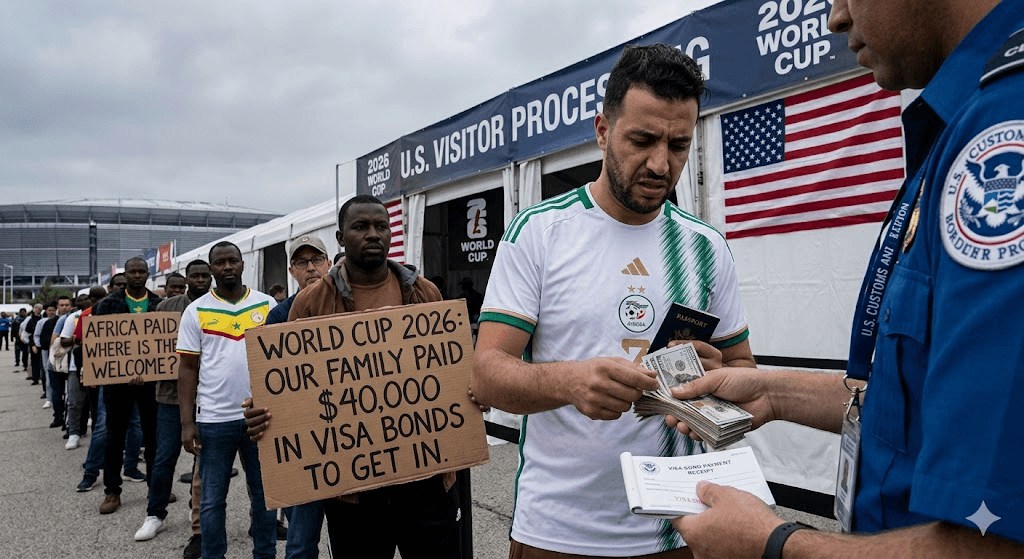
With less than 80 days until the 2026 World Cup kicks off, the Trump administration’s hardline immigration policies are clashing with the “most inclusive” tournament in FIFA history. A newly expanded “Visa Bond Pilot Program” is turning the dream of attending a World Cup into a financial nightmare for fans and even some athletes from participating nations.
The $15,000 “Security Deposit”
Under the policy, which is set to expand to 50 countries on April 2, travelers from specific nations must post a refundable bond ranging from $5,000 to $15,000 just to apply for a B-1 or B-2 visa. Billed as a “national security” measure to prevent visa overstays, the program acts as a massive financial hurdle for citizens of countries where the average annual income is often less than the bond itself.
The bond is per person, meaning a family of four from a targeted nation could be forced to front up to $40,000 in cash to the U.S. government before even booking a flight or buying a match ticket. While the money is supposedly refunded upon a successful and timely exit from the U.S., the upfront cost is being labeled by critics and civil rights groups as a “legalized shakedown.”
World Cup Nations Caught in the Net
The latest expansion of the list has hit five qualified World Cup nations particularly hard:
- Algeria
- Cape Verde
- Ivory Coast
- Senegal
- Tunisia
For these teams—all of which are from Africa—the “welcome mat” to the United States has been replaced by a paywall. Fans who have saved for years to support their national teams now face a sudden, mandatory “deposit” that many simply cannot afford.
No Exceptions for Athletes?
The controversy isn’t limited to the stands. According to reports from The Athletic, the current regulations offer no automatic exemptions for the players, coaches, or support staff of the competing teams. While FIFA is reportedly in private negotiations with the State Department to waive these fees for official delegations, no such deal has been finalized.
Even if FIFA succeeds in exempting the players, the waivers are not expected to extend to the players’ families. This creates a surreal scenario where a world-class athlete could be playing in a stadium in New Jersey or Los Angeles while their spouse or children are barred from entry unless they hand over a $15,000 bond.
A Tournament Under Pressure
FIFA President Gianni Infantino has long promised that the 2026 World Cup—hosted across the U.S., Mexico, and Canada—would be a celebration of global unity. However, the Trump administration’s refusal to grant special visa priority to FIFA fans, combined with these new financial barriers, suggests a different reality.
Secretary of State Marco Rubio has defended the measures, stating that uniform entry procedures are essential for immigration control. But as international visitation to the U.S. continues to dip, many in the sports world fear that the “United” World Cup will be defined more by who was kept out than who was allowed in.
With the opening match on June 11 fast approaching, the clock is ticking for FIFA to find a workaround, or else the 2026 World Cup risks becoming the first elite-only tournament where the price of admission starts at the border.