
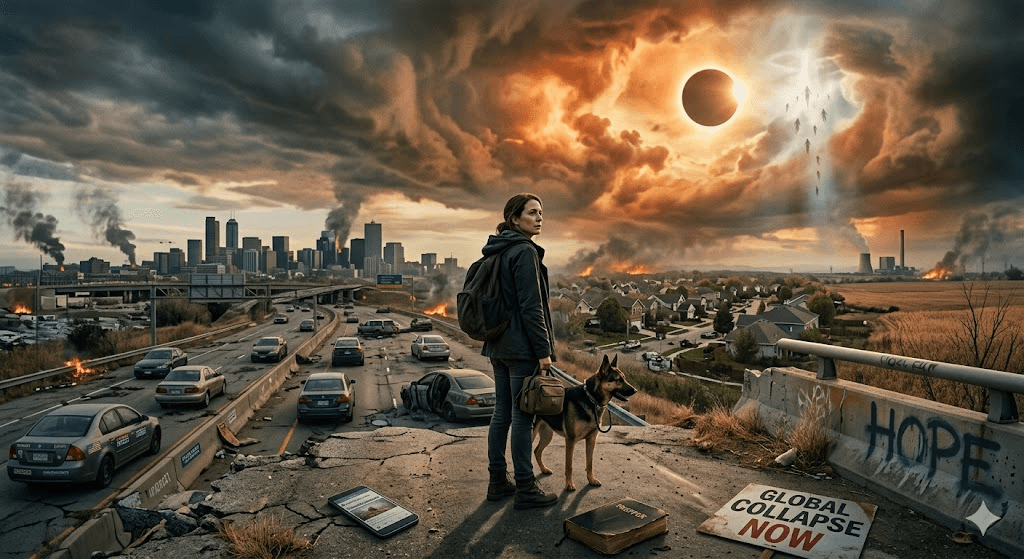
For decades, the idea of “the end of the world” was a fringe preoccupation, relegated to street-corner preachers and low-budget sci-fi movies. But today, something has shifted. Apocalyptic anxiety is no longer a subculture; it is the cultural baseline. From the “prepper” movement going mainstream to the pervasive sense of dread on social media, tens of millions of Americans now believe we are living in the final chapter of the human story.
Why has the “End of Days” become a bipartisan, multi-generational obsession? The answer lies in a perfect storm of secular crises and spiritual hunger.
The Death of the “Slow Progress” Narrative
For most of the 20th century, the dominant American narrative was one of steady, inevitable progress. We believed that technology would get cleaner, medicine would get better, and democracy would spread.
Today, that narrative has collapsed. For many, the future no longer looks like a shiny utopia; it looks like a resource-depleted wasteland. When you combine the visceral reality of record-breaking heatwaves with the instability of the global economy, “the end” stops feeling like a biblical prophecy and starts feeling like a logical conclusion.
The Algorithm of Doom
We cannot ignore the role of the digital age in fueling this fire. In the past, if you wanted to read about the apocalypse, you had to seek it out. Now, the apocalypse seeks you.
Algorithms are designed to prioritize high-arousal emotions, and nothing triggers an emotional response quite like fear and outrage. Whether it’s a viral clip of a civil unrest or a thread about “societal collapse,” we are constantly fed a diet of evidence that the world is breaking. When you see 50 videos a day of the world “ending,” it is hard to maintain a belief that it is actually continuing.
The Convergence of Religion and Politics
In America, the apocalyptic impulse has deep religious roots. For tens of millions of evangelical Christians, “the Rapture” is a literal event they expect to see in their lifetime. Historically, this was a spiritual belief about salvation.
However, in recent years, this theology has fused with political identity. Political losses are no longer seen as temporary setbacks but as signs of a “final battle” between good and evil. This “apocalyptic politics” makes compromise impossible; if you believe the other side is the harbinger of the Antichrist or the end of civilization, you aren’t looking for a policy solution—you’re looking for a bunker.
The Comfort of the End
Perhaps the most uncomfortable truth is that, for some, the idea of the end is actually… comforting.
Living in a world of complex, unsolvable problems—like systemic inequality or a globalized economy that feels out of our control—is exhausting. The “End” offers a clean break. It promises a final resolution where the “good” are vindicated and the “bad” are punished. It replaces the messy, boring work of maintaining a civilization with the cinematic drama of a finale.
The Danger of the Final Act
The danger of tens of millions of people believing the end is near is that it becomes a self-fulfilling prophecy. When people stop believing in a future, they stop investing in one. Why fix the climate, why save for retirement, or why protect democratic institutions if the world is going to end next Tuesday?
We are a nation that has lost its sense of “tomorrow.” To find our way back, we have to move past the allure of the apocalypse and rediscover the difficult, necessary, and deeply human work of building a world that lasts. The end may be a better story, but the continuation is a better reality.