
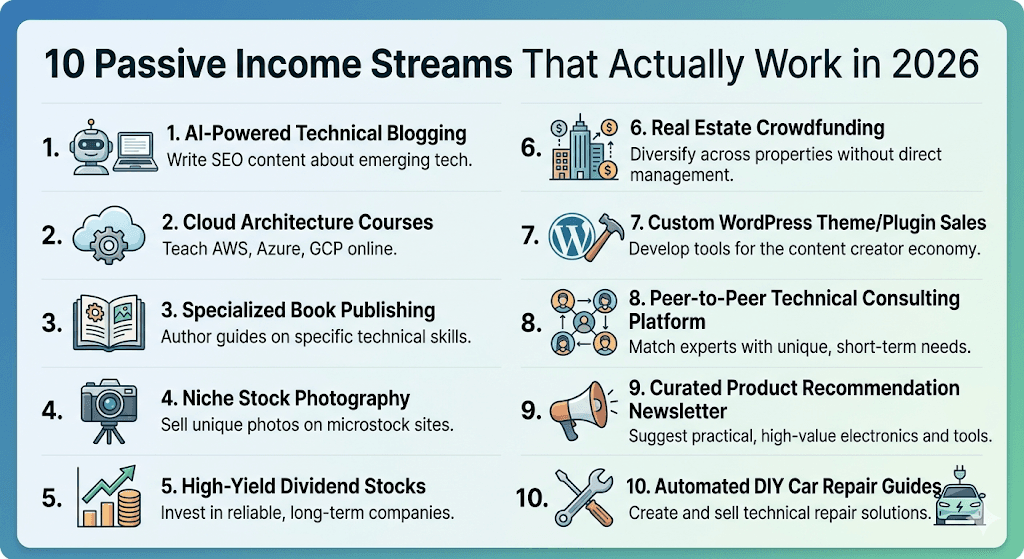
Forget the guru hype. These are the income streams real people are using to build wealth this year — with honest numbers, real startup costs, and zero fluff.
Let’s be real for a second. If you’ve spent any time on social media lately, you’ve probably seen someone in a rented Lamborghini telling you they make $47,000 a month “in their sleep.” And look — I’m not here to sell you that fantasy.
Passive income is real. But it’s not magic. Almost every stream on this list requires either money upfront, time upfront, or both. The “passive” part kicks in after you’ve done the work. That’s the honest truth nobody wants to put in their thumbnail.
With that said, 2025 has been a genuinely interesting year for building income outside of a 9-to-5. Interest rates are shifting, AI tools have lowered the barrier to creating digital products, and there are more platforms than ever connecting creators and investors with opportunities that didn’t exist five years ago.
So here are 10 passive income streams that are working for real people right now — not hypothetical, not “coming soon,” not reserved for millionaires.
This is the granddaddy of passive income, and for good reason — it still works. When you buy shares of companies that pay dividends, you get regular cash payments just for holding the stock. You’re literally getting paid for owning a tiny slice of a business.
In 2025, high-yield dividend stocks have been especially attractive. Companies like AbbVie, Realty Income, and Enterprise Products Partners have continued raising their payouts, with some yielding 4–7% annually. That might not sound sexy, but $50,000 invested at a 5% yield means $2,500 a year hitting your account — and it compounds over time.
Here’s what changed in 2025: you no longer need to be a designer or a writer to create digital products that sell. Tools like Canva, Notion, and even AI writing assistants have made it possible for basically anyone to package their knowledge into something people will pay for.
I’m talking about things like budget spreadsheets, wedding planning templates, social media content calendars, meal prep guides, resume templates — the list is endless. You create it once, list it on Etsy, Gumroad, or your own site, and every sale after that is almost pure profit.
Okay, this one isn’t glamorous. Nobody’s making a TikTok about their savings account. But here’s the thing — with many online banks still offering 4–5% APY in 2025, your cash is actually working for you in a way it hasn’t in over 15 years.
If you have an emergency fund sitting in a regular checking account earning 0.01%, you’re leaving money on the table. Moving $20,000 into a high-yield savings account at 4.5% APY earns you $900 a year for doing absolutely nothing. It’s not life-changing, but it’s real money — and it’s the most risk-free item on this entire list.
Affiliate marketing is one of those things that sounds scammy until you realize how common it is. When a food blogger recommends a specific blender and includes a link, they earn a commission if you buy it. That’s affiliate marketing. It’s everywhere.
What makes it genuinely passive is that content you create today — a blog post, a YouTube video, a Pinterest pin — can keep generating clicks and commissions for years. The key is creating helpful content that ranks in search engines or gets shared organically. In 2025, niches like personal finance tools, home office equipment, health supplements, and software reviews remain strong.
If you know how to do something well — like photography, Excel, baking sourdough, coding, or playing guitar — there are people willing to pay you to teach them. And unlike in-person teaching, an online course lets you teach once and get paid thousands of times.
Platforms like Udemy, Skillshare, and Teachable make it relatively easy to get started. The online education industry has been growing at roughly 25% annually in recent years, though popular categories are getting more competitive. That said, niche topics (think “data analysis for real estate agents” rather than “learn Python”) still have tons of room.
Quick reality check: The most sustainable passive income usually comes from stacking 2–3 of these streams together, not going all-in on one. Diversification isn’t just for stock portfolios — it’s smart for income streams too.
If you have even a sliver of creative ability — or access to AI design tools — print-on-demand is one of the lowest-risk ways to sell physical products online. You design graphics for t-shirts, mugs, tote bags, or phone cases, upload them to a platform like Printful or Redbubble, and they handle everything: printing, shipping, customer service.
You never touch inventory. You never deal with returns. You just collect a margin on every sale. Some people treat this like a hobby and make a few hundred dollars a month. Others build full storefronts with hundreds of designs and pull in serious income.
Want the benefits of real estate investing without becoming a landlord? REITs let you invest in real estate the same way you’d invest in stocks. You buy shares of companies that own income-producing properties — things like apartment buildings, shopping centers, warehouses, and data centers — and they’re required by law to distribute at least 90% of their taxable income to shareholders.
In 2025, REITs focused on industrial, healthcare, and data center properties have been particularly strong. You can buy individual REIT stocks through any brokerage or invest in REIT ETFs for broader diversification. It’s one of the most accessible ways to get real estate exposure without dealing with tenants or plumbing.
YouTube is probably the hardest thing on this list to get started. Building an audience takes time, consistency, and thick skin. But once you hit a certain threshold, older videos keep getting views — and ad revenue — for years. Some creators earn more from videos they published two years ago than from anything they put out last week.
In 2025, educational and evergreen content performs especially well for passive income. A video explaining “how to tile a bathroom” or “how tax brackets work” doesn’t expire. Combine ad revenue with affiliate links in the description and maybe a digital product, and a single channel can become a legitimate income engine.
This is the “boring” option that quietly makes more people wealthy than any other item on this list. When you invest in a broad market index fund — like one tracking the S&P 500 — you’re buying a tiny piece of hundreds of companies at once. Over time, the market has historically returned roughly 8–10% per year on average.
The key word is “over time.” You’re not going to double your money overnight. But if you consistently invest even a few hundred dollars a month for 10–20 years, compound interest does genuinely astonishing things. It’s not passive income in the “money shows up in your bank account monthly” sense — it’s passive wealth building. And for most people, it’s the single most important financial move they can make.
This is the newer kid on the block, and it’s grown significantly in 2025. Platforms like Fundrise, Groundfloor, and Prosper let you lend money to borrowers or invest in real estate projects with relatively small amounts of capital. You earn interest or returns from the investments, often in the 6–12% range.
The tradeoff? Your money is usually locked up for a period — sometimes six months, sometimes several years. And there’s real risk involved: borrowers can default, and real estate projects can underperform. This isn’t a savings account. But for money you don’t need immediately, it can be a solid way to earn above-average returns without managing properties or picking individual stocks.
So Which One Should You Start With?
Honestly? It depends entirely on what you already have. If you have some savings sitting around, high-yield savings or dividend investing are the easiest first steps — they require almost no time and the barrier to entry is essentially zero.
If you have more time than money, digital products, affiliate marketing, or YouTube let you trade sweat equity now for ongoing income later. The upfront investment is minimal, but you’re paying with your hours instead of your dollars.
And if you’re already doing well financially and want to diversify? REITs, index funds, and peer-to-peer lending let your existing capital work harder for you.
The one thing I’d encourage you to avoid is analysis paralysis. Don’t spend six months researching the “perfect” passive income stream. Pick one that fits your current situation, start small, learn as you go, and expand from there. The best time to start was five years ago. The second best time is today.
The Bottom Line
Passive income isn’t about getting rich overnight. It’s about building systems that work for you while you’re living your life. Start with one stream, learn the ropes, then stack another on top. That’s how real financial freedom gets built — one small, consistent step at a time.