
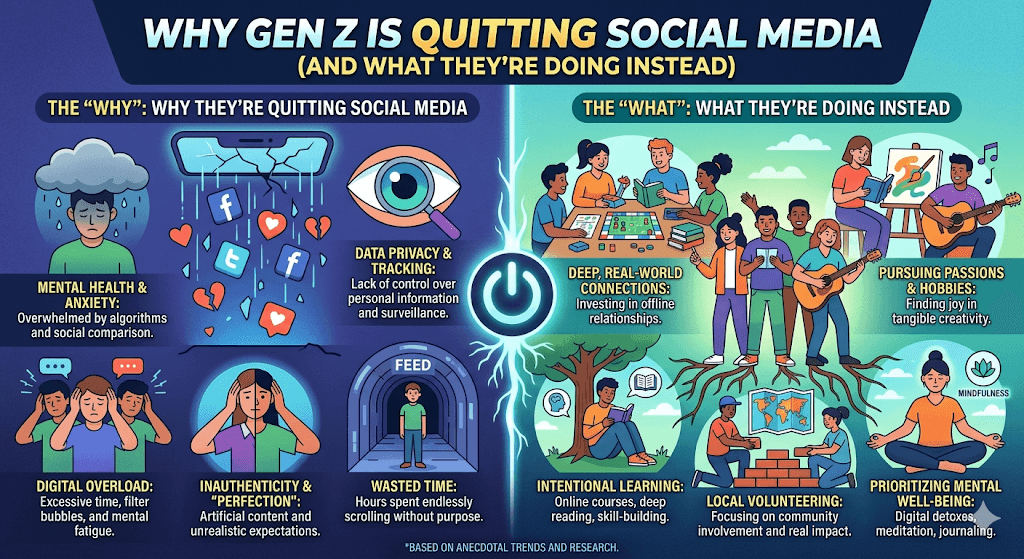
Why Gen Z Is Quitting Social Media (And What They’re Doing Instead)
The generation that grew up on Instagram is now logging off for good — and they’re not looking back.
Here’s something nobody expected: the most digitally native generation in history is slowly, quietly, and deliberately walking away from social media. Not because they can’t afford a phone. Not because they’re living off-grid somewhere. They’re doing it because they’re tired — and they’re choosing something better.
If you’ve noticed your younger cousins, siblings, or colleagues going quiet on Instagram or TikTok lately, you’re not imagining things. A real, grassroots shift is happening — and it’s worth understanding why.
The burnout no one warned them about
Gen Z didn’t choose social media — it was handed to them. They were 10 when Instagram launched filters. Thirteen when Snapchat streaks became social currency. Sixteen when TikTok rewired what “short” meant for human attention. By the time they were old enough to reflect on it, the platforms had already shaped their sense of self.
And then came the exhaustion. Not dramatic, not sudden — just a slow accumulation of comparisons, performance anxiety, parasocial relationships, and the relentless hunger of an algorithm that only wants more of your time.
“I realized I was performing my life instead of living it. Every moment became potential content, and it made me feel hollow.”
— 23-year-old, former lifestyle content creatorThe mental health data has been building for years. Anxiety, loneliness, sleep disruption, and distorted body image have all been linked to heavy social media use — particularly among young women. But Gen Z isn’t just reading the studies. They’re living them. And they’re deciding enough is enough.
It’s not anti-tech — it’s anti-performance
Let’s be clear: Gen Z isn’t anti-technology. They still use their phones constantly. They still stream, message, listen, and create. What they’re rejecting isn’t the internet — it’s the specific, exhausting theater of public social media.
The shift is from broadcasting to connecting. From performing to being. From public timelines curated for strangers to private conversations with people they actually care about.
The platforms Gen Z is leaving are the ones built on public performance metrics — likes, follower counts, and viral reach. The spaces they’re moving toward are quieter, more intimate, and far less gamified.
So where are they going?
This is the part that’s genuinely fascinating. The alternatives Gen Z is gravitating toward aren’t just “other apps.” They’re fundamentally different ways of spending time and relating to other people.
- Reading — physical books, real pages BookTok may have started on TikTok, but the love of actual reading has outlasted the trend. Independent bookstores are seeing a Gen Z revival, and “reading as self-care” has become a genuine cultural identity marker.
- Analog hobbies and making things by hand Pottery, embroidery, journaling, film photography, painting, and cooking from scratch. The appeal is tactile, slow, and gloriously offline. You can’t like a sourdough loaf. It just has to taste good.
- Private online communities and niche Discord servers Instead of broadcasting to thousands of strangers, Gen Z is finding small, interest-based communities where people actually know each other. Less fame, more belonging.
- In-person social experiences Running clubs, board game nights, local volunteering, farmers markets, climbing gyms. The “third place” — somewhere that isn’t home or work — is back in demand, and Gen Z is actively seeking it out.
- Subscription music and audio — without the scroll Listening to albums front-to-back, discovering podcasts, exploring Bandcamp. Audio feels intentional. It doesn’t demand your eyes or your performing self.
The “soft quit” is real — and it’s spreading
Most Gen Z-ers aren’t deleting their accounts with a grand announcement. They’re just… using them less. Logging in once a week instead of hourly. Muting notifications. Archiving old posts. Letting stories go unposted.
This “soft quit” doesn’t make the headlines the way dramatic deactivations do, but it may actually be more significant. It means the compulsive pull of the apps is weakening — not through willpower, but through genuine disinterest. The novelty has worn off. The cost feels clearer now.
“I didn’t delete Instagram. I just stopped opening it. One day I realized it had been three weeks and I hadn’t missed it once.”
— 21-year-old university studentWhat platforms got wrong
Social media was sold as connection. What it delivered, in many cases, was comparison. Every scroll is a curated highlight reel of other people’s bodies, relationships, travels, and achievements — optimized by an algorithm that knows exactly which emotional buttons to push to keep you scrolling.
Gen Z grew up being told they were “digital natives” — as if fluency in technology meant immunity to its harms. It didn’t. If anything, earlier and heavier exposure meant earlier and more profound disillusionment.
The platforms also failed to evolve in ways that mattered. They got bigger, flashier, more algorithmically sophisticated — but they didn’t get kinder, calmer, or more genuinely human.
What this means for the rest of us
Gen Z’s quiet exit from social media isn’t a passing trend or a contrarian pose. It’s a cultural correction — and one that the generations before them are starting to follow.
Millennials who built their identities on early social media are now approaching 40 and re-evaluating the role it plays in their lives. Parents of teenagers are having conversations about screen time that feel less like rules and more like reflection. Even brands are noticing that reach without trust doesn’t convert.
The era of “more followers = more value” is losing its grip. In its place, something older and more human is re-emerging: the idea that real connection happens in smaller rooms, slower moments, and conversations that don’t need an audience.
The bottom line
Gen Z didn’t invent the problems with social media — they just experienced them earliest and most intensely. Their exit isn’t a rejection of connection. It’s a search for better connection. Realer. Slower. Less curated and more honest.
And if you’ve been feeling the same pull toward your phone with diminishing returns — toward a feed that exhausts more than it energizes — maybe the most radical thing you can do is take the cue from the generation everyone assumed would be glued to screens forever.
Log off. Make something with your hands. Call a friend. Be somewhere without documenting it.
The world, it turns out, is still very much out there. And it doesn’t require a WiFi connection.
“You don’t have to go viral. You just have to be present.”

Comments are closed.