
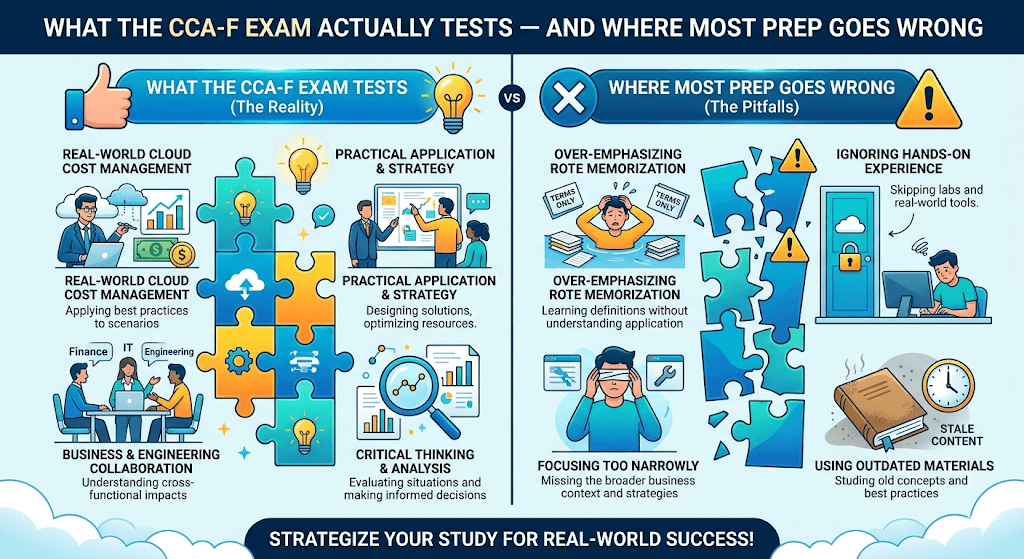
Most people preparing for the Claude Certified Architect exam make the same mistake. They try to learn everything. Documentation, tutorials, scattered notes, long videos. It quickly turns into noise — and when exam time arrives, the problem is rarely that they didn’t study enough. It’s that they studied too broadly and revised too little.
This post distills what the CCA-F is, what it truly tests, where candidates stumble, and how to walk in sharp. Whether you’re a week out or just starting your roadmap, this is the orientation you needed on day one.
Quick Facts: The 2026 Exam at a Glance
Launched March 12, 2026, the Claude Certified Architect – Foundations is Anthropic’s first official proctored technical credential. This is not an AI literacy badge or course-completion certificate — it’s a 301-level systems design exam.
The exam is delivered online through ProctorFree — no pauses, no external resources, no Claude. Results arrive within two business days along with a domain-by-domain breakdown and a shareable digital badge. Access is currently through the Claude Partner Network, which is free to join; the first 5,000 partner employees receive the exam at no cost.
The Five Domains — Weighted by Difficulty
Every question drops you into a production scenario and asks you to make the right architectural call from four options where at least two will sound completely reasonable. Here’s how the exam is weighted:
Notice that Agentic Architecture and Claude Code together account for 47% of the exam. This is not a prompting fundamentals test. It is a systems design exam — and the community confirms that the hardest points are lost to MCP tool boundaries, fallback loop design, and JSON schema structuring.
The Real Gap: Learning vs. Revision
“You can understand hooks, stop_reason, and schema design in isolation. But reading about them and being able to apply them reliably under a 120-minute clock are two different skills.”
Every major CCA-F prep resource is built to help you learn. Almost none of them are built to help you review. There is a meaningful difference. Learning requires depth and context. Reviewing requires clarity and speed. The material most useful for learning — long explanations, detailed examples, worked-through concepts — is exactly the wrong thing to open the night before your exam.
What you need in the final stretch is something that reminds you of the pattern instantly, shows you the trap, and moves on.
A Concrete Example: The Agentic Loop
Take the agentic loop — the core execution pattern behind every Claude agent. The exam will test you on when a loop should stop. Most candidates know the answer involves something called stop_reason. But under pressure, with four plausible options on screen, the question becomes: do you know it, or do you feel it?
⚠ Common Traps on This Question
- max_tokens — signals truncation, not task completion. Wrong.
- Parsing response text — brittle, unreliable, and an anti-pattern. Wrong.
- Counting iterations — a safety backstop, not a completion signal. Wrong.
- end_turn — the correct signal that Claude has finished its turn cleanly. ✓
A good revision resource makes that distinction so clear and so fast that you eliminate two wrong answers before you finish reading the question. That kind of reflexive recognition comes from revision, not from reading documentation once.
What to Actually Study
High-priority topics
- Agentic loop design and stop_reason handling (27% of exam)
- Multi-agent hub-and-spoke orchestration patterns
- MCP server tool boundaries — preventing reasoning overload
- CLAUDE.md hierarchies and .claude/rules/ configuration
- JSON schema structuring to prevent hallucinations
- Batch API cost optimization patterns
- Error-handling hooks, session resumption, and escalation protocols
- Context management and long-context handoff patterns
What candidates report being tested on most:
Fallback loop design and graceful degradation strategies
Tool description clarity — ambiguous descriptions are how models get misrouted
Confidence calibration and structured escalation to human reviewers
CI/CD pipeline integration using Claude Code custom slash commands
Free Official Preparation Resources
If you’re studying from scratch, start with Anthropic Academy at anthropic.skilljar.com. All 13 courses are free and directly exam-relevant. The recommended path is approximately 2–4 weeks of focused study (20–30 hours) if you already build with Claude daily.
For revision, sites like claudecertifications.com offer free study guides, 25 practice questions, and a 12-week study plan. Aim for 900+ on the official practice exam before booking your proctored slot.
Why This Credential Matters in 2026
This certification is not arriving in a vacuum. Anthropic has committed $100 million to the Claude Partner Network in 2026. Accenture is training approximately 30,000 professionals on Claude as part of its partnership; Cognizant is training up to 350,000 employees globally. At that scale, the CCA-F is becoming a baseline expectation for Claude-focused delivery roles at major consulting firms.
More certifications are confirmed for later in 2026 — targeting sellers, developers, and advanced architects. The Foundations credential is the entry point of a credential stack, not a standalone badge. The architecture-level skills it validates — context window management, reliable structured output, agentic workflow design — are exactly what enterprise teams need and currently can’t easily verify.
“The AI market has enough prompt users. What it needs now is real AI architects.”
One Last Thing
The exam is harder than people expect and more passable than they fear. The candidates who struggle are not the ones who know less — they are the ones whose knowledge isn’t sharp enough to be fast. Revision is what creates that sharpness.
Aim high on the practice exam, build at least one complete agentic loop before your sitting, and trust your preparation. The gap between candidates who pass and candidates who re-sit is almost never the volume of study. It’s the quality of the final week.
Good luck. Build well.