Introductions
IIn today’s digital-first world, businesses no longer rely on bulky physical servers sitting in offices. Instead, they use cloud computing—a faster, scalable, and cost-efficient way to run applications and store data. At the center of this revolution is Amazon Web Services (AWS), one of the most widely used cloud platforms globally.
This beginner-friendly guide will walk you through what AWS is, how it works, and why it’s essential in 2026 and beyond.
What Is AWS?
Amazon Web Services (AWS) is a cloud computing platform provided by Amazon. Launched in 2006, AWS offers a wide range of services like computing power, storage, databases, machine learning, and more—all delivered over the internet.
Instead of buying and maintaining physical servers, you can rent resources from AWS on a pay-as-you-go basis.
What Is Cloud Computing?
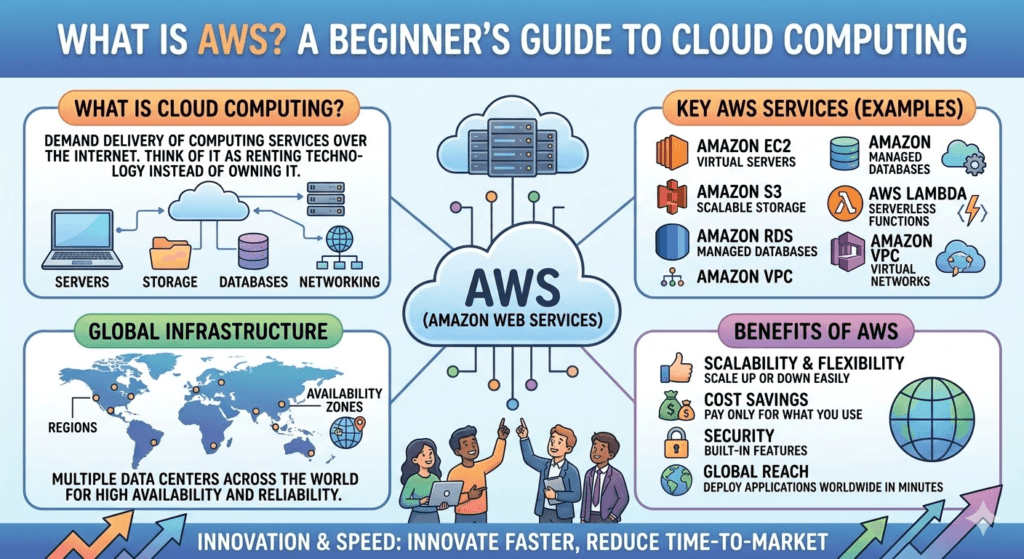
Cloud computing is the delivery of computing services—such as servers, storage, networking, and software—over the internet.
Key Benefits:
- Scalability: Increase or decrease resources instantly
- Cost-effective: Pay only for what you use
- Accessibility: Access from anywhere in the world
- Security: Enterprise-level data protection
How AWS Works
AWS operates through a global network of data centers, organized into:
- Regions: Geographic locations (e.g., US East, Asia Pacific)
- Availability Zones (AZs): Isolated data centers within a region
This architecture ensures:
- High availability
- Fault tolerance
- Low latency
Core AWS Services Explained
Here are some essential AWS services every beginner should know:
1. Compute (Servers in the Cloud)
- Amazon EC2 (Elastic Compute Cloud)
Run virtual servers to host websites, apps, or software.
2. Storage
- Amazon S3 (Simple Storage Service)
Store files, images, videos, and backups securely.
3. Databases
- Amazon RDS (Relational Database Service)
Manage databases like MySQL, PostgreSQL easily.
4. Networking
- Amazon VPC (Virtual Private Cloud)
Create your own private network in AWS.
5. Security
- AWS IAM (Identity and Access Management)
Control who can access your resources.
Types of Cloud Computing in AWS
AWS supports three main cloud service models:
1. IaaS (Infrastructure as a Service)
- Rent servers and storage
- Example: EC2
2. PaaS (Platform as a Service)
- Focus on development without managing infrastructure
- Example: AWS Elastic Beanstalk
3. SaaS (Software as a Service)
- Use software over the internet
- Example: Gmail (not AWS, but a SaaS example)
Why AWS Is So Popular
AWS dominates the cloud industry for several reasons:
- Global infrastructure: Available in multiple regions worldwide
- Reliability: 99.99% uptime for many services
- Massive service portfolio: 200+ services
- Trusted by companies: Netflix, NASA, Airbnb
Many startups and enterprises rely on AWS because it allows them to scale quickly without heavy upfront investment.
Real-World Use Cases of AWS
AWS is used across industries for:
- Hosting websites and blogs
- Running mobile and web apps
- Data storage and backup
- Machine learning and AI applications
- Game development
- Streaming services
AWS Pricing Model
AWS follows a pay-as-you-go pricing structure:
- No upfront cost
- Pay only for the resources you use
- Free tier available for beginners
This makes AWS accessible even for students and small businesses.
Getting Started with AWS
Here’s how beginners can start using AWS:
- Create a free AWS account
- Explore the AWS Free Tier
- Launch your first EC2 instance
- Store files in S3
- Learn basic security practices (IAM roles)
Pros and Cons of AWS
Pros:
- Highly scalable
- Secure and reliable
- Wide range of services
- Strong community support
Cons:
- Can be complex for beginners
- Pricing can be confusing
- Requires learning curve
Future of AWS and Cloud Computing
Cloud computing is expected to grow rapidly with advancements in:
- Artificial Intelligence (AI)
- Internet of Things (IoT)
- Big Data Analytics
AWS continues to lead innovation in these areas, making it a critical skill for developers, businesses, and tech professionals.
Final Thoughts
AWS has transformed how the digital world operates. Whether you’re building a blog, launching a startup, or learning tech skills, understanding AWS is a valuable investment.
If you’re just starting out, focus on core services like EC2 and S3, and gradually explore advanced features. With consistent practice, you can become proficient in cloud computing and unlock countless career opportunities.