

Introduction: Fasten Your Seatbelts
The internet of 2025 is not just “faster” or “bigger.” It is fundamentally different. If the last decade was defined by mobile connectivity and social media synchronization, the next five years will be defined by intelligence, immersion, and decentralization. The infrastructure is already being laid. The shock will come from how quickly these technologies merge and how profoundly they rewrite the rules of commerce, communication, and identity.
Here are the three foundational pillars of the internet you will experience in 2025
Pillar 1: The Prediction Engine (Your AI-Integrated Life)
By 2025, the boundary between “the internet” and “your thought process” will begin to dissolve. We are moving from a reactive internet, where you search for answers, to a predictive internet, which anticipates your needs.
This shift is driven by deep artificial intelligence integration. In 2025, AI is not just a chatbot; it is the fabric of the web. Your personal AI agent (an evolution of today’s digital assistants) will manage your digital footprint. It won’t just remind you of an appointment; it will preemptively schedule the necessary travel, purchase a gift based on the recipient’s real-time mood data, and filter your incoming communication, presenting you only with what requires human judgment.
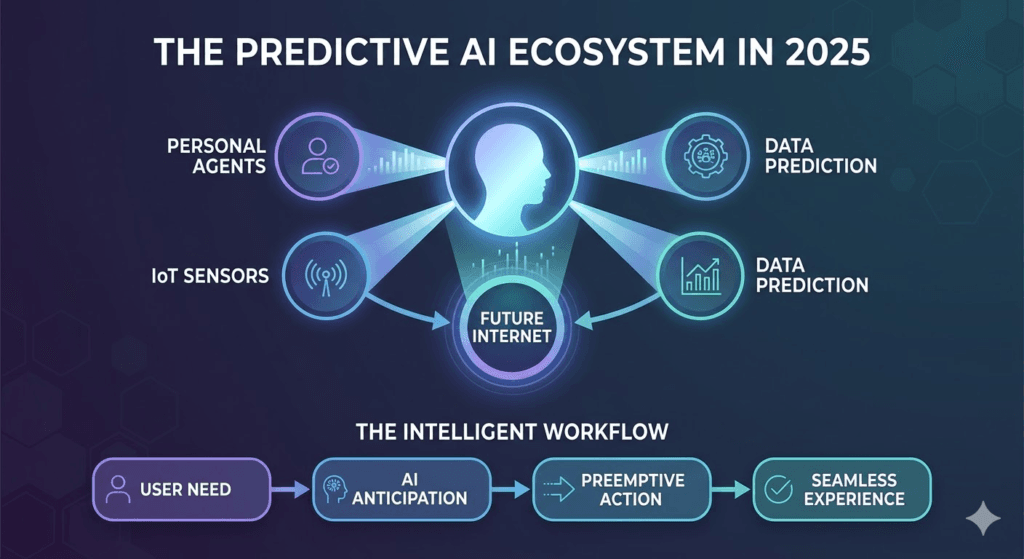
How to read this chart: Notice how the central user is no longer initiating every query. In 2025, the Data Prediction engine, constantly fed by IoT Sensors (from your wearables, home, and city), provides the context. Your Personal Agent interprets this context and takes Preemptive Action—automating the “Intelligent Workflow” that runs your life. The internet shifts from a tool you use to an environment you inhabit.
Pillar 2: The End of Screens (Spatial Computing)
The concept of “going online” will seem archaic by 2025. You are always online, because the internet is now spatial.
While virtual reality (VR) will have carved out niches for deep immersion (like fully simulated workspaces or advanced training), the breakthrough technology of 2025 is Augmented Reality (AR), or Spatial Computing. This means that high-fidelity data layers will be overlaid precisely on the physical world. This is not just Pokémon GO; this is complex architectural modeling visualized on an empty lot, real-time language translation subtitling a conversation, or repair schematics projected directly onto a broken appliance. The hardware will have stabilized into sleek, lightweight glasses or advanced contact lenses.
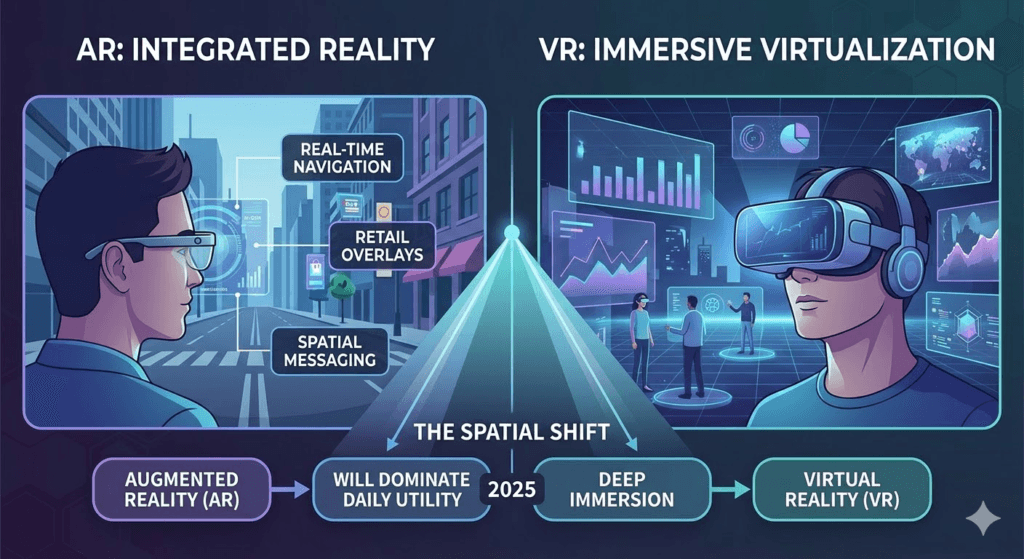
The key takeaway: This image, matching the futuristic aesthetic established in our first infographic (Image 0), shows a hybrid existence. By 2025, Integrated Reality (AR) will handle your daily utility: a walk down the street provides real-time data navigation and localized retail offers. But for deep work, complex data manipulation, or social virtualization, you will switch to Immersive Virtualization (VR), entering fully synthetic 3D environments. Your digital identity must move seamlessly between both.
Pillar 3: The Ownership Revolution (Decentralized Web3)
Perhaps the most disruptive shift—the “shock”—is not visual, but foundational. The internet of 2025 is moving away from centralization (where a few giant companies hold all data and user identity) toward decentralization (Web3).
In Web3, the infrastructure is built on blockchain technology. The goal is to return data ownership to the creator and the user. By 2025, your “login” is no longer a Google or Facebook account; it is your self-sovereign digital wallet. This wallet contains your identity, your assets (NFTs representing digital property or certifications), and your permissions. This architecture changes everything from social media monetization to how you interact with healthcare data.
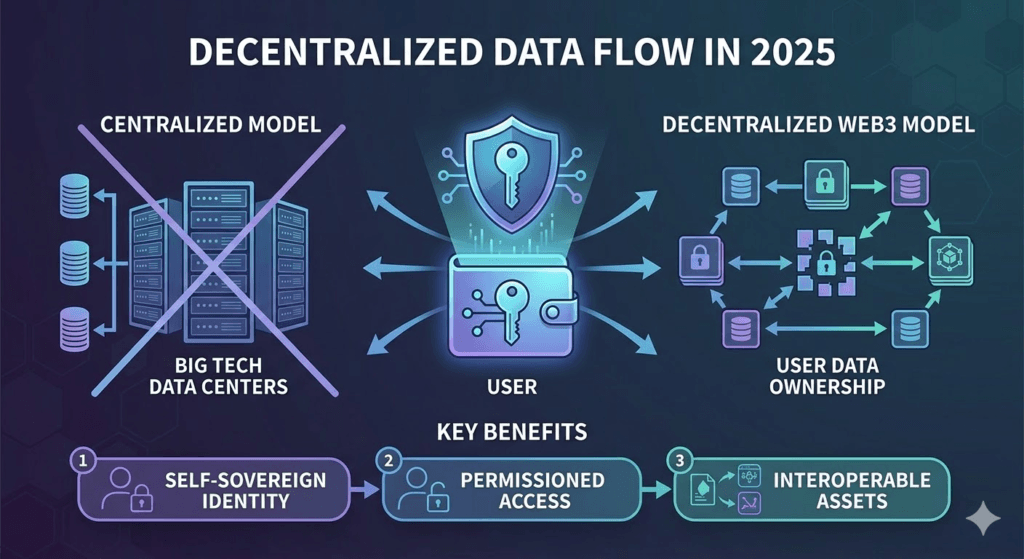
The key takeaway: This infographic, retaining the cool-toned, geometric style, contrasts the two models. We are crossing out the old “Centralized Model” where user data flows only into Big Tech silos. The new “Decentralized Web3 Model” centers on User Data Ownership, facilitated by a secure Identity Wallet. Your personal AI agent (from Image 0) relies on this wallet to access Permissioned Data securely, and any digital assets you acquire in Spatial Virtualization (Image 1) are truly yours, moving with you across the decentralized web.
In Summary
The future of the internet is not a gradual evolution; it is a convergence of intelligence, immersion, and ownership that will require us to adapt. The infrastructure visualised in these infographics—the predictive AI ecosystem, the integrated spatial computing landscape, and the decentralized ownership architecture—are all arriving by 2025.
By understanding how these systems interact, you move from being a passive subject of technological change to an active architect of your digital life. The future is almost here. Fasten your seatbelts.
The internet as we know it is evolving at lightning speed. From AI-powered everything to mind-blowing new tech, 2025 is set to be the year that reshapes how we live, work, and connect online.
Here are the 5 biggest internet trends you can’t afford to ignore:
1. AI Is Taking Over (But Not How You Think)
ChatGPT was just the beginning. AI is now writing code, creating hyper-realistic videos, and even replacing customer service jobs. The scary part? AI-generated content is flooding the web, making it harder to tell what’s real. Will we even trust the internet in a few years?
2. The Rise of “Invisible Apps”
Forget downloading apps—soon, you’ll just talk to AI assistants that do everything for you. Google, Apple, and OpenAI are racing to build AI that can book flights, order food, and manage your schedule without you lifting a finger. Is this the end of traditional apps?
3. TikTok’s Algorithm Is Rewiring Our Brains
Studies show that short-form video addiction is changing attention spans. The average person now struggles to focus for more than 30 seconds. Are we heading toward a future where nobody reads long articles (like this one)? 😅
4. The Dark Side of VR & the Metaverse
Meta’s VR push isn’t dead—it’s getting creepier. With ultra-realistic avatars and AI-generated virtual worlds, people are spending more time in digital spaces than real ones. Could this lead to a mass loneliness epidemic?
5. Internet Censorship Is Getting Worse
Governments and big tech are tightening control over online speech. AI moderation tools are flagging “harmful” content at record rates—but who decides what’s harmful? Free speech could be the next casualty of the digital age.
Are We Ready for What’s Coming?
The internet in 2025 will be faster, smarter, and more addictive than ever. But at what cost? Privacy, truth, and human connection are all at risk.
What do YOU think? Will these changes make life better—or are we heading toward a digital dystopia? Comment below!


Jili128 is my go-to for a quick gaming fix. It’s straightforward and gets the job done. No complaints from me! Find it here: jili128
Bet888vina, what’s the deal? Honestly, I’ve seen better. They got the basics covered, I guess, but nothing really stood out to me. It’s alright, nothing special in my personal opinion. Check it out for yourself at: bet888vina