
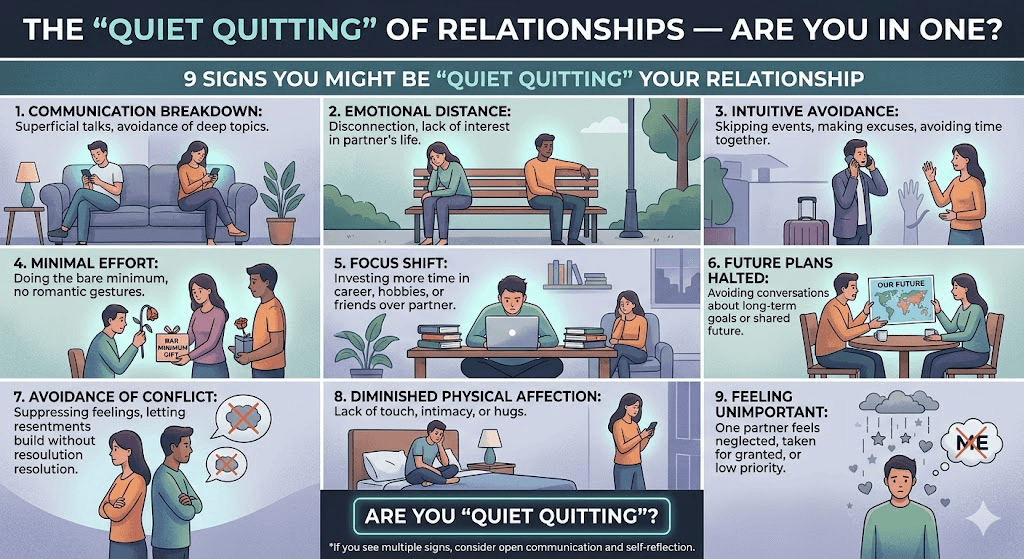
The “Quiet Quitting” of Relationships — Are You in One?
You’re still together. The calendar says so. But something has quietly slipped away — and you’re not sure when it happened, or who let go first.
“We’re fine.” That’s what they say. That’s what you say. But fine has started to feel like a ceiling, not a floor.
You’ve probably heard “quiet quitting” in the context of work — the idea that an employee stops going above and beyond without ever formally resigning. They show up. They do the bare minimum. They clock out, emotionally and literally. It became a cultural moment because it named something millions of people were already living but couldn’t articulate.
Now, the same thing is happening in our most intimate relationships — and we don’t talk about it nearly enough. Not because it isn’t painful. But because it’s invisible. There’s no breakup, no big fight, no dramatic exit. Just a slow, nearly undetectable retreat from the fullness of what love once was.
What does “quiet quitting” a relationship actually look like?
It’s not indifference from the start. That would be easier to name. Quiet quitting in a relationship usually happens after a period of unaddressed frustration, unmet needs, or repeated disappointments. At some point, one — or both — partners stops investing emotionally. Not in a moment of rage. In a quiet, almost rational decision to protect themselves.
Think of it as emotional self-preservation that masquerades as stability.
Why it’s so hard to catch in the moment
Here’s the cruel irony of relationship quiet quitting: it often feels responsible. You’re not being dramatic. You’re not causing scenes. You’re being mature, measured, and steady. Except what you’re actually doing is withdrawing — from vulnerability, from the risk of being hurt, from the messiness that real intimacy requires.
“You can be in the same bed and feel like strangers. That’s the loneliness no one warns you about.”
It also happens gradually enough that neither person can pinpoint exactly when things changed. That’s by design — not intentional design, but the natural design of how humans cope. We don’t always storm out. Sometimes we just… stop showing up with our whole selves. And then the absence becomes the new normal.
Are you the one who quietly quit — or the one being quietly quit on?
Both roles are painful. Both deserve honest reflection. Use this quick self-check to see where you land — tap the ones that feel true for you.
What causes it — and who’s “to blame”?
Blame is the wrong frame entirely. Quiet quitting in relationships usually emerges from a pattern, not a person. Unspoken resentments that calcify over time. A mismatch in how partners communicate needs. Life transitions — careers, kids, loss, stress — that quietly crowd out the relationship. Emotional wounds that never got tended to.
Sometimes one person initiates the withdrawal and the other responds in kind. Sometimes both pull back simultaneously. Either way, it becomes a loop: the less one partner shows up, the less safe it feels for the other to show up fully. And soon, you’re both performing a relationship neither of you is fully in.
The difference between a rough patch and quiet quitting
Every relationship goes through dry spells. Life gets hard. People get depleted. A temporary dip in connection isn’t the same as a structural retreat from the relationship itself. The difference is in the direction: are you both still leaning in, even imperfectly? Or has one of you — or both — fundamentally stopped trying?
What can actually be done about it
If you’ve read this far and felt that uncomfortable recognition — good. Awareness is always the beginning. Here’s what the path forward tends to look like.
Before any conversation with your partner, get honest with yourself. What are you actually feeling? What do you actually want? Fuzzy self-awareness leads to fuzzy conversations.
“You’ve been distant” lands differently than “I’ve been missing you.” Lead with what’s true for you, not what the other person has failed to do.
Ask questions you genuinely don’t know the answer to. What’s been hard for them lately? What do they miss? Couples therapy research consistently shows that curiosity is one of the most powerful reconnection tools.
You don’t have to solve five years of distance in one conversation. Share one real thing about yourself today. Ask one real question. Connection is rebuilt in small, repeated moments.
This is the hardest question. Reconnection requires two people willing to be seen and to risk. If one person is genuinely done, no amount of effort from the other will rebuild what’s been lost. That’s not failure — it’s honesty.
And if the answer is: maybe we’re done?
That’s a valid answer. A painful one, but valid. Sometimes quiet quitting isn’t a crisis to be fixed — it’s a relationship that’s honestly run its course, and both people have known for a while but haven’t said it yet. Recognizing that clearly, and with compassion, is its own form of courage.
The goal was never to stay together at all costs. The goal — always — is to live and love with honesty. Whether that means rebuilding what’s here or finding the grace to let it go.
The relationship worth fighting for is one where both people are fighting
Not against each other. For each other. For the version of the relationship that still feels possible — if you can both choose, again, to show up.


Comments are closed.