
Artificial Intelligence is evolving at an extraordinary pace. What once seemed like science fiction—machines that can write, create images, diagnose diseases, and drive cars—is now becoming a part of everyday life. But the current wave of AI innovation may only be the beginning.
Researchers, technology companies, and startups are working on the next generation of AI breakthroughs that could transform industries, economies, and society itself. From smarter AI models to human-like robots, the coming years may bring technological changes faster than anything we’ve experienced before.
As of March 2026, artificial intelligence isn’t just evolving—it’s accelerating into everyday infrastructure. After years of hype around chatbots and image generators, 2026 marks the shift from experimentation to execution. Frontier models are hitting new benchmarks, agentic systems are handling real workflows autonomously, and breakthroughs in efficiency and discovery are reshaping industries. Experts from Microsoft, IBM, Stanford, and MIT agree: this year, AI becomes a true partner, not just a tool.

Let’s explore some of the most exciting AI breakthroughs expected in the near future.
1. Artificial General Intelligence (AGI)
One of the most anticipated developments in AI research is Artificial General Intelligence (AGI)—a system capable of performing any intellectual task that a human can do.
Unlike today’s narrow AI systems that specialize in specific tasks, AGI would be able to:
- Learn new skills independently
- Solve unfamiliar problems
- Reason across different domains
- Adapt to new environments
Companies like OpenAI and Google DeepMind are actively researching AGI.
Tech leaders such as Sam Altman believe AGI could dramatically accelerate scientific discovery and global innovation.
2. AI That Can Think and Reason
Current AI models are excellent at recognizing patterns but often struggle with deep reasoning and logical thinking.
The next generation of AI systems aims to improve:
- Multi-step reasoning
- Complex problem-solving
- Strategic decision-making
These capabilities could allow AI to help with tasks such as scientific research, engineering design, and legal analysis.
3. AI-Powered Scientific Discovery
AI is already helping researchers discover new materials, medicines, and chemical compounds.
Companies like IBM and Microsoft are developing AI systems that can analyze enormous scientific datasets and identify patterns humans might miss.
Future AI breakthroughs may allow machines to:
- Discover new antibiotics
- Develop climate solutions
- Design advanced energy technologies
Some experts believe AI could reduce drug discovery timelines from decades to just a few years.
4. Human-Like AI Assistants
AI assistants are becoming increasingly powerful and personalized.
Future AI assistants may be able to:
- Understand context and emotions
- Manage complex tasks across devices
- Act as personal tutors or productivity coaches
Large language models like ChatGPT are already moving toward this vision by helping people write, research, and learn more efficiently.
5. AI-Generated Video and Virtual Worlds
AI-generated images have already taken the internet by storm. The next big leap is AI-generated video and fully immersive virtual environments.
This technology could revolutionize:
- Film and entertainment
- Gaming
- Education
- Marketing and advertising
Companies like Meta Platforms are investing heavily in AI-powered virtual experiences that could power the future metaverse.
6. Autonomous AI Agents
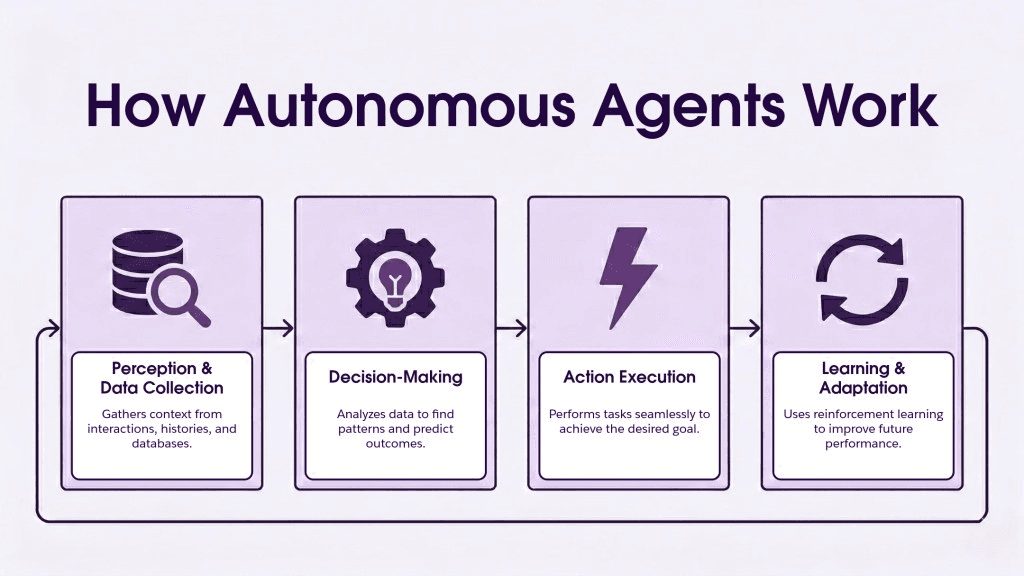
Another major breakthrough on the horizon is the rise of AI agents—systems that can perform complex tasks independently.
Unlike current tools that respond to prompts, AI agents could:
- Plan tasks
- Execute actions online
- Learn from results
- Improve over time
For example, an AI agent might research a topic, write a report, create visuals, and publish content automatically.
7. AI-Powered Robotics
Robots powered by advanced AI are expected to become far more capable in the coming years.
These machines could help with:
- Warehouse automation
- Elder care
- Disaster response
- Construction work
Companies like Tesla are already working on humanoid robots designed to perform everyday physical tasks.
8. Personalized AI in Healthcare
Healthcare may benefit from some of the most impactful AI breakthroughs.
Future AI systems could analyze a person’s genetic information, lifestyle, and medical history to create personalized treatment plans.
AI may also help doctors with:
- Early disease detection
- Medical imaging analysis
- Remote patient monitoring
This could lead to longer, healthier lives for millions of people.
9. Multimodal AI Systems
Next-generation AI models are being designed to understand multiple types of information at once.
These multimodal AI systems can process:
- Text
- Images
- Audio
- Video
- Data
This allows AI to interact with the world in a much more human-like way.
10. Safer and More Ethical AI
As AI becomes more powerful, researchers are focusing on making systems safer and more aligned with human values.
Organizations like the Future of Life Institute are advocating for responsible AI development.
Key areas of focus include:
- Preventing AI misuse
- Reducing algorithmic bias
- Ensuring transparency and accountability
Responsible development will play a crucial role in shaping the future of AI.
Looking Ahead: 2026 as the Inflection Point
No full AGI arrives this year—most experts agree—but capabilities saturate key benchmarks in coding, math, and reasoning. Models like Claude 5, Gemini 4, and GPT-6 push boundaries, with open-source narrowing gaps early before widening again.
The real breakthrough? AI woven into operations, augmenting humans 10x–100x. From autonomous labs revolutionizing discovery to agents as everyday infrastructure, 2026 isn’t about one big leap—it’s many small (and not-so-small) advances compounding into transformation.
The future isn’t coming—it’s deploying now. Stay adaptable; the winners will be those who orchestrate these agents, not just use them.
Agentic AI Takes Center Stage
The biggest story of 2026 is agentic AI—systems that don’t just respond but plan, act, and adapt autonomously. These “digital coworkers” execute multi-step tasks with minimal human input, from troubleshooting IT issues to orchestrating enterprise workflows.
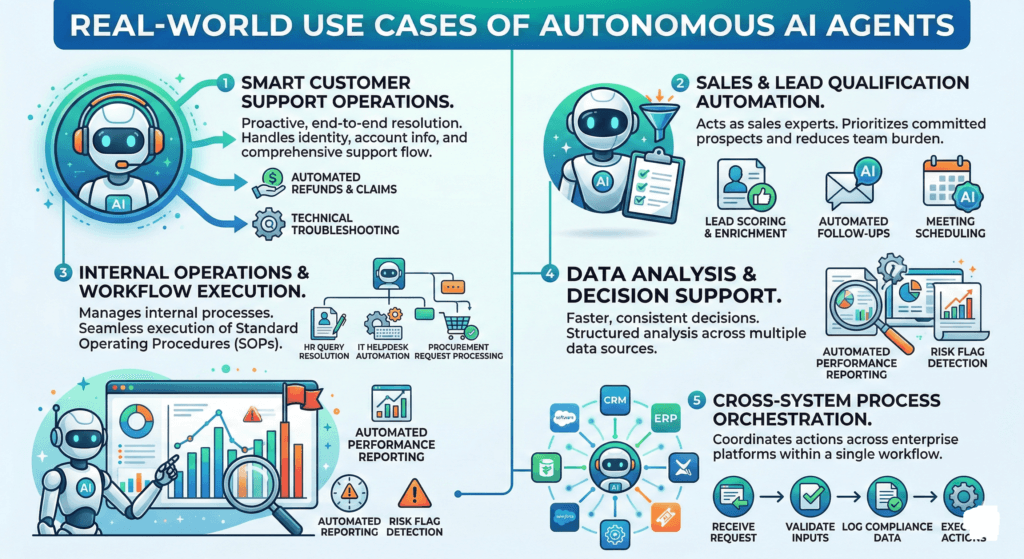
Microsoft predicts AI will actively join scientific discovery in physics, chemistry, and biology, while Gartner forecasts 40% of enterprise apps will incorporate task-specific agents by year-end (up from under 5% in 2025). Real-world examples already include autonomous agents handling sales lead qualification, customer support refunds, and cross-system orchestration.
We’re seeing the rise of multi-agent teams: agents delegating to sub-agents, forming an “agent economy.” This unlocks long-running, always-on autonomy—think reliable computer-use agents shopping or managing finances seamlessly.
Autonomous Agents in Science and Research
AI is no longer summarizing papers—it’s driving breakthroughs. Systems like evolved versions of AlphaEvolve combine LLMs with evolutionary algorithms to solve unsolved problems in math and algorithms, outperforming humans in some cases.
Microsoft Research highlights AI accelerating climate modeling, molecular dynamics, and materials design. Startups like Edison Scientific’s Kosmos are uncovering new insights in Alzheimer’s research by combing literature for novel discoveries. Expect more “AI research interns” and continual learning models that update post-deployment, pushing toward longer time horizons (METR predictions eye 24+ hours for complex tasks).
This could lead to a “ChatGPT moment” in medicine, with massive healthcare datasets enabling superhuman diagnostics and drug discovery.
Hardware and Efficiency Leaps
Compute remains king, but efficiency is the new frontier. Nvidia’s Rubin architecture arrives, while China’s domestic chips make strides toward closing the gap. IBM sees ASIC accelerators, chiplets, and even quantum-assisted optimizers maturing for agentic workloads.
On-device and edge AI go mainstream, powering personalized experiences without cloud dependency. Hyperscale data centers evolve into specialized supercomputers for frontier models, though energy demands spark debates on sustainability.
Photonic processors and other innovations promise extreme efficiency gains, potentially revolutionizing inference speed.

Multimodal and World Models Advance
2026 cements multimodal AI as standard—models handling text, images, video, voice, and sensor data seamlessly. Generative video matures beyond short clips, with world models enabling prompt-to-3D and playable generations.
Robotics catches up: embodied intelligence via RL through world models accelerates humanoid scaling. Full self-driving reaches new reliability levels, with Waymo and Tesla expanding everywhere.
Governance, Security, and Societal Shifts
As agents act independently, risks rise—malicious chaining for scams, deepfakes becoming routine, and AI-driven cyberattacks. Global regulators push for safeguards, with coordinated statements on deepfakes and provenance.
Yet optimism prevails: AI sovereignty grows as nations build independent stacks, and continual learning could shift compute toward inference-heavy paradigms. Economic measurements replace hype, tracking real productivity gains.