IIntroduction
IIn 2026, the creator economy stands as one of the most dynamic and transformative forces in the global digital landscape. What began as a fringe phenomenon — passionate individuals sharing content for niche audiences — has matured into a multibillion‑dollar economic ecosystem influencing marketing strategy, cultural trends, media consumption, and even macroeconomic policy.
This year’s InspireViral State of the Creator Economy Report brings together the latest data, expert analysis, and real‑world trends shaping how creators earn, build communities, adopt technology, and define the future of digital work.
1. The Creator Economy at a Glance: Size, Growth & Global Reach
2026 marks another year of substantial expansion for creator‑driven commerce.
- The global creator economy is valued in the hundreds of billions, with several independent research estimates placing its 2026 value between roughly $230B – $300B and continuing rapid growth thereafter.
- In the United States alone, ad‑spend tied to creator partnerships is projected to approach $44 billion in 2026, up from about $37 B in 2025 — a signal that brands now see creators as a core strategic channel rather than a peripheral campaign add‑on.
- More than 200 million people worldwide now identify as content creators, spanning social platforms, niche communities, education, newsletters, long‑form media, and commerce‑first ecosystems.
What this means: the creator economy is no longer a marginal workplace or aspirational side hustle — it’s a major economic structure with multiple layers of revenue, global participation, and sophisticated market dynamics.
2. Who Are the Creators of 2026? A Demographic & Professional Shift
The nature of creation has shifted from amateur posting to professional media entrepreneurship.
Aging & Maturing Audience
- Across major platforms, the largest audience segment now falls in the 25–34 age range, signaling a pivot from younger early‑adopters to creators and audiences who are more career‑oriented and monetization‑savvy.
Professionalization
- Survey data shows most creators are engaging regularly with their audiences — with roughly 85 % publishing new content weekly or more.
- Nearly half of surveyed creators reported year‑over‑year earnings growth in 2025 despite volatile platforms and rising competition.
Today’s creators are more likely to see their work as sustained entrepreneurship — investing in branding, strategic partnerships, and diversified revenue systems rather than chasing short‑term engagement spikes.
3. Monetization Realities: From Income Inequality to New Revenue Models
While growth continues, earning parity remains uneven across the creator landscape.
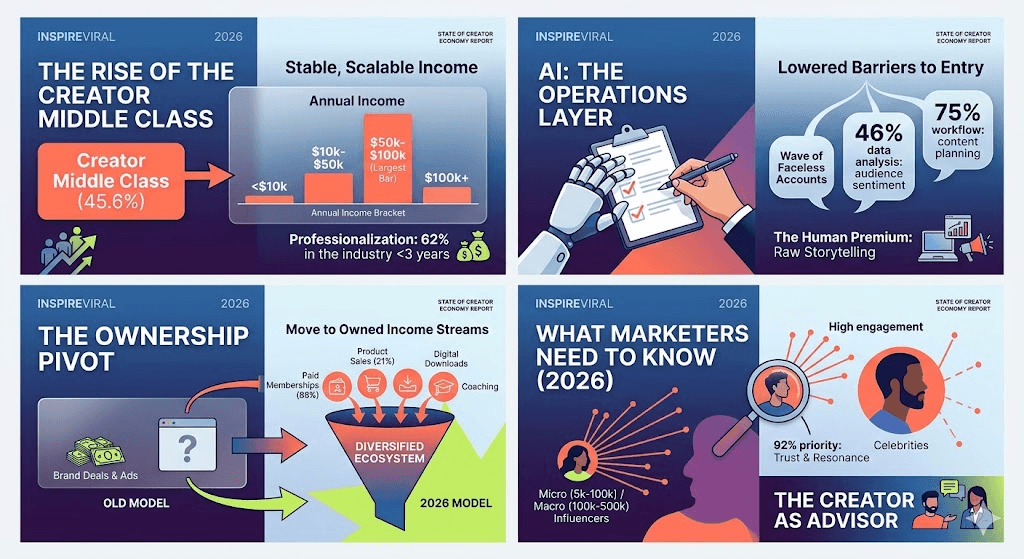
Emerging “Middle Class”
- Around 45 % of U.S. creators earn between $10,000–$100,000 annually, suggesting the rise of a creator “middle class” engaging in sustainable monetization beyond hobbyist income.
- However, nearly the same proportion (about **49 %) still report earning under $10,000 per year, underscoring the gap between visibility and financial stability.
Income Concentration
- Separate industry reports show that top creators are capturing a disproportionate share of brand revenue, with the top 10 % earning well over half of total ad payments in some networks.
Diversified Revenue Streams
Creators are no longer dependent on one monetization channel:
- Ad revenue and sponsorships still drive a significant percentage of total income.
- But product/merch sales, affiliate marketing, paid memberships, and digital services are rapidly growing business lines.
- Community‑based monetization — such as memberships and subscription platforms — now commands a dominant percentage of sustainable creator income, shifting creators toward recurring revenue models.
4. AI & Technology Adoption: Tools Shaping the New Creator Workflow
Artificial intelligence is no longer a futuristic concept in creator workflows — it’s now mainstream.
- A majority of creators report using AI to assist with content ideation, planning, editing, and productivity tasks.
- AI adoption isn’t simply about automating content — it’s enabling creators to scale production, optimize strategies, and manage complex operational workflows that were previously prohibitive for solo entrepreneurs.
Meanwhile, advanced creators and technology integrators are reporting that aggregated AI tool stacks can significantly increase revenue efficiency — not by churning out more content, but by amplifying engagement and tactical distribution.
5. Community, Trust & the Future of Creator Relationships
A meaningful transition in 2026 isn’t just about how many followers — it’s about what creators build with and for their audiences.
- High‑trust community platforms are emerging as the centerpiece of long‑term monetization — from member‑only content hubs to deeper relationship commerce.
- Industry commentary now emphasizes creator autonomy, genuine audience engagement, and long‑term partnerships over short‑term, metrics‑driven campaigns.
Creators who invest in owned audiences and membership value are more insulated against platform algorithm shifts, offering a hedge against the volatility that defined earlier years of the creator economy.
6. Challenges on the Horizon
Despite its growth, the creator economy isn’t without structural tension:
- Income disparity continues to grow as the top tier captures the lion’s share of brand dollars.
- Monetization clarity remains a barrier for emerging creators — with many struggling to negotiate brand deals or build predictable revenue flows.
- Payment timing, influencer compensation tracking, and contractual transparency are persistent pain points across the ecosystem.
Additionally, debates around transparency, FTC compliance for affiliate marketing, and ethical AI deployment are becoming central industry concerns as monetization sophistication grows.
7. Looking Ahead: What 2027 Holds for Creators & Brands
Macro growth will continue, with industry forecasts predicting exponential expansion of creator‑linked commerce, SaaS tooling, and platform ecosystems over the next decade.
Key trends for the immediate future include:
- Continued professionalization of creator roles
- Increasing brand integration into strategic business planning
- More AI‑enhanced content ecosystems
- A shift from transactional content toward IP, community, and long‑term business creation
Creators who succeed in this evolving landscape will be those who view themselves not just as influencers, but as entrepreneurs, media owners, and cultural leaders.
Conclusion
The InspireViral State of the Creator Economy Report 2026 shows an ecosystem maturing rapidly — structurally complex, economically substantial, and culturally influential. While challenges like income inequality and monetization clarity persist, the overall trajectory is clear: creators are building real, sustainable businesses that rival traditional media and marketing sectors.
This isn’t another bubble. It’s a foundational shift in how value is created, distributed, and consumed in the digital age.