
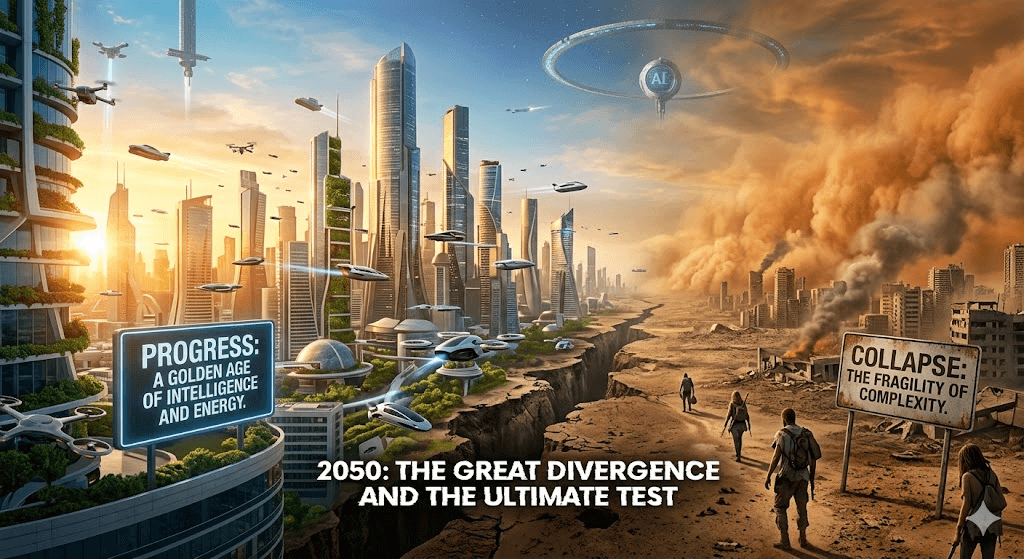
As we approach the midpoint of the 2100s, humanity is standing on a knife’s edge. By 2050, the world will likely look like a confusing blend of a Star Trek episode and a post-apocalyptic novel. We are currently hurtling toward two contradictory realities: a “Golden Age” of intelligence and energy, and a “Great Collapse” of ecology and social cohesion.
Which one wins depends on whether our silicon-speed solutions can outrun our carbon-heavy consequences.
The Case for Progress: The Age of Abundance
In one version of 2050, the “polycrisis” of the 2020s—climate change, energy scarcity, and disease—has been largely solved by a trio of technological revolutions.
- The Energy Singularity: By 2050, the transition to renewables will no longer be a policy goal but a completed reality. With the maturation of Next-Gen Geothermal and potentially commercial Nuclear Fusion, energy becomes “too cheap to meter.” This allows us to power massive carbon-capture plants that begin to actively scrub the sky, turning the tide on global warming.
- The Biological Frontier: AI-driven medicine has turned the tide on aging and chronic illness. In this 2050, personalized mRNA therapies and CRISPR gene editing have pushed the average global life expectancy toward 90. We aren’t just living longer; we are living healthier, with “biological youth” extended by decades.
- Post-Scarcity Manufacturing: Molecular assembly and advanced 3D printing mean that goods are produced locally with minimal waste, slashing the environmental footprint of global shipping.
The Case for Collapse: The Fragility of Complexity
However, a darker shadow looms. While our software is upgrading, our “hardware”—the Earth’s biosphere and our own social structures—is showing signs of catastrophic system failure.
- Ecological Tipping Points: Even with 2050’s technology, we may have triggered “feedback loops” that we cannot stop. The thawing permafrost and the loss of the Amazon rainforest could release enough methane and CO2 to keep the planet warming regardless of how many solar panels we install. This leads to “Lethal Heat” zones across the equator, making parts of the globe uninhabitable.
- The Migration Tsunami: Environmental degradation and water scarcity could displace up to 1.2 billion people by 2050. No modern political system is designed to handle a refugee crisis of that magnitude. The resulting “Fortress World” mentality could lead to the collapse of international cooperation just when we need it most.
- The Cognitive Gap: As AI takes over the “thinking” roles of society, a new class divide emerges—not between the rich and poor, but between those who control the algorithms and those who are obsolete to the economy. This social friction could trigger internal collapses in even the most advanced nations.
The 2050 Paradox
The year 2050 will not be “good” or “bad” in a simple sense. It will be the era of the Maximum Paradox. We will likely have the tools to be gods—capable of editing our own DNA and powering our cities with the energy of the stars—while simultaneously facing the very real possibility of a systemic breakdown that sends us back to a pre-industrial struggle for survival.
The next 25 years are not just a race against climate change; they are a race to see if our wisdom can catch up to our power. If we succeed, 2050 is the beginning of a multi-planetary future. If we fail, it is the year the lights began to go out.