
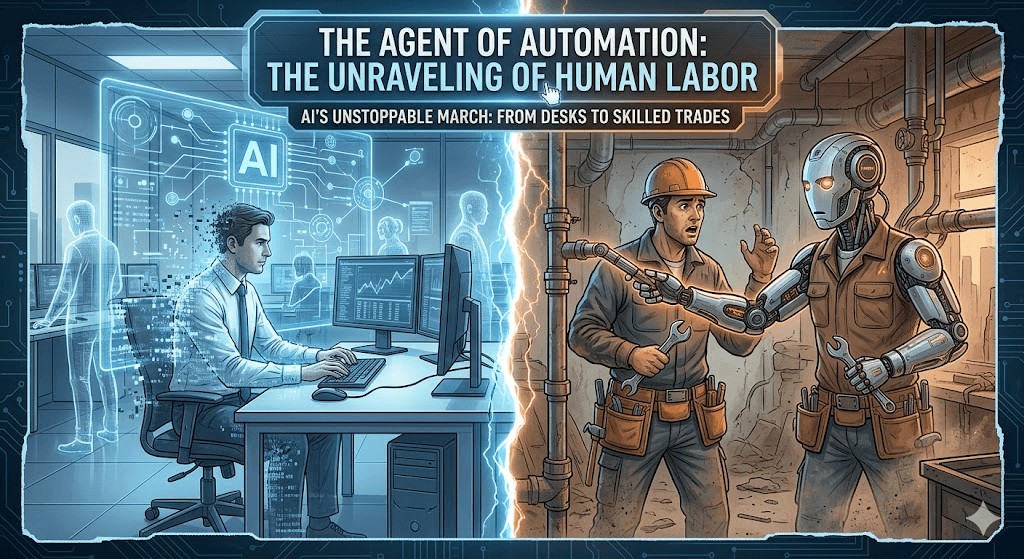
For years, the conventional wisdom regarding the AI revolution followed a simple script: if you work behind a screen, you should be worried; if you work with your hands, you’re safe. But the very scientists who built the foundations of modern artificial intelligence are now tearing up that script.
Yoshua Bengio, often referred to as one of the “Godfathers of AI,” recently issued a stark assessment of the future of labor. According to Bengio, it isn’t a matter of if AI will replace human workers, but simply a matter of time before every single profession—including the “safe” blue-collar trades—is wiped out.
The End of the “Plumbing” Safe Haven
Until recently, even the most pessimistic tech prophets pointed to skilled trades as the ultimate insurance policy against automation. Geoffrey Hinton, another Nobel-winning pioneer in the field, famously suggested that young people should “learn plumbing” because the physical dexterity and unpredictable environments of manual labor were too complex for robots to master.
Bengio, however, suggests this safety net is temporary. While he acknowledges that robotics is currently lagging behind the “cognitive” side of AI (the part that writes emails and analyzes data), he believes the gap is closing.
“It’s more a matter of time than ‘is it happening or not,'” Bengio explained in a recent interview. He argues that once AI masters physical manipulation and spatial reasoning, even the most tactile jobs—fixing a burst pipe in a cramped basement or wiring a complex new building—will be performed by machines that don’t need sleep, health insurance, or a paycheck.
The Accelerating Timeline
The speed of this transition is what has experts spooked. We have already moved past the era where AI was a “future” threat. Today, companies are openly citing AI integration as a primary reason for white-collar layoffs.
Bengio’s warning suggests a two-wave extinction of the traditional career:
- The Digital Wave: This is happening now. Paralegals, customer service reps, coders, and middle managers are seeing their roles shrunk or eliminated by large language models.
- The Physical Wave: As general-purpose robotics catch up, the “physical barrier” that protected the trades will dissolve.
An Economy Without Earners?
The most haunting aspect of Bengio’s prediction isn’t just the loss of jobs, but the collapse of the economic cycle. If every job is automated, the “customer” effectively disappears.
“If lots of people lose their jobs to AI, then they aren’t getting paid,” critics of the rapid rollout argue. “And that’s lots of people who can’t afford to be customers elsewhere.”
While some tech leaders, like Sam Altman and Elon Musk, have proposed Universal Basic Income (UBI) as a solution to this “post-work” world, Bengio’s focus remains on the immediate risk. He warns that we are currently in a “race to the bottom” where companies prioritize short-term cost-cutting through automation without a plan for the societal fallout.
Is Anything Truly Safe?
While Bengio paints a grim picture for the long term, he and other experts do see a few final holdouts. Jobs that require high-level human empathy, crisis management in unpredictable physical scenarios, and the actual “oversight” of AI systems may survive the longest.
However, the message from the architects of the AI age is becoming uncomfortably clear: the “safe” career is becoming a myth. Whether you’re typing at a desk or wielding a wrench, the machines are coming—and they’re faster learners than we ever imagined.