
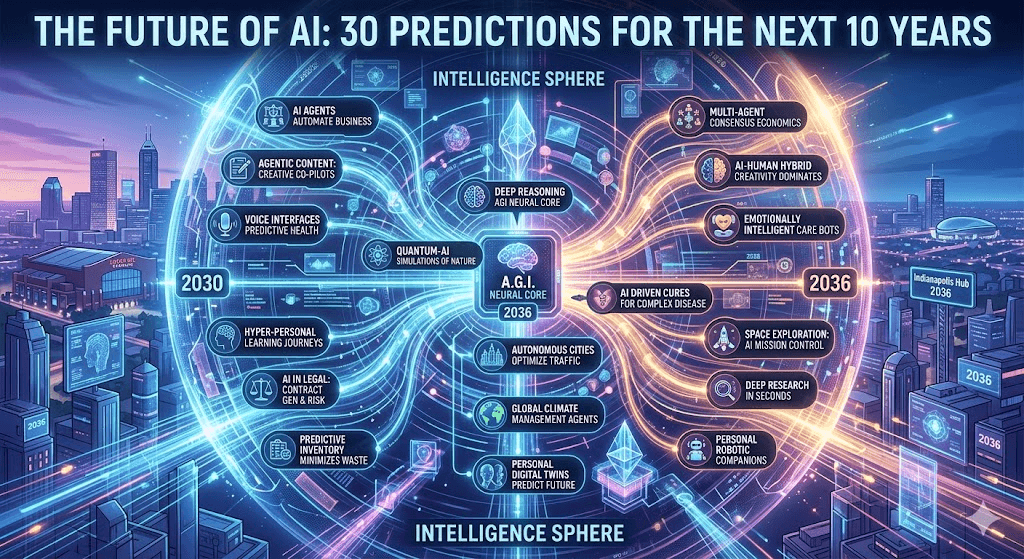
AI in 2026 is no longer experimental—it’s becoming infrastructure. Agentic systems handle complex workflows, multimodal models generate video and audio with near-Hollywood quality, and early humanoid robots pilot in warehouses. But what comes next? Over the next decade, AI will shift from powerful tools to collaborative partners, physical embodiments, and potentially transformative forces in science, economy, and society.
Drawing from current trends in agentic AI, robotics, efficiency breakthroughs, and expert forecasts, here are 30 bold yet grounded predictions for 2026–2036. These span technology, business, daily life, and global implications.
2026–2028: The Agentic and Multimodal Explosion
- Agentic AI becomes the default interface. By 2027, most professionals will interact with multi-agent systems that autonomously plan, research, execute tasks, and iterate with minimal supervision—handling everything from email triage to full project management.
- Multi-agent orchestration dominates enterprise workflows. Teams of specialized AI agents will collaborate on complex processes like drug discovery pipelines, supply chain optimization, and personalized patient care, delivering measurable ROI and compressing timelines dramatically.
- Video and multimedia generation reaches production quality. Tools evolving from today’s Veo, Runway, and Sora will produce consistent, physics-accurate long-form videos with sound and narrative coherence, disrupting Hollywood, advertising, and education content creation.
- AI coding agents replace junior developer roles. Autonomous coding systems (building on Cursor, Devin, and Claude) will handle full feature development, debugging, and deployment, boosting developer productivity 5–10x while shifting human roles toward architecture and oversight.
- Efficient, specialized models outperform massive general ones in many domains. Smaller, hardware-aware models running on edge devices or modest accelerators will deliver better cost-performance for specific tasks, making advanced AI accessible beyond big tech.
- AI-ready data and “knowledge layers” become the new competitive advantage. Organizations will prioritize high-quality, structured data foundations over raw model size, with context engineering emerging as a critical skill.
- Humanoid robots enter commercial pilots. Early deployments in warehouses, factories, and labs (from Figure, Tesla Optimus, and others) will prove safety and ROI, with thousands of units in controlled environments by 2028.
- Sovereign AI platforms rise globally. Dozens of countries will build or adopt region-specific AI infrastructure with proprietary data to reduce dependence on U.S. providers, accelerating geopolitical AI competition.
2029–2032: Physical AI, Reasoning, and Economic Transformation
- Physical AI and embodied intelligence mature. Robots with advanced world models will handle diverse real-world tasks, moving beyond narrow environments into homes and unstructured settings, with household robots becoming affordable (under $10,000 in some projections).
- AI accelerates scientific discovery exponentially. Systems will design experiments, predict outcomes, co-author papers, and identify novel drug candidates or materials in days or weeks instead of years, transforming R&D across biology, chemistry, and physics.
- Personal AI teams become ubiquitous and cheap. For the cost of a streaming subscription, individuals will have always-on AI assistants acting as tutors, advisors, coaches, and collaborators tailored to their preferences and history.
- Brain-computer interfaces move from experimental to practical. Non-invasive or minimally invasive links (advancing toward nanobot concepts) will enable direct thought-to-action for communication, control, and cognitive enhancement for medical and productivity uses.
- AI agents intermediate the majority of B2B transactions. By around 2030, AI-driven exchanges could handle trillions in procurement and commerce, with agents negotiating, comparing, and executing deals autonomously.
- Domain-specific models and vertical AI dominate key industries. Healthcare, legal, finance, and education will feature highly specialized agents outperforming general models, leading to personalized medicine, automated legal workflows, and adaptive learning systems.
- Energy and compute efficiency breakthroughs mitigate scaling bottlenecks. New architectures, sparse models, and hardware innovations will allow continued progress even as raw compute demands grow, though energy constraints will shape deployment strategies.
- Significant job transformation (not just displacement). AI will automate routine and cognitive tasks, creating new roles in AI oversight, prompt engineering, ethics, and human-AI collaboration, while prompting widespread reskilling initiatives.
- AI governance and risk frameworks become mandatory. “Death by AI” legal claims and regulatory scrutiny will drive standardized responsible AI practices, with organizations implementing rigorous guardrails and accountability measures.
2033–2036: Toward AGI-Level Capabilities and Human-AI Symbiosis
- Long-horizon planning and memory in agents reach advanced levels. AI systems will manage month- or year-scale projects with persistent memory, self-correction, and adaptation, blurring lines between tools and collaborators.
- Multimodal and spatial intelligence enables seamless virtual-physical integration. AI will deeply understand 3D environments, powering advanced AR/VR, digital twins, and mixed-reality experiences that feel indistinguishable from reality.
- AI contributes to “longevity escape velocity.” Breakthroughs in biology and personalized medicine (aided by AI) could extend healthy lifespans, with some forecasts suggesting annual gains in life expectancy through better disease prediction and treatment.
- Self-improving AI systems emerge under controlled conditions. Models will optimize their own architectures or code for efficiency, accelerating progress in narrow domains while raising alignment and safety questions.
- Quantum computing achieves practical advantage in specific AI tasks. Hybrid quantum-classical systems could solve optimization or simulation problems intractable for classical AI alone, boosting fields like materials science and cryptography.
- Global AI economic impact becomes precisely measurable. High-frequency “AI dashboards” will track productivity gains, job shifts, and new value creation at task and occupation levels, informing policy and business strategy.
- Ethical and societal debates intensify around critical thinking atrophy. Organizations may require “AI-free” assessments as over-reliance on generative tools potentially dulls human skills, prompting balanced human-AI education models.
- Agentic internet and billions of interconnected agents. Networks of hundreds of billions of AI agents could form new digital ecosystems for coordination, commerce, and problem-solving at planetary scale.
Broader Societal and Philosophical Shifts (Across the Decade)
- AI becomes embedded like oxygen in professional life. Describing “using AI” will feel as quaint as describing using electricity—every knowledge worker will have personalized systems attuned to their style and history.
- Regulatory and geopolitical tensions shape deployment. AI sovereignty, export controls, and international agreements will influence which models and capabilities are available where, potentially creating fragmented “AI worlds.”
- Creative and knowledge work evolves into curation and direction. Humans will focus more on vision, taste, ethics, and high-level strategy as AI handles execution, leading to new forms of art, science, and entrepreneurship.
- Risks of misalignment and unintended consequences are actively mitigated. Greater investment in interpretability (e.g., opening the “black box” via techniques like sparse autoencoders), safety evaluations, and provenance tracking will aim to keep advanced systems beneficial.
- Human-AI symbiosis redefines intelligence. By the mid-2030s, combined biological and cybernetic intelligence could expand human capabilities dramatically—potentially by orders of magnitude in some optimistic scenarios—while prompting deep questions about consciousness, identity, and purpose. True AGI timelines remain debated (with expert medians often clustering in the 2030s), but narrow superhuman performance in many domains will feel transformative long before then.
Navigating the AI Decade Ahead
These predictions reflect accelerating trends in scaling, efficiency, embodiment, and agency—but progress won’t be perfectly linear. Compute costs, energy limits, data quality, regulation, and unexpected breakthroughs (or plateaus) will influence the pace. Optimistically, AI could solve grand challenges in health, climate, and discovery; cautiously, we must prioritize safety, equity, and human agency.
The next 10 years will test our ability to steer powerful technology responsibly. The winners won’t just be those who adopt AI fastest, but those who integrate it thoughtfully while preserving what makes us human.
Which of these predictions excites or concerns you most? Do you think agentic AI or physical robotics will have the bigger impact by 2030? Share your thoughts in the comments.
Subscribe for ongoing AI analysis, trend updates, and practical guides to navigating the future. The decade of AI partnership is just beginning.