
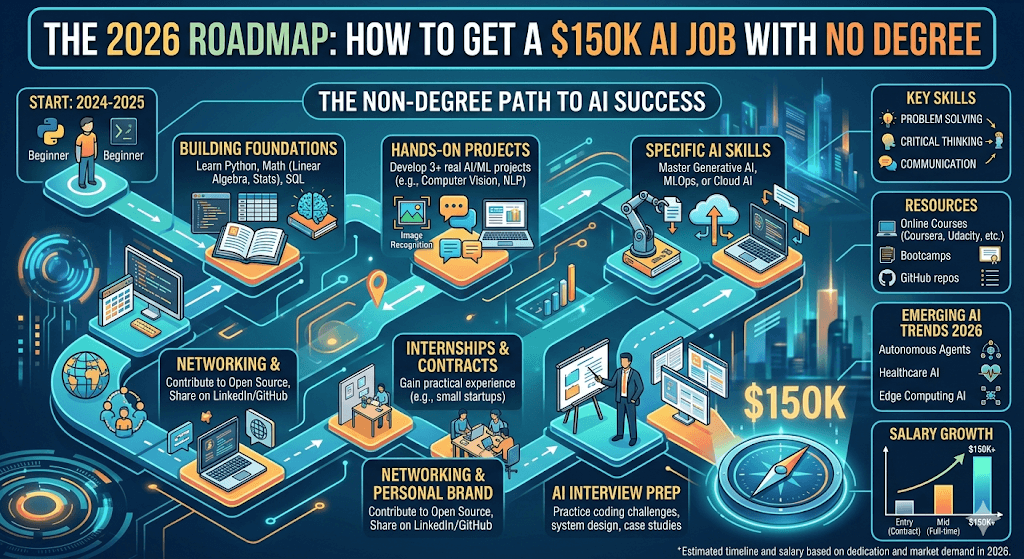
The 2026 Roadmap:
How to Get a $150K AI Job With No Degree
Forget the diploma. The AI industry is rewriting the rules of hiring, and the window for career changers to walk in is wide open — if you know where to step.
Let me tell you something that would have sounded absurd five years ago: in 2026, some of the highest-paid people in tech never set foot in a university lecture hall. They didn’t grind through four years of algorithms and data structures. They didn’t collect a diploma with fancy Latin on it. What they did do was pay attention — really pay attention — to where the world was heading, and then they positioned themselves there before everyone else caught up.
I’m talking about the AI job market. And right now, it’s unlike anything we’ve ever seen in the history of employment.
Companies across every industry — healthcare, finance, retail, manufacturing — are scrambling to find people who understand how to work with artificial intelligence. The demand is so intense and the talent pool so shallow that traditional gatekeeping (read: college degrees) is crumbling. Employers are choosing what you can do over where you studied, and that shift has created a once-in-a-generation opportunity for anyone willing to put in the work.
This isn’t a motivational pep talk. This is a step-by-step roadmap — built on real data, real salaries, and real hiring trends from 2026 — to help you go from where you are right now to a six-figure AI career.
Why the “No Degree” Path Is Real Right Now
Here’s the uncomfortable truth that universities don’t want you to hear: AI is moving so fast that traditional education can’t keep up. By the time a curriculum gets approved, printed, and taught, the technology it covers is already two generations old.
That’s not hyperbole. According to research from Gartner, one in four CIOs are actively planning to reduce degree requirements in their hiring. The share of job seekers pursuing AI and machine learning certifications has more than doubled — jumping from 17% in 2022 to 35% in 2024 — making it the second most popular certification specialty in the market.
And this tracks with what’s actually happening on the hiring floor. A recent study by EIT Campus identified multiple AI roles in the U.S. that require only two to four weeks of focused training. Not two to four years. Weeks.
“You’re not competing against people with 10 years of experience, because large language models haven’t been around for 10 years. This creates a unique window of opportunity for career changers.”Luisa Esposito, Project Manager, EIT Campus
That quote isn’t just encouraging — it’s structurally true. The most in-demand AI skills in 2026 didn’t exist in 2020. Nobody has a decade of experience in prompt engineering, RAG pipeline development, or agentic AI workflows. The playing field, for the first time, is genuinely level.
The Roles That Pay $150K+ (Without a Degree)
Not every AI job is created equal. Some require deep research experience and advanced math. Those aren’t your entry point. But there’s an entire category of high-paying roles that prioritize practical skill, domain expertise, and the ability to get things done — and they’re hiring right now.
| Role | Entry Salary | With 3–5 Yrs Experience | Degree Required? |
|---|---|---|---|
| AI Product Manager | $130K–$150K | $150K–$250K | No — portfolio + certs |
| Prompt Engineer | $95K–$138K | $140K–$180K | No — demonstrated skill |
| AI Automation Specialist | $85K–$110K | $130K–$175K | No — project portfolio |
| AI Ethics & Compliance | $105K–$140K | $150K–$220K | No — domain expertise valued |
| Generative AI Engineer | $120K–$150K | $160K–$220K | Sometimes — but portfolio first |
| AI Sales Engineer | $82K–$137K | $150K–$200K+ | No — sales experience valued |
Look at that table. Notice something? Every single role either doesn’t require a degree at all, or cares far more about what you’ve built than what’s written on your diploma. The AI Product Manager role is especially interesting — companies will happily pay $150K to someone who can translate business problems into AI solutions, even if that person’s background is in marketing, operations, or healthcare.
The 6-Month Roadmap: From Zero to Job-Ready
Alright. Here’s the part you actually came for. This is a realistic, month-by-month plan for someone starting from scratch — maybe you’re a marketing manager, a nurse, a teacher, a freelancer, or someone who’s just done with their current career. This roadmap assumes you can commit 10 to 15 hours per week while you keep paying the bills.
Start with Andrew Ng’s free AI for Everyone course on Coursera — it’s roughly six hours and gives you the mental models you need. Then pick up Google’s AI Essentials certificate. Don’t try to code yet. Your goal this month is fluency: you should be able to explain what a large language model does, what fine-tuning means, and why RAG matters — in plain English, to a non-technical person.
This is where most people make a critical mistake: they try to become an “AI generalist.” Don’t. The market pays specialists. If you come from sales, lean toward AI Sales Engineer. If you’ve managed teams or products, AI Product Manager is your lane. If you’re detail-oriented and care about fairness, look at AI Ethics. If you love building workflows and automating things, AI Automation Specialist is calling your name. Pick one and commit.
Not all certificates are created equal. Focus on credentials that hiring managers actually recognize: Google’s AI Product Manager Certificate (about 6 months but you can accelerate), Microsoft’s free AI Business School track, or IBM’s AI Developer Professional Certificate on Coursera. If you’re going the technical route, the AWS Certified AI Practitioner or Azure AI Fundamentals are strong signals. Two to three stacked certs in your chosen lane > one random degree.
This is the single biggest differentiator between people who get interviews and people who don’t. Build two to three real projects that demonstrate your chosen skill. Automate a real business process using AI. Build a prototype chatbot for a specific industry. Write a case study analyzing how a company should deploy AI. Put everything on GitHub or a personal website. Share your progress on LinkedIn. Nobody cares what school you went to when they can see, with their own eyes, what you’ve built.
Here’s something they don’t teach you in school (because they can’t): most jobs aren’t won through applications. They’re won through relationships. Join AI communities on Discord, Reddit, and LinkedIn. Attend virtual meetups. Comment thoughtfully on posts from people doing the kind of work you want to do. Offer to help on open-source projects. When a hiring manager sees your name pop up in an application, you want them to already know who you are.
Don’t blast 200 generic applications. Instead, identify 20 to 30 companies that are actively building AI teams — mid-size companies are often better than Big Tech for career changers because they’re more flexible on credentials. Tailor every application. Lead with your domain expertise and frame your career change as a strength, not a weakness. A nurse who understands healthcare AND AI is worth more than a fresh CS grad who’s never been inside a hospital. Your experience isn’t a liability. It’s your competitive moat.
The “Secret Weapon” Nobody Talks About: Domain Expertise
Here’s something that consistently gets overlooked in these conversations, and it’s the thing that will make the biggest difference for most of you reading this: the AI industry has a massive domain expertise gap.
Think about it. Companies don’t just need people who understand AI. They need people who understand AI and their specific industry. A law firm doesn’t want someone who can build a generic chatbot — they want someone who understands legal workflows, compliance requirements, and attorney-client privilege, and also knows how to apply AI to those workflows.
According to McKinsey, nearly half of business leaders identify skill gaps as the biggest barrier to AI adoption. That gap isn’t about Python proficiency. It’s about people who can bridge the translation between “what the AI can technically do” and “what the business actually needs.”
If you’ve spent 5 or 10 years in healthcare, finance, logistics, education, or legal — you already have something a fresh computer science graduate doesn’t: deep knowledge of real problems that need solving. Layer AI skills on top of that, and you become the rarest kind of hire: someone who understands both the problem and the tool. That combination commands premium salaries, often in the $150K to $300K range for consulting or specialist roles.
What Employers Are Actually Looking For in 2026
Let’s strip away the jargon and talk about what hiring managers actually care about when they’re filling AI roles. I’ve synthesized what multiple salary guides and hiring reports are saying, and it comes down to five things — and notice that “where you went to school” isn’t one of them.
A portfolio of real work. Hiring managers in AI consistently prioritize demonstrated ability over academic credentials. GitHub repositories, deployed projects, documented case studies, Kaggle competition results — these are your resume. They want to see that you’ve shipped something, not just studied something.
The ability to communicate AI to non-technical people. This is the skill that separates $100K earners from $200K earners. Can you explain to a CFO why an AI project is worth funding? Can you walk a product team through the trade-offs between different model architectures without making their eyes glaze over? If you can, you’re worth your weight in gold.
Cloud deployment experience. Knowing how to build an AI model in a Jupyter notebook is entry-level. Knowing how to get that model into production on AWS, Azure, or Google Cloud — with proper monitoring, version control, and retraining pipelines — is what companies are willing to pay a premium for.
An understanding of AI ethics and risk. As AI regulation increases globally, companies need people who can spot bias, ensure fairness, and navigate compliance frameworks. This isn’t just a nice-to-have anymore — it’s a financial necessity.
Speed of learning. In AI, what you knew six months ago might already be outdated. Employers want people who demonstrate a pattern of continuous learning and adaptability. Your certification stack and project timeline tell this story better than any transcript.
The Certifications Worth Your Time (and Money)
Not going to sugarcoat this: the certification landscape is noisy. Everyone’s selling a course. Here are the ones that actually carry weight with hiring managers in 2026, organized by investment level.
Google AI Essentials — foundational AI literacy, widely recognized. Microsoft AI Business School — free, takes 3 to 4 months, specifically designed for business professionals. Google Cloud AI/ML learning path — free coursework with optional $200 certification exam. Andrew Ng’s AI for Everyone — free to audit on Coursera, about 6 hours total.
IBM AI Developer Professional Certificate — $20/month on Coursera, roughly 6 months. Covers Python, Flask, and deploying AI apps. AWS Certified AI Practitioner — exam fee around $150, strong signal for cloud-focused roles. Azure AI Fundamentals (AI-900) — exam fee around $165, pairs well with the free Microsoft learning paths.
Google AI Product Manager Certificate — about $49/month for 6 months, includes real-world projects and connects directly to hiring partners. Deep Learning Specialization by Andrew Ng — if you’re going technical, this is still the gold standard. Coursera AI Strategy specializations from Stanford/Wharton — $39 to $79/month, 4 to 6 months, excellent for leadership-track roles.
Salary Realities: Honest Numbers, No Fluff
Let me give you the straight numbers based on multiple 2026 salary reports. The average base salary for an AI engineer in the U.S. sits somewhere between $140,000 and $185,000 — with total compensation (including bonuses and equity) pushing well past $200,000 for mid-career professionals.
For self-taught professionals and career changers without formal degrees, the data suggests a realistic salary ceiling around $150,000 to $180,000 — which is still extraordinary by any standard, and that ceiling gets raised the moment you add domain expertise or leadership skills to your toolkit.
Here’s the thing that most salary articles won’t tell you: specialization is what drives the biggest jumps. Generative AI engineers — the people who can fine-tune foundation models, build RAG pipelines, set up guardrails, and evaluate outputs in a business context — are commanding the biggest premiums right now. Over three-quarters of AI job listings now prioritize deep specialists over generalists. Pick a lane and go deep.
“Skill velocity matters more than credentials. In AI, what you can build often outweighs where you studied.”Rebellion Research, 2026 AI Jobs Report
The Three Biggest Mistakes Career Changers Make
Mistake #1: Trying to learn everything. You don’t need to understand transformer architecture at the mathematical level to get an AI Product Manager job. You don’t need to master PyTorch to be an AI Ethics Specialist. Match your learning depth to your target role. Go wide enough to be literate, then go deep in your specific lane.
Mistake #2: Waiting until they feel “ready.” You will never feel ready. The people who land these roles aren’t the ones who finished one more course or read one more article. They’re the ones who started building, started sharing, and started applying before they felt 100% confident. Confidence comes from action, not preparation.
Mistake #3: Hiding their previous career. Your years in healthcare, finance, education, law, or whatever field you’re coming from are not a weakness. They are your single greatest competitive advantage. Companies are desperate for people who understand real-world business contexts. Lead with your experience, don’t bury it.
Where to Find These Jobs
The geography of AI hiring is broader than most people think. Yes, San Francisco, Seattle, Austin, and New York still pay the highest salaries. But remote work has democratized access, and emerging markets like Denver, Atlanta, and Boston offer competitive salaries with significantly lower cost of living.
Beyond location, think about company size. Mid-market companies (500 to 5,000 employees) are often your best bet as a career changer. They need AI talent badly, they move faster in hiring, and they’re typically more flexible on credentials than Fortune 500 companies with rigid HR processes. They’re also more likely to let you wear multiple hats, which accelerates your learning and your resume.
The Window Won’t Stay Open Forever
I want to be direct about something: the opportunity that exists right now is structurally unusual. Large language models are relatively new. The roles they’ve created are relatively new. The certification pathways are relatively new. Right now, someone with six months of focused study can genuinely compete for roles that pay $130K to $180K.
That won’t always be the case. As more people enter the field, as university programs catch up, as hiring managers develop better filters — the bar will rise. It always does. The people who move now, while the barrier to entry is at its lowest point, will be the ones who have “3 years of AI experience” on their resume when everyone else is just starting their first course.
You don’t need permission. You don’t need a degree. You don’t need to be a genius. You need a plan, the discipline to follow it, and the willingness to start before you’re ready.
The roadmap is in front of you. The question is whether you’ll act on it.
Ready to Start Your AI Career?
Bookmark this guide, share it with someone who needs to see it, and block out your first learning session this week. Six months from now, you’ll be glad you started today.
Share This Roadmap →