The SEO landscape in 2026 looks nothing like it did even two years ago. Google’s AI Overviews now dominate many searches, zero-click results are the norm, and core updates (including the brutal March 2026 rollout) continue to reward genuine expertise while punishing thin, spammy, or purely AI-generated content. E-E-A-T (Experience, Expertise, Authoritativeness, Trustworthiness) isn’t just a guideline anymore—it’s one of the strongest ranking signals. Mobile-first indexing, Core Web Vitals, and entity-based understanding rule the game.
Yet countless site owners and marketers are still falling into the same old traps that worked in 2020 but actively hurt rankings today. The result? Dropping visibility, lost traffic, and frustrated teams watching competitors pull ahead.
Search Engine Optimization has evolved dramatically in recent years. With AI-driven search, smarter algorithms, and increasing competition online, strategies that worked five years ago may actually hurt your rankings today.
In 2026, successful SEO is about quality, relevance, user experience, and authority — not shortcuts.
Yet many bloggers, marketers, and website owners still make critical SEO mistakes that prevent their content from ranking on Google.
If your website traffic is not growing, you might be making one of these errors.
Let’s look at the five biggest SEO mistakes in 2026 — and what you should do instead.
Here are the 5 most damaging SEO mistakes still happening in 2026—and exactly what to do instead for sustainable, future-proof results.
Mistake #1: Keyword Stuffing and Over-Optimization
You know the type: pages crammed with the same keyword repeated 15+ times in unnatural sentences, meta descriptions that read like robot speak, and H2s stuffed to the brim.
Why it tanks your rankings in 2026 Modern algorithms (powered by NLP and AI) instantly detect manipulation. Keyword density tools are outdated because search engines now prioritize natural language and actual helpfulness. Stuffing makes content unreadable, spikes bounce rates, and triggers helpful-content filters. In the AI search era, over-optimized pages get ignored by generative summaries entirely.
What to do instead
- Use your primary keyword naturally (usually once in the title, intro, and a couple of headings) and rely on semantic variations, LSI terms, and related entities.
- Write first for humans—read it aloud. If it sounds awkward, rewrite it.
- Tools like Google’s Natural Language API or Surfer/Frase can flag over-optimization without forcing density targets.
- Focus on topical depth: cover sub-questions users actually ask rather than repeating the same phrase.
Result: Content that flows, ranks higher, and gets cited in AI Overviews.
Mistake #2: Ignoring Search Intent and User Context
You target “best project management tool” with a listicle full of features, but users searching that term in 2026 actually want comparison tables, pricing breakdowns, integration guides, and real-user case studies for mid-sized teams.
Why it tanks your rankings in 2026 Google and AI engines understand conversational context better than ever. If your page doesn’t match the exact intent (informational, navigational, transactional, or commercial investigation), it gets buried—even if you rank temporarily. AI summaries pull only from pages that directly answer the “why” and “how” behind the query.
What to do instead
- Map every keyword to its dominant intent using SERP analysis (look at what currently ranks: listicles? Tutorials? Product pages?).
- Structure content around user questions: use clear headings that mirror search queries (“How to Choose…”, “Pros & Cons for…”, “2026 Pricing Guide”).
- Add practical elements: comparison tables, step-by-step walkthroughs, embedded calculators, or video demos.
- Use tools like AnswerThePublic, AlsoAsked, or Google’s “People Also Ask” to uncover hidden sub-intents.
When your content perfectly satisfies the user’s goal, you win both traditional clicks and AI citations.
Mistake #3: Neglecting Page Speed, Core Web Vitals, and Mobile Experience
Slow loading times, giant unoptimized images, intrusive pop-ups, and desktop-only layouts are still shockingly common.
Why it tanks your rankings in 2026 Core Web Vitals (especially Interaction to Next Paint) are direct ranking factors. Mobile-first indexing means Google judges your site by its mobile version. AI Overviews favor fast, frictionless experiences because users expect instant answers. A 1-second delay can increase bounce rates dramatically and kill any chance of being selected for generative results.
What to do instead
- Run Google PageSpeed Insights and Lighthouse audits monthly. Aim for green scores across Largest Contentful Paint, Cumulative Layout Shift, and INP.
- Implement modern optimizations: WP Rocket or similar caching, WebP/AVIF images with lazy loading, CDN, code minification, and reduced third-party scripts.
- Ensure fully responsive design—test with Google’s Mobile-Friendly Test and real devices.
- Prioritize server response time (choose fast hosting) and eliminate render-blocking resources.
Fast, smooth sites don’t just rank better—they convert better and signal quality to both Google and AI systems.
Mistake #4: Publishing Low-Quality or Unsupervised AI-Generated Content (Ignoring E-E-A-T)
Mass-producing 50 AI-written blog posts per month with generic “Team” bylines, no sources, and zero original insights.
Why it tanks your rankings in 2026 The March 2026 Core Update and ongoing helpful-content systems specifically target thin, AI-spun content lacking real expertise. Pure AI output fails E-E-A-T signals: no lived experience, no unique data, no author credibility. Google now rewards human-first content with clear expertise signals; AI-only pages are getting decimated in visibility.
What to do instead
- Treat AI as a research and drafting assistant only—never publish raw output.
- Add strong E-E-A-T signals: detailed author bios with credentials and photos, original research/data, first-person experience stories, citations from reputable sources, and updates with “Last updated” dates.
- Create fewer, higher-quality pieces written or heavily edited by subject-matter experts.
- Incorporate multimedia (original images, videos, infographics) and structured data (schema markup) to help AI engines understand and cite your content accurately.
Human content with real expertise doesn’t just survive—it dominates in 2026.
Mistake #5: Treating Content as “Set It and Forget It”
Publishing once and never updating, even as data changes, algorithms evolve, or competitors release fresher guides.
Why it tanks your rankings in 2026 Freshness is a stronger ranking signal than ever. Outdated stats, broken links, or stale information make pages irrelevant to both users and AI summarizers. Google favors sites that demonstrate ongoing authority through regular updates—especially in fast-moving industries.
What to do instead
- Schedule quarterly content audits using Google Search Console (sort by dropping impressions/CTR) and Analytics.
- Refresh high-performing pages: update statistics, add new sections, include 2026-specific insights, fix links, and expand with new multimedia.
- Repurpose top content into video (YouTube is exploding for traditional SEO in 2026), infographics, or FAQ schema.
- Build a content calendar that includes “evergreen maintenance” alongside new posts.
Treating content as a living asset keeps your site authoritative and visible year after year.
The 2026 SEO Mindset Shift
Stop chasing shortcuts. The winners in 2026 build topical authority through helpful, expert, fast-loading, intent-matched content that works for both humans and AI. They invest in E-E-A-T signals, technical excellence, and continuous improvement rather than volume or manipulation.
Quick action plan to fix these mistakes today:
- Audit your top 10 pages for keyword stuffing and intent match.
- Run a full site speed and mobile test.
- Add author bios and update your 5 oldest high-traffic articles.
- Start creating one human-first, multimedia-rich piece this week.
SEO in 2026 is no longer about shortcuts or outdated tactics.
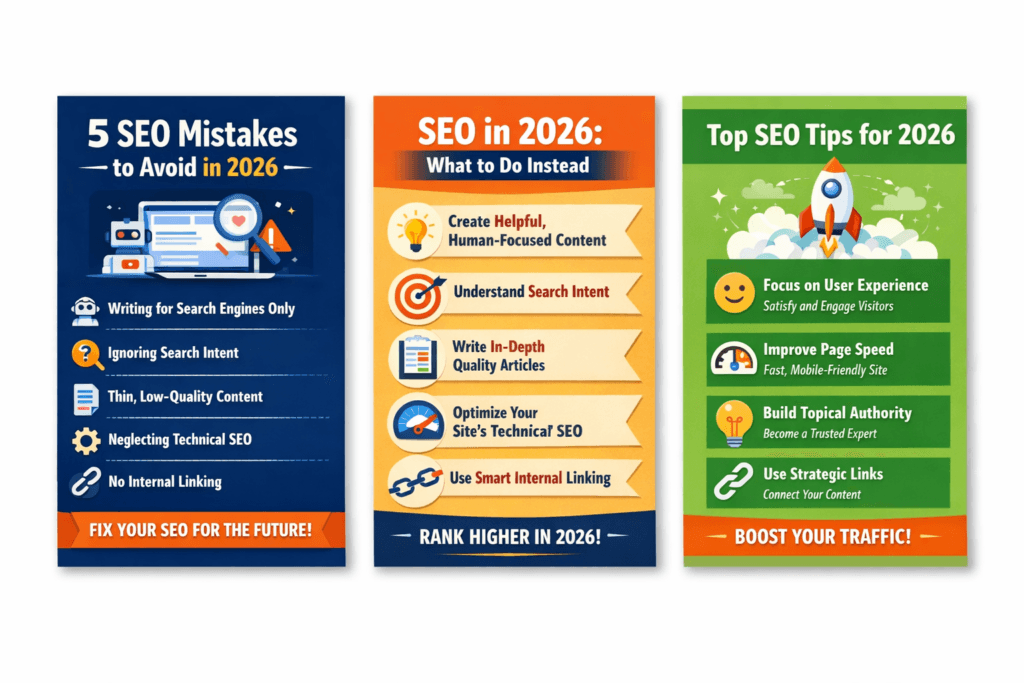
If you want your website to rank and attract consistent traffic, avoid these five mistakes:
- Writing content only for search engines
- Ignoring search intent
- Publishing thin content
- Neglecting technical SEO
- Forgetting internal linking
By focusing on quality, relevance, and user experience, you can build a website that ranks higher and attracts long-term organic traffic.
Remember: the goal of SEO is not just to rank — it is to help users find the best answers online.
SEO in 2026 rewards the patient, the authentic, and the user-obsessed. Stop making these mistakes—and start building an asset that compounds for years.
What’s the biggest SEO mistake you’ve caught on your own site lately? Drop it in the comments—I read every one.