
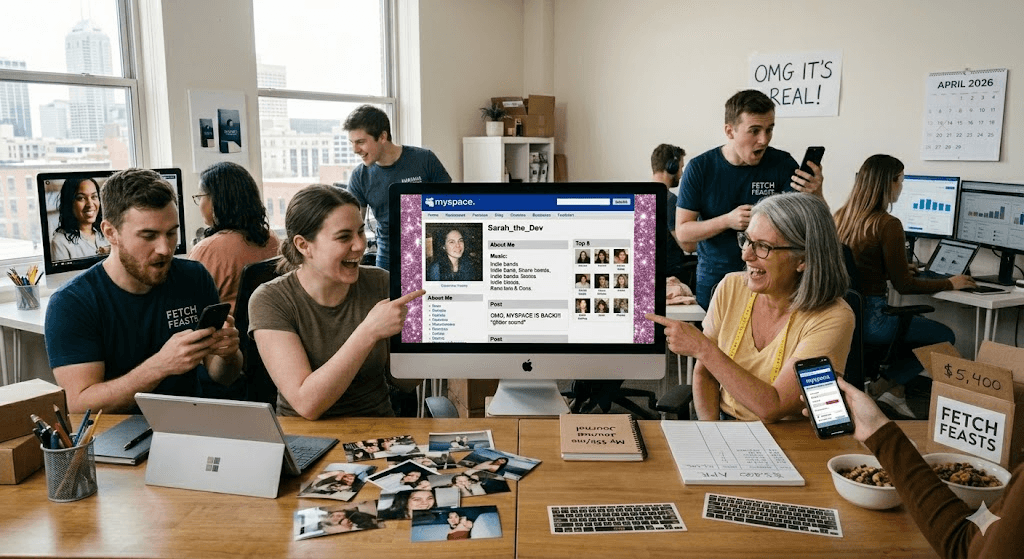
MySpace Is Back — And
Millennials Are Losing Their Minds
The social network that taught a generation how to be chronically online is making its most unexpected comeback yet — and yes, your Top 8 still matters.
“It was ugly, it was chaotic, it had auto-playing music that violated your eardrums — and it was the greatest social network that ever existed.”
Somewhere between your third cup of coffee and your fourteenth Instagram scroll, something happened this week that stopped millennials dead in their tracks: MySpace announced it’s relaunching — rebuilt from the ground up, with new features, a new mission, and yes, the promise of getting your Top 8 back.
The internet exploded. Twitter (fine, X) trended. Facebook groups — the ones that haven’t been abandoned like digital ghost towns — erupted with disbelief. “Wait, is this real?” was the most-typed sentence in America for about four hours. And then came the tears. The happy, nostalgic, embarrassingly sincere tears of a generation that grew up learning who they were through a profile page with a glittery background and a fallout boy song.
But before we get into why this matters and what the new MySpace actually looks like, let’s pour one out for what MySpace was — and why none of us have ever fully gotten over it.
The era that built us
If you were between 12 and 25 in the mid-2000s, MySpace wasn’t just a website. It was your first digital bedroom. You arranged your Top 8 with the strategic precision of a chess grandmaster. You stayed up until 2 AM perfecting your “About Me” section to sound deep but also cool. You wrote song lyrics in your bio that were a thinly veiled message to your crush. You know exactly what we’re talking about.
At its peak, MySpace had over 100 million users and was the most visited website in the United States — outranking even Google. It wasn’t just social media. It was the internet for an entire generation. It’s where bands you love today got their first fans. It’s where you learned HTML by accident just to put a sparkle cursor on your page. It’s where you posted photos from your flip phone that should never, under any circumstances, see the light of day again.
And then Facebook happened. Clean, white, adult, controlled. And slowly, painfully, everyone migrated. MySpace didn’t just lose — it died with all of your embarrassing memories still trapped inside it.
For a lot of millennials, losing MySpace felt weirdly like losing a childhood home. All that messy, chaotic, embarrassing evidence of who you were becoming — just gone. The new MySpace is a chance to have that space again, but this time, to actually own it.
— A very emotional millennial who definitely still remembers their password (it was probably “password1”)So what is the new MySpace, exactly?
Here’s where things get interesting. The new MySpace isn’t trying to be Facebook or TikTok or Instagram. It’s not chasing the algorithm. In fact, one of its biggest selling points is that it’s going deliberately against the grain of everything modern social media has become.
Why now? Why does this actually make sense?
We’re living through a very specific cultural moment. People are exhausted by the internet. Instagram makes us feel bad about our bodies. TikTok hijacks our entire afternoon. X is a slow-motion disaster. Facebook is for your aunt’s casserole photos. LinkedIn is… LinkedIn. The whole landscape feels like it was designed by people who forgot that the internet is supposed to be fun.
Meanwhile, millennials — now solidly in their 30s and early 40s — are gripped by a very specific kind of nostalgia. Not just for the music or the movies or the flip phones, but for a time when online felt personal. When your profile actually represented you, not an optimized, filtered version of you designed to get engagement metrics up.
The new MySpace is betting on something radical: that people want to own their little corner of the internet again. That chronological feeds and intentional connection will always beat algorithmically manufactured virality. That authenticity — even messy, overcustomized, animated-gif authenticity — is worth something.
And honestly? They might be right.
A brief timeline of the fall and rise
How the internet is reacting
Should you actually care?
Here’s the honest answer: maybe. And that “maybe” is doing a lot of work.
If you’re a millennial who genuinely misses having a digital space that feels like yours — one without ads pretending to be posts, without an algorithm deciding your worth by impressions, without the pressure to perform for a faceless mass audience — then yes. The new MySpace is worth your genuine attention.
If you’re a musician, an artist, a creative who’s been burned by every platform that promised to amplify your work and then buried it unless you paid to boost — this new music-first approach is worth watching closely.
But let’s be clear-eyed too. Nostalgia is powerful and often misleading. The original MySpace wasn’t perfect. It was chaotic, sometimes toxic, and riddled with spam. The question is whether the new iteration has learned from those failures while keeping what made it magical — the sense that the internet could be a place for genuine self-expression, not just personal branding.
We’re cautiously, emotionally, probably-going-to-spend-three-hours-on-our-profile optimistic. And honestly? That feeling alone — that flicker of genuine internet excitement — might be the most valuable thing MySpace has already delivered, before a single user even signs up.
Did this take you back?
Share this article with someone who remembers spending 45 minutes picking the perfect profile song. They need to know.

Comments are closed.