Artificial Intelligence (AI) and Machine Learning (ML) are two terms that are often used interchangeably in tech conversations—but they are not the same. While closely related, they serve different purposes and have distinct functionalities. Understanding the difference is crucial for businesses, tech enthusiasts, and anyone curious about how modern technology works.
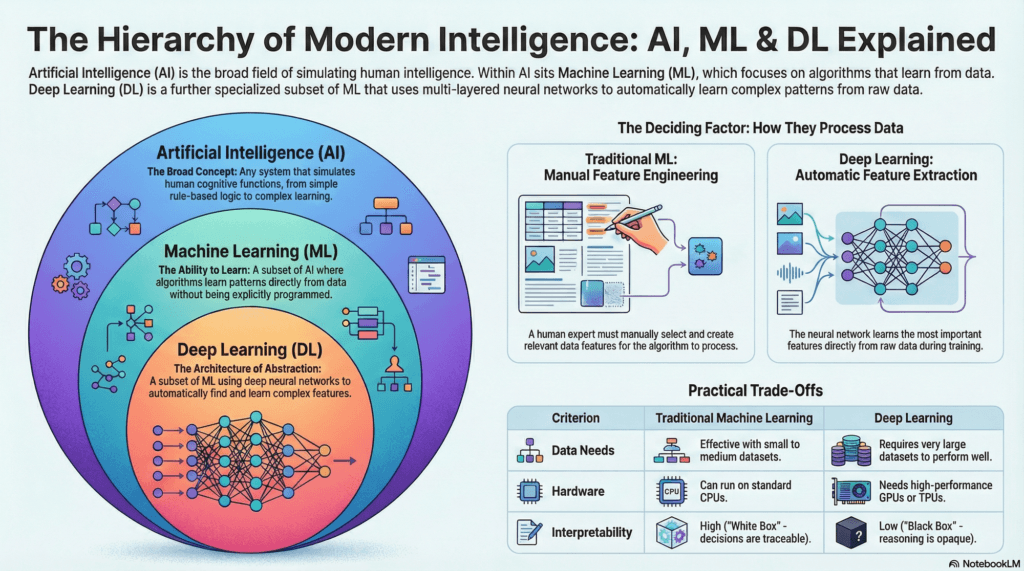
What is Artificial Intelligence?
Artificial Intelligence is the broader concept of creating machines or systems that can mimic human intelligence. AI systems can perform tasks such as:
- Problem-solving
- Understanding natural language
- Recognizing patterns and images
- Making decisions
In essence, AI is about teaching machines to think and act like humans, even if the process isn’t exactly like human reasoning. AI can be rule-based, where decisions follow pre-defined rules, or learning-based, where the system improves over time.
Real-World Examples of AI:
- Virtual Assistants: Siri, Alexa, and Google Assistant respond to voice commands.
- Autonomous Vehicles: Tesla’s self-driving technology uses AI to navigate traffic.
- Recommendation Engines: Netflix and Spotify suggest content based on user behavior.
What is Machine Learning?
Machine Learning is a subset of AI that focuses specifically on learning from data. Instead of programming a system with explicit instructions, ML allows machines to improve their performance as they process more data. This means the system can adapt and become smarter over time without being reprogrammed.
Key Types of Machine Learning:
- Supervised Learning: The model is trained on labeled data (input + correct output). Example: Email spam filters.
- Unsupervised Learning: The model finds patterns in unlabeled data. Example: Customer segmentation in marketing.
- Reinforcement Learning: The model learns by trial and error to maximize rewards. Example: AI in game playing, like AlphaGo.
Real-World Examples of ML:
- Predicting stock prices using historical data
- Detecting fraudulent credit card transactions
- Personalized product recommendations on e-commerce platforms
AI vs ML: Key Differences
| Feature | Artificial Intelligence | Machine Learning |
|---|---|---|
| Definition | Broader concept of machines performing intelligent tasks | Subset of AI that learns from data |
| Approach | Can be rule-based or learning-based | Data-driven, improves over time |
| Goal | Mimic human intelligence | Make predictions or decisions based on patterns |
| Examples | Chatbots, self-driving cars | Fraud detection, recommendation systems |
How They Work Together
While AI and ML are different, they are deeply connected. Machine Learning is what enables AI systems to learn and improve. For instance:
- A chatbot (AI) becomes more accurate over time using ML algorithms.
- An autonomous car (AI) uses ML to recognize objects and predict movements.
In short, ML is the engine that powers AI’s learning capabilities.
Why the Difference Matters
Understanding the distinction between AI and ML is not just a technicality—it affects:
- Business strategy: Choosing AI solutions vs ML tools depends on your needs.
- Career paths: AI focuses on cognitive systems and decision-making, ML emphasizes algorithms and data modeling.
- Innovation potential: Knowing the difference helps identify opportunities where each can add value.
More Details
AI is the broad concept of machines simulating human intelligence, while Machine Learning is a specialized method that allows systems to learn from data. Together, they are transforming industries, enhancing efficiency, and shaping the future of technology. Whether you’re a business leader, a developer, or a tech enthusiast, grasping this distinction is essential to understanding the digital world we live in.
In 2026, people throw around “AI” and “machine learning” as if they’re the same thing. You see headlines like “AI is taking over jobs” or “Machine learning powers your Netflix recommendations”—and companies market everything as “AI-powered” even when it’s just basic algorithms.
But they’re not identical. Understanding the real difference helps cut through the hype and see what’s actually driving today’s tech boom.
The Big Picture: AI is the Goal, Machine Learning is (Mostly) How We Get There
- Artificial Intelligence (AI) is the broad field of creating machines or software that can perform tasks requiring human-like intelligence. This includes reasoning, problem-solving, understanding language, recognizing images, making decisions, planning, and adapting to new situations.AI has existed conceptually since the 1950s. Early AI used hand-written rules (e.g., expert systems in the 1980s that diagnosed diseases based on if-then logic). Modern AI almost always relies on data-driven approaches, but the term still covers anything that mimics human cognition.
- Machine Learning (ML) is a specific subset of AI. It focuses on algorithms that learn patterns from data and improve performance on a task without being explicitly programmed for every scenario.Instead of a human writing rules like “if the email contains ‘viagra’ and has attachments, mark as spam,” ML looks at millions of labeled emails, figures out patterns itself, and gets better with more examples.
In short: AI = the big umbrella goal of intelligent machines. ML = the dominant method we use today to achieve many AI capabilities.
Most “AI” you interact with in 2026 (ChatGPT, Grok, Gemini, self-driving features, recommendation engines) is powered by machine learning—specifically deep learning, a further subset we’ll touch on.
Classic Visual: The Nested Relationship
Here’s the standard way experts illustrate it (as of 2026):
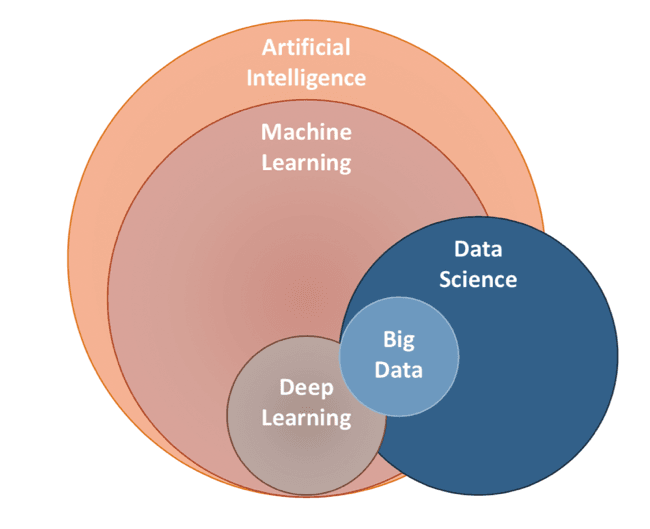
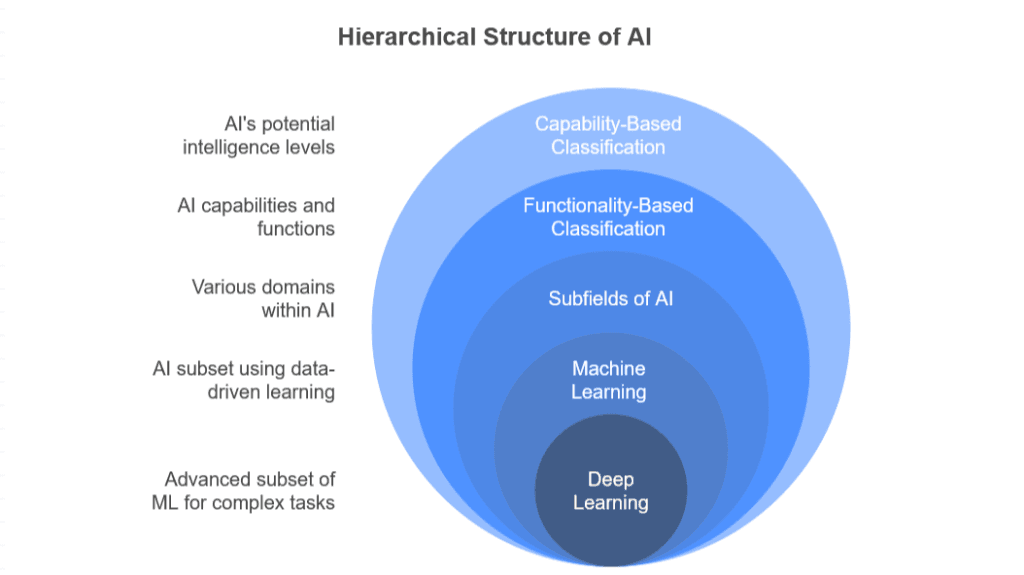
You see concentric circles:
- Biggest: Artificial Intelligence
- Inside it: Machine Learning
- Deep inside ML: Deep Learning (multi-layered neural networks, the tech behind large language models and image generators)
Some diagrams add symbolic/rule-based AI or expert systems outside ML to show older approaches.
Key Differences at a Glance
| Aspect | Artificial Intelligence (AI) | Machine Learning (ML) |
|---|---|---|
| Scope | Broad: any technique for human-like intelligence | Narrower: data-driven learning algorithms |
| Approach | Can be rule-based, search-based, logic-based, or learning-based | Always learning from data (supervised, unsupervised, reinforcement) |
| Explicit programming | Often requires rules/logic in non-ML AI | Minimal: learns patterns automatically |
| Data dependency | Varies (rule-based needs little; modern needs lots) | High: performance improves with more quality data |
| Examples (classic) | Chess programs with minimax search (Deep Blue, 1997) | Spam filters, recommendation systems |
| Examples (2026) | Full autonomous agents, multimodal reasoning systems | Most LLMs, computer vision models, predictive maintenance |
| Interpretability | Rule-based AI is explainable; modern often not | Traditional ML more explainable; deep ML is “black box” |
Real-World Examples to See the Difference
- Recommendation on Spotify/Netflix → Machine Learning (collaborative filtering + deep neural nets learn your taste from listening/watching history). It’s ML achieving an AI goal (personalized suggestions that feel intelligent).
- Early chess programs (pre-2010s) → Pure AI (search algorithms + hand-crafted evaluation functions), not ML—no learning from games, just clever rules.
- Tesla Full Self-Driving or Waymo → Heavy ML (deep neural networks process camera/lidar data), but the overall system is AI (perceiving, planning, deciding like a human driver).
- Rule-based chatbots from the 2010s → AI (they simulate conversation), but not ML (no learning; scripted responses).
- Generative AI like Grok or Midjourney → Deep Learning (a subset of ML), which is a subset of AI. It generates text/images by predicting patterns from trillions of examples.
Why the Confusion in 2026?
Marketing plays a big role—companies slap “AI” on anything with a bit of automation. Plus, since ~2012 (deep learning boom), nearly all impressive AI advances come from ML techniques. So people use the terms interchangeably.
But technically: not all AI is ML (e.g., symbolic reasoning systems still exist in niches like planning or theorem proving), and not all ML is used for “intelligent” tasks (simple regression models count as ML but aren’t very “AI-like”).