Artificial Intelligence (AI) is one of the fastest-growing fields in the world. From self-driving cars to smart assistants, AI is transforming industries and creating millions of new job opportunities.
The best part? You don’t need to be a genius or have a PhD to start a career in AI. With the right roadmap, anyone can learn the necessary skills and build a successful career.
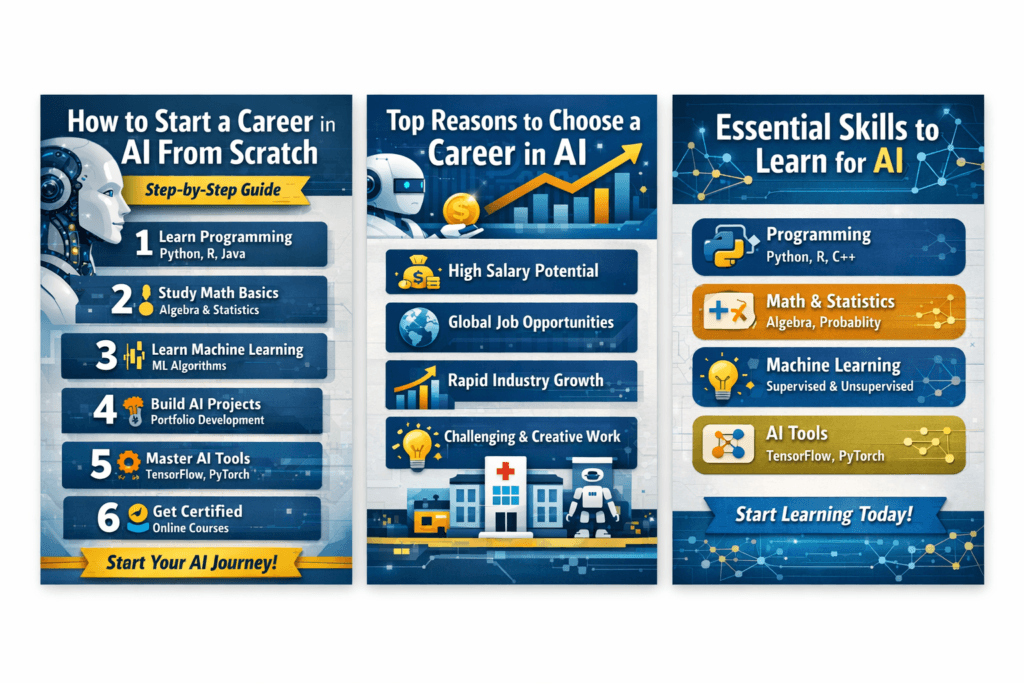
In this guide, you’ll learn exactly how to start a career in Artificial Intelligence from scratch, even if you have no prior experience.
What is Artificial Intelligence?
Artificial Intelligence refers to machines or software that can perform tasks that normally require human intelligence. These tasks include:
- Learning from data
- Recognizing images and speech
- Making predictions
- Understanding language
- Solving complex problems
AI powers technologies like:
- Chatbots
- Recommendation systems
- Self-driving cars
- Fraud detection systems
- Virtual assistants
Why Choose a Career in AI?
AI professionals are among the most in-demand and highest-paid tech experts today.
Benefits of an AI Career
🚀 High salary potential
🌎 Global job opportunities
📈 Rapid industry growth
🧠 Challenging and creative work
🏢 Opportunities in multiple industries
Companies in healthcare, finance, marketing, cybersecurity, and robotics are all investing heavily in AI talent.
Step-by-Step Guide to Start a Career in AI
1. Learn the Basics of Programming
Programming is the foundation of Artificial Intelligence.
The most popular programming languages for AI include:
- Python (most important)
- R
- Java
- C++
Why Python?
Python is widely used because it is easy to learn and has powerful AI libraries like:
- TensorFlow
- PyTorch
- Scikit-learn
- Keras
If you are starting from zero, Python should be your first priority.
2. Understand Mathematics for AI
AI heavily relies on mathematics.
Important topics include:
- Linear Algebra
- Probability
- Statistics
- Calculus
These concepts help machines understand patterns in data and make predictions.
Don’t worry — you don’t need advanced math immediately. Focus on practical understanding first.
3. Learn Machine Learning
Machine Learning is the core of modern AI.
It allows computers to learn from data instead of being explicitly programmed.
Types of Machine Learning
Supervised Learning
- Predicting house prices
- Email spam detection
Unsupervised Learning
- Customer segmentation
- Pattern discovery
Reinforcement Learning
- Game-playing AI
- Robotics
Machine learning skills are essential for most AI jobs.
4. Work on Real AI Projects
The best way to learn AI is by building real projects.
Beginner project ideas:
- Spam email classifier
- Movie recommendation system
- Chatbot
- Image recognition model
- AI-powered resume screener
Projects help you build a portfolio, which is crucial when applying for jobs.
5. Learn AI Tools and Frameworks
AI engineers rely on specialized frameworks to build models efficiently.
Popular AI tools include:
- TensorFlow
- PyTorch
- OpenCV
- Hugging Face
- Scikit-learn
Learning these tools makes you industry-ready.
6. Take Online Courses and Certifications
Many world-class universities and tech companies offer free AI courses.
Popular platforms include:
- Coursera
- Udemy
- edX
- Google AI courses
Certifications can help validate your skills and improve your resume.
7. Build a Strong Portfolio
Employers want proof of your skills.
Create a portfolio that includes:
- GitHub AI projects
- Data science notebooks
- Machine learning models
- Real-world case studies
A strong portfolio can sometimes matter more than a degree.
8. Join the AI Community
Networking is extremely important in tech.
Join communities such as:
- GitHub
- Kaggle
- Reddit AI groups
- AI Discord communities
- LinkedIn AI professionals network
Participating in discussions and competitions helps you learn faster.
9. Apply for Entry-Level AI Jobs
Once you gain some experience, apply for roles like:
- Machine Learning Intern
- Data Analyst
- AI Research Assistant
- Junior Machine Learning Engineer
- Data Scientist
Many professionals enter AI through data science or analytics roles.
10. Keep Learning and Stay Updated
AI evolves extremely fast.
New technologies appear every year, including:
- Generative AI
- Large Language Models
- AI agents
- Autonomous systems
Continuous learning is the key to long-term success in this field.
Top AI Career Roles
Popular AI job roles include:
| Role | Description |
|---|---|
| Machine Learning Engineer | Builds and trains AI models |
| Data Scientist | Analyzes data to extract insights |
| AI Engineer | Develops intelligent systems |
| NLP Engineer | Works with language models |
| Computer Vision Engineer | Builds image recognition systems |
How Long Does It Take to Learn AI?
The timeline depends on your dedication.
Typical learning paths:
- 3–6 months: AI basics
- 6–12 months: Build projects and portfolio
- 1–2 years: Become job-ready for AI roles
Consistency matters more than speed.
Important Thoughts
Starting a career in Artificial Intelligence may seem difficult, but with the right approach, it is absolutely achievable.
Focus on:
- Learning programming
- Understanding machine learning
- Building projects
- Staying curious
The demand for AI professionals will continue to grow, making it one of the best career choices of the future.
If you start learning today, you could become an AI expert sooner than you think.