
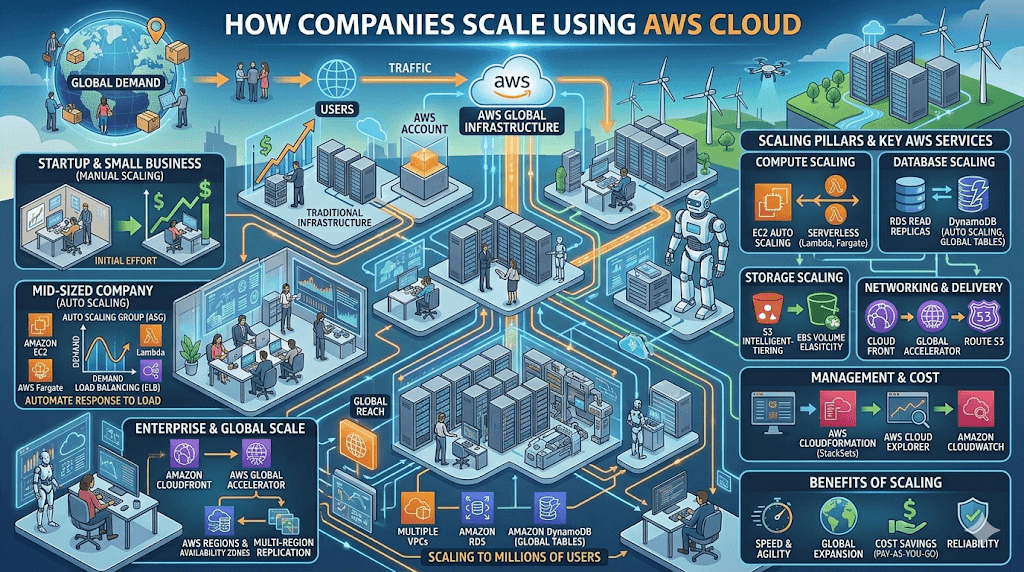
In today’s digital world, growth can happen overnight.
A startup launches…
A post goes viral…
A product suddenly gets thousands of users…
And if your infrastructure can’t handle it — your business suffers.
That’s why companies across the world — from startups to global giants — are using AWS (Amazon Web Services) to scale faster, smarter, and more efficiently.
In this guide, we’ll explore how companies scale using AWS Cloud, why it matters, and how your business can do the same.
What Does “Scaling” Really Mean?
Scaling means your system can handle growth without breaking.
For example:
- 100 users today → 100,000 users tomorrow
- 10GB data → 10TB data
- Small team → Global users
Without proper scaling:
- Websites crash
- Apps slow down
- Customers leave
- Revenue drops
AWS solves this problem with on-demand cloud infrastructure.
Why Companies Choose AWS to Scale
Here’s why AWS is the go-to cloud platform for scaling businesses:
1. Pay As You Grow
Traditional infrastructure requires upfront investment:
- Buy servers
- Setup data centers
- Hire IT teams
AWS eliminates all of this.
You only pay for what you use.
This makes scaling cost-efficient and low-risk.
2. Instant Global Infrastructure
AWS operates multiple regions and availability zones worldwide.
This allows companies to:
- Launch globally in minutes
- Reduce latency
- Improve performance
Your users in the U.S., India, and Europe can all experience fast performance.
3. Automatic Scaling
One of AWS’s biggest strengths is Auto Scaling.
Your system automatically:
- Adds servers during high traffic
- Removes servers during low traffic
- Saves money and improves performance
No manual intervention required.
Key AWS Services That Help Companies Scale
Let’s look at the most important AWS tools companies use to scale.
1. Amazon EC2 (Elastic Compute Cloud)
Amazon EC2 provides virtual servers on demand.
Companies use EC2 to:
- Run applications
- Host websites
- Handle backend services
Benefits:
- Launch servers in minutes
- Scale automatically
- Pay only for usage
2. AWS Auto Scaling
Auto Scaling automatically adjusts resources.
For example:
- Traffic increases → AWS adds servers
- Traffic decreases → AWS removes servers
This keeps applications running smoothly.
3. Amazon S3 (Simple Storage Service)
Amazon S3 allows companies to store unlimited data.
Companies use S3 for:
- Images
- Videos
- Backups
- Logs
Benefits:
- Highly scalable
- Secure
- Cost-efficient
4. Amazon CloudFront (CDN)
CloudFront helps deliver content faster.
It distributes your content globally through edge locations.
Benefits:
- Faster load times
- Better user experience
- Reduced server load
5. AWS Lambda (Serverless Scaling)
AWS Lambda automatically runs code without servers.
Benefits:
- No server management
- Scales automatically
- Pay only when code runs
Perfect for:
- APIs
- Automation
- Background processing
Real-World Example: How Companies Scale Using AWS
Example 1: Startup Growth
A startup launches a mobile app.
Initially:
- 500 users
- Small infrastructure
Suddenly:
- App goes viral
- 50,000 users join
Without AWS:
- App crashes
- Users leave
With AWS:
- Auto Scaling adds servers
- Performance remains stable
- Business continues growing
Example 2: E-commerce Sale
During Black Friday:
- Traffic increases 10x
- Orders spike
AWS automatically:
- Adds compute resources
- Balances traffic
- Prevents downtime
Scaling Strategies Companies Use on AWS
Here are common strategies businesses use:
1. Horizontal Scaling
Add more servers instead of upgrading one.
Benefits:
- Better performance
- High availability
- Cost-effective
2. Load Balancing
AWS Elastic Load Balancer distributes traffic.
Benefits:
- Prevents overload
- Improves reliability
3. Microservices Architecture
Companies break applications into small services.
Benefits:
- Independent scaling
- Faster development
- Better reliability
4. Serverless Architecture
Use AWS Lambda and managed services.
Benefits:
- Automatic scaling
- Lower cost
- Faster deployment
Benefits of Scaling with AWS
Here’s what companies gain:
Faster Growth
Launch features quickly and scale instantly.
Lower Costs
Pay only for what you use.
Better Performance
Global infrastructure improves speed.
High Availability
Multiple regions reduce downtime.
Improved Security
AWS offers enterprise-level security.
Companies Using AWS to Scale
Many global companies rely on AWS:
- Netflix
- Airbnb
- Uber
- Spotify
- Slack
These companies serve millions of users using AWS.
Best Practices for Scaling on AWS
To scale successfully:
Use Auto Scaling
Automate infrastructure growth.
Monitor with CloudWatch
Track performance and usage.
Use Load Balancers
Distribute traffic evenly.
Use CDN (CloudFront)
Improve global performance.
Optimize Costs
Use reserved and spot instances.
Future of Scaling with AWS
The future of scaling is:
- Serverless architecture
- AI-driven scaling
- Multi-region deployment
- Edge computing
AWS continues to innovate in these areas.
Final Thoughts
Scaling is no longer a luxury — it’s a necessity.
Whether you’re:
- Startup founder
- Developer
- Enterprise business
AWS provides the tools to scale confidently and grow faster.
Companies that leverage AWS today are building the next generation of global products.
And the best part?
You can start small and scale as you grow.
FAQs
Is AWS good for startups?
Yes. AWS allows startups to scale without heavy investment.
Is AWS expensive?
No. AWS follows a pay-as-you-go model, making it cost-effective.
Can small businesses scale using AWS?
Absolutely. AWS works for businesses of all sizes.
Which AWS service helps scaling the most?
Auto Scaling, EC2, Lambda, and CloudFront are key services.


Comments are closed.