Artificial Intelligence is rapidly becoming one of the most transformative technologies of the 21st century. From diagnosing diseases to personalizing education and automating financial services, AI is reshaping how industries operate and how people interact with technology.
Major technology companies such as Microsoft, Google, and IBM are investing billions of dollars into AI development. As these technologies mature, their impact on healthcare, education, and finance will likely redefine how these sectors function in the coming decades.
In March 2026, artificial intelligence has moved decisively from hype and pilots to embedded infrastructure across critical sectors. Agentic systems, governed multimodal models, and real-time analytics are driving measurable value, efficiency gains, and innovation. Healthcare, education, and finance—three pillars of modern society—are undergoing profound shifts as AI augments human expertise, personalizes experiences, and scales decision-making. While challenges like governance, equity, and trust remain, 2026 is the year AI delivers tangible impact at scale.

Let’s explore how AI is expected to revolutionize these three critical industries.
AI in Healthcare: The Future of Medicine
Healthcare is one of the fields where AI can have the most life-saving impact. With the ability to analyze massive amounts of medical data, AI systems can assist doctors in diagnosing diseases, predicting health risks, and discovering new treatments.
1. Faster and More Accurate Diagnoses
AI algorithms can analyze medical images such as X-rays, MRIs, and CT scans with remarkable accuracy. These systems help doctors detect conditions such as cancer, heart disease, and neurological disorders earlier than ever before.
For example, AI technologies developed by IBM have been used to analyze medical data and assist doctors in identifying potential health issues.
2. Drug Discovery and Medical Research
Developing new drugs traditionally takes 10–15 years. AI can dramatically reduce this timeline by analyzing biological data and predicting how different compounds interact with the human body.
Researchers can now use AI to identify promising drug candidates in months instead of years.
3. Personalized Healthcare
AI systems can analyze a patient’s genetics, lifestyle, and medical history to create personalized treatment plans. This approach, often called precision medicine, allows doctors to tailor therapies to individual patients rather than using generalized treatments.
4. AI-Powered Medical Assistants
Virtual health assistants can help patients monitor symptoms, schedule appointments, and receive health advice. These tools improve access to healthcare while reducing the workload on medical professionals.
AI in Education: Personalized Learning for Everyone
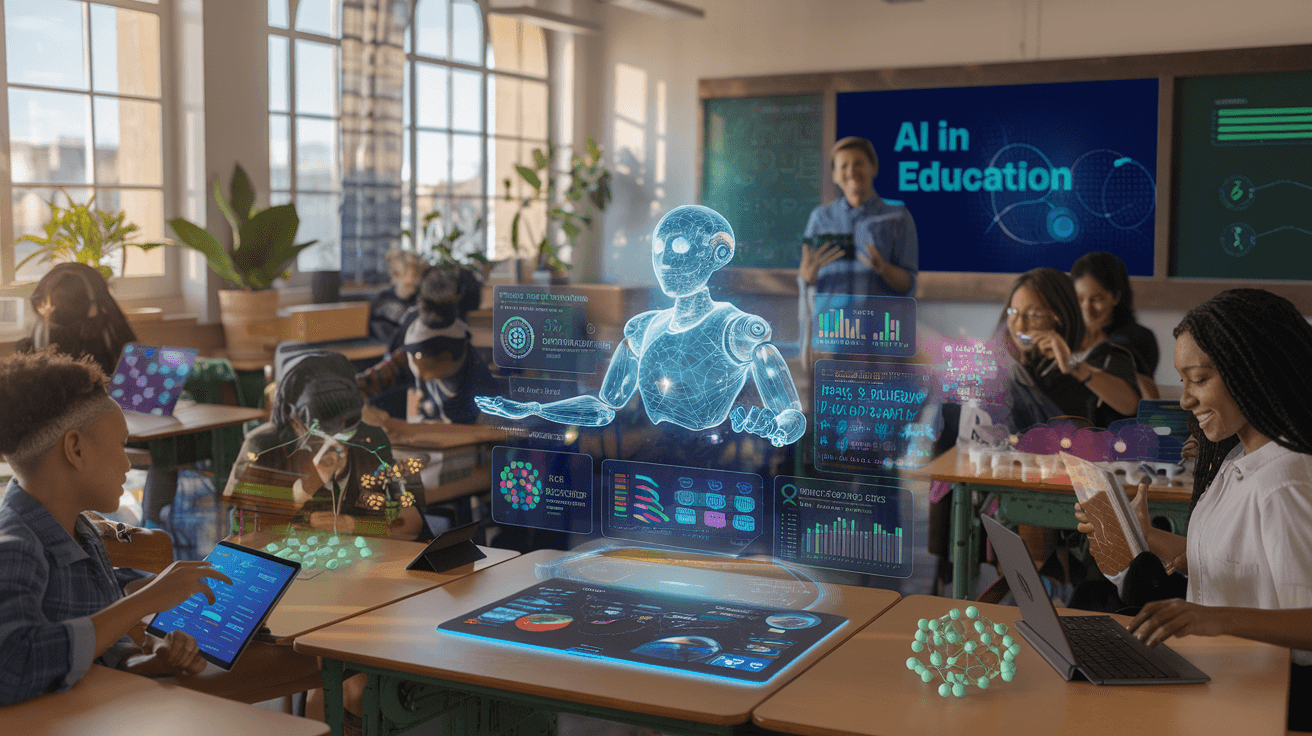
Education is undergoing a digital transformation, and AI is at the center of this shift. Traditional classrooms often follow a one-size-fits-all approach, but AI can tailor education to individual learning styles.
1. Personalized Learning Experiences
AI-powered learning platforms analyze student performance and adapt lessons accordingly. If a student struggles with a concept, the system provides additional explanations and exercises.
This personalized approach helps students learn at their own pace, improving outcomes and engagement.
2. AI Tutors and Learning Assistants
AI tools such as ChatGPT from OpenAI can act as virtual tutors, answering questions, explaining complex topics, and assisting with research.
Students can receive 24/7 academic support, something that traditional education systems cannot easily provide.
3. Automated Grading and Feedback
Teachers spend significant time grading assignments and exams. AI can automate much of this process, allowing educators to focus more on teaching and mentoring students.
4. Expanding Access to Education
AI-driven platforms can make high-quality education accessible to people worldwide. Online courses, language translation tools, and virtual classrooms allow students from different countries to learn from the same resources.

AI in Finance: Smarter and Safer Financial Systems
The financial industry has been quick to adopt AI technologies. Banks, investment firms, and financial institutions use AI to analyze data, detect fraud, and improve customer services.

1. Fraud Detection and Security
Financial fraud costs billions of dollars each year. AI systems can monitor transactions in real time and detect suspicious patterns that may indicate fraud.
Major financial institutions increasingly rely on AI to protect customers and prevent cybercrime.
2. AI-Powered Investment Strategies
AI can analyze market trends, economic data, and company performance to make investment predictions.
Investment firms use AI algorithms to identify opportunities and manage portfolios more efficiently than traditional methods.
3. Automated Customer Support
AI chatbots are now widely used in banking apps and financial platforms. These systems can answer customer questions, process transactions, and provide financial advice instantly.
4. Credit Scoring and Risk Assessment
AI can evaluate credit risk more accurately by analyzing multiple data points, including spending patterns and financial history. This allows lenders to make faster and more informed decisions.
Challenges and Ethical Concerns
Despite its benefits, AI adoption also raises several concerns.
Data Privacy
Healthcare and financial systems store highly sensitive data. Protecting this information is essential to prevent misuse and cyberattacks.
Algorithmic Bias
AI systems can inherit biases from the data used to train them. Ensuring fairness and transparency is a major challenge.
Job Displacement
Automation powered by AI may replace certain roles in these industries. However, it will also create new jobs requiring advanced technological skills.
The Future of AI Across Industries
The integration of AI into healthcare, education, and finance is only just beginning. Over the next decade, AI is expected to become a core part of decision-making processes across these sectors.
Potential future developments include:
- AI-powered hospitals with automated diagnostics
- Fully personalized education systems
- Smart financial platforms that manage investments automatically
As AI continues to evolve, its success will depend on responsible development, ethical guidelines, and collaboration between humans and intelligent machines.
Artificial Intelligence is poised to transform some of the most important sectors in our lives. In healthcare, it can save lives through better diagnostics and treatments. In education, it can create personalized learning experiences for students worldwide. In finance, it can make financial systems safer, smarter, and more efficient.
Rather than replacing humans, AI will likely serve as a powerful tool that enhances human capabilities and helps solve some of society’s biggest challenges.
The future of AI is not just about technology—it’s about building a smarter, healthier, and more connected world.