The “American Dream” is often cited in hushed, almost mythical tones. But for those who arrive with nothing but a suitcase and a relentless drive, it isn’t a myth—it’s a blueprint.
The journey from a rural village with intermittent electricity to the glass-walled boardrooms of a tech empire is rarely a straight line. It’s a masterclass in resilience, adaptation, and the power of a fresh perspective.
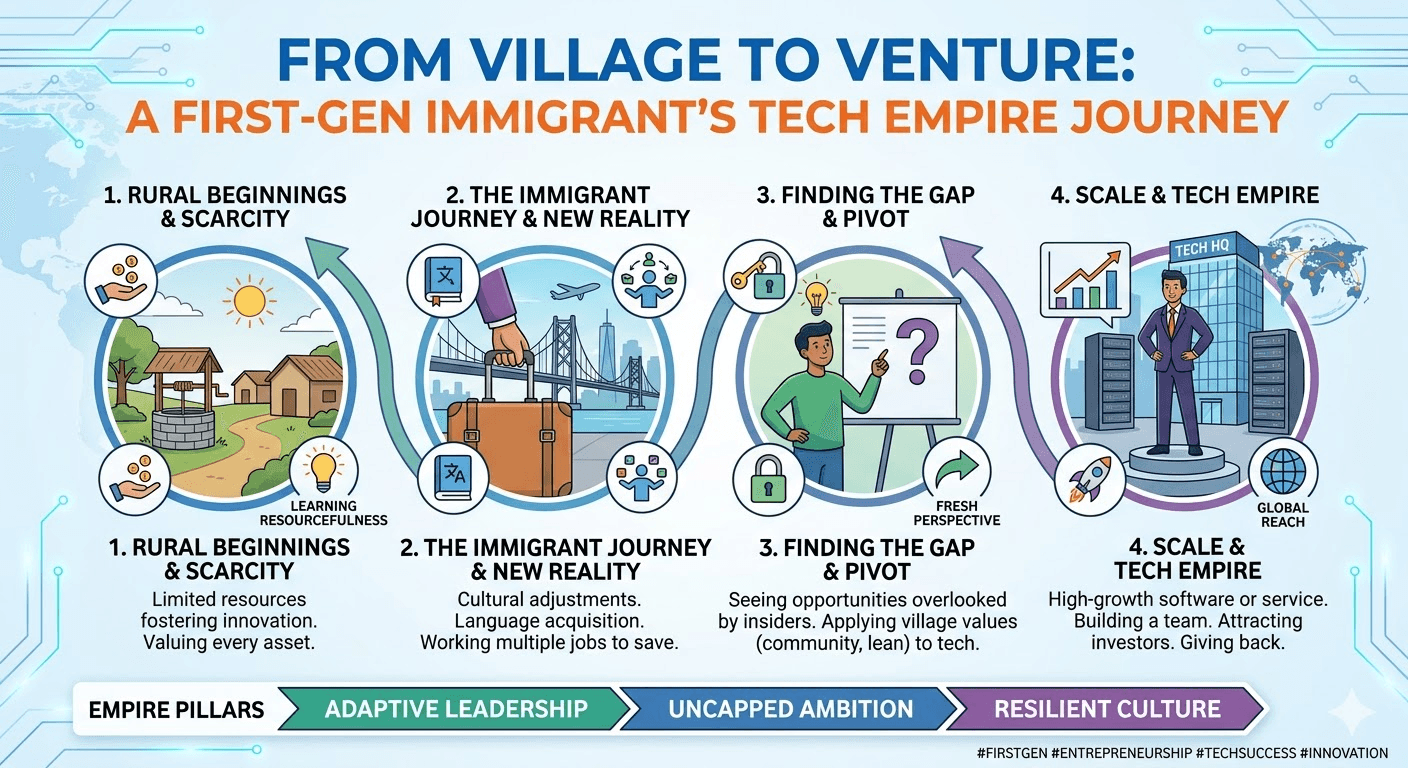
In today’s global economy, some of the most inspiring success stories come from people who started with almost nothing. One such story is the remarkable journey of Sundar Pichai—a first-generation immigrant who rose from humble beginnings to lead one of the most powerful technology companies in the world, Google.
His journey from a modest home in India to the helm of a trillion-dollar tech giant is not just a story of personal success—it’s a blueprint for ambition, resilience, and the transformative power of education.
Humble Beginnings in a Small Home
Sundar Pichai was born in Madurai and raised in Chennai in a middle-class family. His father worked as an electrical engineer and his mother was a stenographer.
The family lived in a small apartment without many luxuries. In fact, the household didn’t even have a telephone until Pichai was 12 years old. Yet this moment sparked something extraordinary: he discovered he had an unusual ability to remember phone numbers instantly.
That curiosity about technology would later shape his entire life.
The Power of Education
Education became the gateway to opportunity. Pichai earned admission to the prestigious Indian Institute of Technology Kharagpur, where he studied metallurgical engineering.
His talent stood out early. After graduating, he received a scholarship to study at Stanford University in the United States—an opportunity that changed the trajectory of his career.
Later, he also earned an MBA from University of Pennsylvania.
For a young immigrant arriving in America, the experience was both exciting and challenging. He faced cultural differences, financial pressures, and the uncertainty that many immigrants encounter.
But his determination pushed him forward.
Entering Silicon Valley
After completing his education, Pichai worked at companies like Applied Materials and McKinsey & Company before eventually joining Google in 2004.
At the time, Google was already a fast-growing company, but few people could have predicted the massive impact Pichai would have on its future.
His early work focused on improving Google’s search toolbar and developing the web browser that would eventually change the internet.
Building One of the World’s Most Popular Browsers
Pichai led the development of Google Chrome, which launched in 2008.
At the time, the browser market was dominated by competitors like Internet Explorer and Mozilla Firefox.
Many people doubted whether Google needed its own browser. But Pichai believed that faster, simpler internet access would drive the future of computing.
He was right.
Today, Chrome is the most widely used browser in the world.
Rising to the Top
Pichai’s leadership style—calm, thoughtful, and collaborative—quickly earned him respect inside the company.
Over the years, he took responsibility for many of Google’s most important products, including:
- Android
- Gmail
- Google Maps
- Google Drive
In 2015, he was appointed CEO of Google. Later, he also became CEO of its parent company, Alphabet Inc..
This made him one of the most influential leaders in the global technology industry.
Challenges Along the Way
Success didn’t come without challenges.
Leading a tech giant means navigating complex issues such as:
- Artificial intelligence regulation
- Data privacy concerns
- Global political pressures
- Competition from companies like Apple Inc., Microsoft, and Amazon
Yet Pichai has maintained a reputation for steady leadership during some of the most transformative years in technology.
Lessons for Aspiring Entrepreneurs
The story of Sundar Pichai offers powerful lessons for entrepreneurs, immigrants, and dreamers everywhere.
1. Your Background Doesn’t Define Your Future
Starting in a small home didn’t limit Pichai’s ambition.
2. Education Can Change Everything
Access to world-class education opened doors to global opportunities.
3. Curiosity Drives Innovation
His fascination with technology started with something as simple as a telephone.
4. Leadership Matters
Success in tech isn’t just about ideas—it’s about leading teams and building products that billions of people use.
The Bigger Story: Immigrants and Innovation
Pichai’s story is part of a larger pattern. Immigrants have played a critical role in shaping the tech industry.
Companies such as Google, Tesla, and Nvidia have all benefited from immigrant leadership and talent.
The lesson is clear: when talent meets opportunity, innovation follows.
Important Thoughts
The journey from a modest home in India to leading one of the most powerful tech companies on Earth is extraordinary.
But what makes Sundar Pichai’s story so inspiring isn’t just the success—it’s the path he took to get there.
His story reminds us that the next world-changing entrepreneur could be anywhere: a small village, a crowded city apartment, or a classroom filled with curiosity.
All it takes is an idea, determination, and the courage to pursue something bigger.
The American Dream often feels like a distant myth, but for some first-generation immigrants, it’s a lived reality forged through grit, ingenuity, and relentless pursuit. Few stories capture this transformation better than that of someone who rises from a remote village with limited resources to building a multi-billion-dollar tech empire.
Consider Jay Chaudhry, the founder and CEO of Zscaler, a leading cloud security company. Born in 1958 in the small village of Panoh in the hills of Himachal Pradesh, India, Chaudhry grew up in humble conditions—no electricity most of the time, studying by the light of a diya (oil lamp), and walking several kilometers to school each day. His early life was defined by simplicity and scarcity, yet it instilled discipline, resourcefulness, and an unshakeable belief in education as the path forward.
Chaudhry excelled academically, cracking the competitive exams to attend IIT (Indian Institute of Technology) at BHU (Varanasi), one of India’s premier engineering institutions. From there, his journey took him to the United States, where he pursued advanced degrees—earning three master’s degrees in engineering and management. He arrived as an immigrant with big ambitions but no safety net, navigating cultural adjustments, language nuances, and the intense competition of Silicon Valley.
His entrepreneurial path began in the 1990s. In 1997, alongside his wife, he took a bold leap: they liquidated their savings to bootstrap SecureIT, a cybersecurity venture. Within 18 months, they sold it to VeriSign—a pattern that would repeat. Chaudhry went on to found or co-found multiple companies, including AirDefense (acquired by Motorola) and CipherTrust (acquired by McAfee). Each success built on the last, teaching him about scaling technology, understanding enterprise needs, and spotting market gaps.
The pinnacle came in 2007 when he launched Zscaler. At the time, cybersecurity was shifting from on-premise hardware to cloud-based models. Chaudhry saw the future: as businesses moved online, traditional security perimeter models would fail. Zscaler pioneered “zero trust” security delivered entirely from the cloud, making it faster, more scalable, and more effective against modern threats. Today, Zscaler is a powerhouse—valued at billions (around $17-18 billion in recent reports), publicly traded, and serving thousands of global enterprises. It protects data for major corporations while employing thousands and driving innovation in one of tech’s hottest sectors.
What makes Chaudhry’s story so compelling isn’t just the financial success—it’s the full-circle elements. Despite his billionaire status (landing him on Forbes lists of top U.S. immigrant billionaires), he remains grounded. He gives back generously to his home village, supporting education and infrastructure projects that echo the challenges he once faced.
His journey highlights timeless lessons for anyone chasing big dreams:
- Education as the great equalizer — In places where opportunities are scarce, knowledge becomes the ultimate currency.
- Risk-taking with calculation — Bootstrapping multiple ventures required courage, but each built skills and capital for the next.
- Spotting inflection points — Chaudhry didn’t follow trends; he anticipated where the world was heading (cloud security) and built ahead of the curve.
- Resilience through adversity — From village hardships to repeated startup pivots and acquisitions, setbacks were stepping stones.
- Giving back — True success isn’t just wealth—it’s lifting others as you rise.
In an era where headlines often focus on tech’s inequalities, stories like Chaudhry’s remind us that the industry still rewards outsiders with bold vision. First-generation immigrants continue to found a disproportionate number of America’s most valuable startups and companies, contributing trillions in economic value and millions of jobs.
From a Himalayan village without basic amenities to leading a tech empire that secures the digital world, Jay Chaudhry’s path proves that origins don’t define limits—they fuel determination. The next world-changing company could be building right now, perhaps in a place no one expects.