
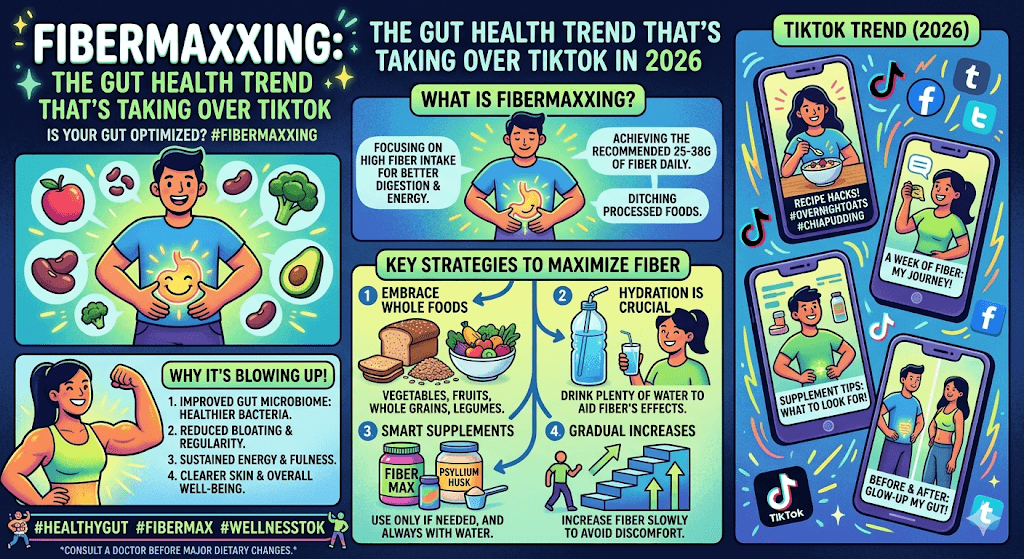
Fibermaxxing: The Gut Health Trend That’s Taking Over TikTok in 2026
If you’ve spent any time scrolling TikTok lately, you’ve probably noticed something: the produce aisle is having a serious moment. People are loading up on lentils, chia seeds, oats, and leafy greens — not to lose weight on some crash diet, but to intentionally “max out” their daily fiber intake. Welcome to fibermaxxing, the gut health trend that’s quietly become one of the biggest nutrition conversations of 2026.
But here’s the thing — unlike a lot of TikTok food fads, this one actually has some serious science behind it. Let’s break down what fibermaxxing really is, why it’s blowing up right now, and how you can do it in a way that genuinely works for your body.
So, what exactly is fibermaxxing?
The name is pretty self-explanatory. Fibermaxxing means intentionally maximizing your daily dietary fiber intake — going beyond just scraping the minimum recommended amount and actively building every meal around high-fiber, whole plant foods. Think vegetables, legumes, whole grains, seeds, and fruits woven into breakfast, lunch, dinner, and snacks.
“Fibermaxxing is essentially attempting to eat a ton of fiber to max out your daily fiber intake — at least meeting, but more likely exceeding, the recommendation for daily fiber intake.”
— Tara M. Schmidt, RDN, Lead Registered Dietitian at Mayo ClinicIt’s been called “fiber becoming the new protein” — and that comparison isn’t too far off. Gen Z creators on TikTok kicked it off with viral plant-variety challenges: “Can you eat 30 different plants this week?” The idea spread fast, and now registered dietitians, nutritionists, and everyday people are all chiming in.
Why is this trend exploding right now?
There’s a broader cultural shift happening in nutrition right now. People are moving away from restrictive dieting and toward what experts are calling “metabolic eating” — choosing foods that fuel your biological systems rather than just cutting calories. And fiber sits right at the center of that conversation, especially as research into the gut microbiome keeps revealing just how deeply our digestive health influences our mood, immunity, energy, and long-term disease risk.
The two types of fiber you actually need to know about
Not all fiber does the same thing. Here’s a quick, non-boring breakdown:
Soluble fiber
- Dissolves in water, forms a gel
- Feeds your gut bacteria
- Manages blood sugar & cholesterol
- Keeps you full longer
- Found in oats, beans, apples, chia seeds, citrus
Insoluble fiber
- Doesn’t dissolve — adds bulk
- Moves food through your gut
- Prevents constipation
- Reduces hemorrhoid risk
- Found in whole grains, nuts, most vegetables
The real magic of fibermaxxing isn’t just eating more fiber — it’s eating a diverse variety of fiber. Different gut bacteria feed on different types of plant fiber. When you eat a wide range of sources, you cultivate a richer, more resilient microbiome that can perform more functions for your health. That’s fiber diversity, and it’s the nuance most TikTok videos miss.
What the science actually says about fiber
Here’s where things get genuinely exciting. When your gut bacteria break down fiber, they produce short-chain fatty acids (SCFAs) like butyrate and propionate. A landmark Stanford University study found that these SCFAs can actually modulate gene expression — influencing cell proliferation and even cancer control through epigenetic mechanisms. That’s not just “good for digestion.” That’s fiber affecting how your genes behave.
A high-fiber diet has been linked to:
Worth noting: the standard recommendation of 25–35 grams per day was actually established decades ago — based primarily on its effect on bowel movements, not on microbiome health. Today, experts suggest that higher intakes may help prevent chronic disease, though research is still emerging. The point is, the old baseline was conservative, and most of us aren’t even hitting that.
Top foods to start fibermaxxing with
You don’t need to overhaul your entire kitchen. Start with these high-fiber, easy-to-incorporate foods:
The pitfalls — and how to avoid them
Look, fibermaxxing is genuinely one of the more well-grounded nutrition trends to come out of social media. But like anything taken to an extreme, it can backfire if you’re not thoughtful about it.
⚠ Watch out for these common mistakes
- Going too fast. Jumping from 15g to 50g overnight is a recipe for bloating, gas, and discomfort. Your gut microbiome needs time to adjust.
- Skipping water. Without adequate hydration, all that extra fiber can cause constipation instead of preventing it. Drink more than you think you need.
- Ignoring balance. Fiber is incredible, but don’t let it crowd out protein, healthy fats, and calcium. Your body needs all of them.
- Relying on one source. Eating only psyllium husk every day feeds a narrow subset of gut bacteria. Diversity is the whole point.
- Not listening to your body. People with short bowel syndrome, pelvic prolapse, or IBS may feel worse on very high fiber diets. Always tune in to your individual response.
✅ How to do it the smart way
- Start gradually — add 5g of fiber per week until you reach your target
- Drink at least 8–10 glasses of water daily, more if you’re very active
- Prioritize variety over quantity — aim for 20+ different plant foods per week
- Mix soluble and insoluble fiber sources at every meal
- Let whole foods lead — use supplements only to fill gaps, not as the main strategy
- Track how you feel, not just how many grams you ate
Is fibermaxxing just a fad, or is it here to stay?
Honestly? The word “fibermaxxing” might fade — that’s just how internet language works. But the underlying habit of consciously prioritizing diverse, high-fiber plant foods? That’s not going anywhere. Researchers, dietitians, and food industry analysts all point to fiber as “the next protein” — a macronutrient category that’s finally getting the attention it deserves after decades of being overshadowed by protein and fat debates.
The American Society for Nutrition reported in 2025 that only 7% of adults hit the daily fiber recommendation — a staggering public health gap. If fibermaxxing helps more people bridge that gap, even imperfectly, that’s a genuine win. The future of this trend is likely moving toward “smart fibermaxxing” — personalized approaches guided by individual microbiome analysis and metabolic responses, rather than just chasing an arbitrary gram count.