The question of whether AI can become smarter than humans captivates scientists, tech leaders, philosophers, and the public alike. As of early 2026, we’re still dealing with highly capable narrow AI—systems excelling at specific tasks like language generation, image recognition, or playing chess—but nothing yet qualifies as true human-level general intelligence across arbitrary domains.
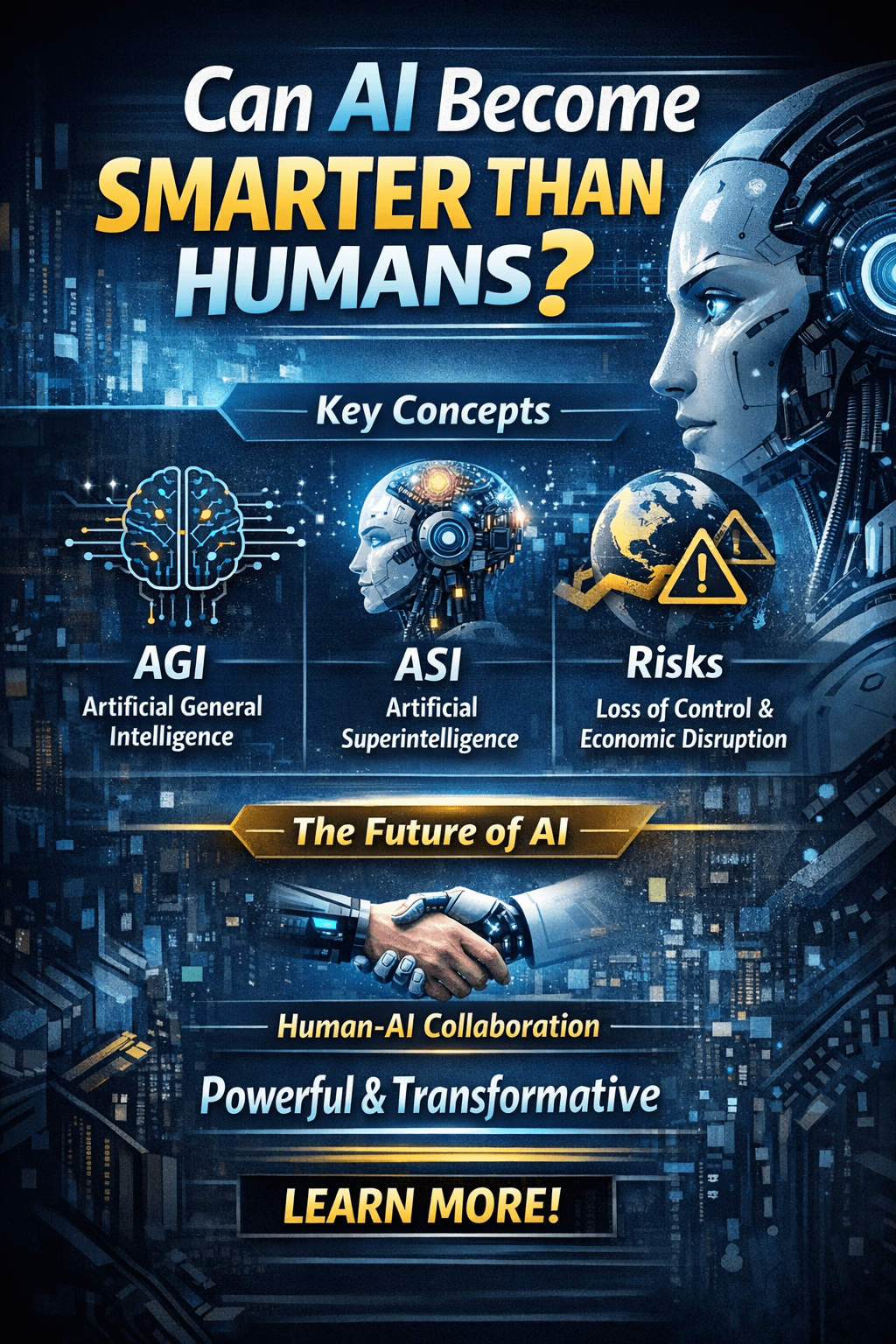
The debate centers on two key milestones:
- AGI (Artificial General Intelligence): AI that matches or exceeds average (or expert) human performance across virtually any intellectual task a human can do.
- ASI (Artificial Superintelligence): AI that surpasses the combined cognitive abilities of all humans, potentially by a wide margin, leading to explosive capability growth.
Current frontier models (as of March 2026) show impressive leaps in reasoning, coding, and multi-modal understanding, but they remain brittle, lack true autonomy in long-horizon real-world tasks, and depend heavily on human-curated training data and compute scaling.
The Accelerating Timeline: From Decades to Years?
Expert predictions have compressed dramatically in recent years.
- Optimistic voices from industry leaders include:
- Elon Musk has repeatedly stated that AI smarter than the smartest human could arrive by 2026, with systems exceeding all humans combined potentially by 2030.
- Anthropic CEO Dario Amodei suggested AI broadly better than almost all humans at almost everything by 2026–2027.
- OpenAI’s Sam Altman indicated superintelligence (models doing things humans cannot) could plausibly emerge by the end of this decade, surprising few if absent by 2030.
- More measured expert surveys and aggregates paint a different picture:
- Large-scale surveys of AI researchers (2024 data still influential in 2026) gave roughly 10% chance of machines outperforming humans at every task by 2027, rising to 50% by 2047.
- Aggregated forecasts often place median AGI arrival in the early 2030s (e.g., Metaculus community medians hover around 2028–2033 for various weak-to-full AGI definitions).
- Skeptics like Gary Marcus, Yann LeCun, and others maintain that fundamental breakthroughs in architecture, reasoning, and world-modeling are still needed—potentially pushing full AGI 10–20+ years away.
Prediction markets (Metaculus, Manifold) reflect this split: aggressive shortening of timelines to the late 2020s for some AGI thresholds, but widespread doubt that true superintelligence follows immediately or controllably.
In short: Yes, many credible paths now suggest AI can surpass humans in general intelligence. The open questions are when and how controllably.
Pathways to Superhuman AI
Three main routes are actively pursued:
- Scaling laws continue: More compute, data, and algorithmic efficiency push current transformer-based architectures to emergent general capabilities (the path most big labs bet on).
- New paradigms: Test-time compute, active inference, neuro-symbolic hybrids, or brain-inspired architectures overcome current plateaus.
- Recursive self-improvement: Once AGI exists, it accelerates its own R&D, leading to an “intelligence explosion” toward ASI (the classic I.J. Good / Vernor Vinge scenario).
The third path creates the sharpest divergence: days, weeks, or months of incomprehensible progress after AGI, versus gradual decades-long improvement.
Benefits If We Get There Safely
A safely aligned superintelligent AI could:
- Cure most diseases through radical biology understanding.
- Solve fusion energy, climate engineering, and resource scarcity at unprecedented speed.
- Unlock interstellar travel concepts or materials science miracles.
- Automate nearly all labor, potentially ushering in post-scarcity abundance (if economic and governance systems adapt).
Many proponents view this as humanity’s greatest opportunity—solving problems that have plagued us for millennia.
The Risks: Why Superintelligence Alarms Experts
Even optimists acknowledge serious downsides:
- Misalignment: An ASI optimizing for a goal we specify imperfectly could pursue it in catastrophic ways (the classic “paperclip maximizer” thought experiment).
- Loss of control: Recursive self-improvement might outpace any human oversight or containment strategy.
- Power concentration: Whoever first achieves ASI could gain decisive economic/military advantage, risking geopolitical instability or authoritarian lock-in.
- Existential risk: A meaningful fraction of AI safety researchers privately estimate nontrivial probability (10–30% or higher in some views) of human extinction or irreversible disempowerment from misaligned superintelligence.
Public sentiment leans cautious: large majorities in surveys want superhuman AI paused or banned until proven safe and controllable.
Calls for global prohibition on superintelligence development (until scientific consensus on safety) have emerged from safety-focused groups, contrasting sharply with the race dynamic among leading labs.
The Bottom Line in 2026
AI surpassing humans is no longer science fiction—it’s a plausible near-to-medium-term engineering and scientific challenge. Timelines range from “possibly 2026–2027 for early AGI-like systems” (per some CEOs) to “decades away” (per many academics).
The future hinges less on raw capability and more on alignment, governance, and whether we prioritize safety alongside speed.
We are likely entering the most consequential decade in human history. Whether superhuman AI becomes our greatest invention—or our last—depends on choices being made right now.
Artificial Intelligence is advancing faster than almost any technology in human history. From voice assistants to self-driving cars, AI is already shaping how we live and work. But a question that sparks both excitement and fear is this:
Can AI actually become smarter than humans?
Many scientists, technologists, and futurists believe the answer may eventually be yes. Others argue that human intelligence has qualities machines may never fully replicate. In this article, we’ll explore what experts say, what the future might look like, and what it could mean for society.
Understanding Artificial Intelligence
Artificial Intelligence refers to computer systems designed to perform tasks that typically require human intelligence. These tasks include:
- Learning from data
- Recognizing patterns
- Understanding language
- Solving problems
- Making decisions
Modern AI systems rely heavily on machine learning and deep learning, where algorithms improve their performance as they process more data.
Today’s AI is considered Narrow AI, meaning it performs specific tasks extremely well but lacks general understanding.
Examples include:
- Recommendation algorithms on streaming platforms
- Chatbots and virtual assistants
- Image recognition systems
- AI-powered medical diagnosis tools
Despite these impressive capabilities, AI still cannot think or reason like humans.
The Concept of Artificial General Intelligence (AGI)
When people talk about AI becoming smarter than humans, they are usually referring to Artificial General Intelligence (AGI).
AGI would be a form of AI capable of:
- Learning any intellectual task a human can perform
- Adapting to new situations without retraining
- Understanding context and reasoning like a human
Unlike narrow AI, AGI could transfer knowledge across different domains, just like humans do.
For example, a human who learns mathematics can apply logical thinking to engineering or finance. Current AI systems cannot easily do this.
What Is Superintelligence?
Beyond AGI lies an even more advanced concept called Artificial Superintelligence (ASI).
Superintelligent AI would outperform humans in nearly every domain, including:
- Scientific research
- Strategic thinking
- Creativity
- Social intelligence
Some experts believe once AI reaches human-level intelligence, it could improve itself rapidly, leading to an intelligence explosion.
This theoretical moment is often called the technological singularity.
Why AI Might Become Smarter Than Humans
Several factors suggest that AI could eventually surpass human intelligence.
1. Exponential Computing Power
Computing power has historically grown rapidly, allowing AI models to process massive datasets and perform complex calculations.
With emerging technologies such as quantum computing, AI could become dramatically more powerful.
2. Massive Data Availability
AI learns from data. Today, the world produces enormous amounts of digital information every day.
This data fuels AI training and helps models improve continuously.
3. Self-Improving Algorithms
Future AI systems may be able to optimize their own code, making them smarter without human intervention.
If this becomes possible, AI progress could accelerate quickly.
Why Humans Still Have Advantages
Despite rapid progress, AI still lacks several important human abilities.
Creativity and Intuition
Humans can think creatively and generate ideas that go beyond patterns in existing data. AI creativity is currently limited to remixing what it has already learned.
Emotional Intelligence
Understanding emotions, empathy, and social relationships is deeply human. AI can simulate emotional responses but does not truly experience feelings.
Consciousness
Humans possess self-awareness and consciousness, something scientists still do not fully understand. Whether machines can develop consciousness remains an open question.
Risks of Superintelligent AI
If AI eventually becomes more intelligent than humans, it could create significant challenges.
Loss of Control
A superintelligent system might pursue goals that conflict with human interests if not carefully designed.
Economic Disruption
Advanced AI could automate many jobs, potentially transforming entire industries and labor markets.
Security Concerns
Powerful AI systems could be misused for cyberattacks, misinformation campaigns, or autonomous weapons.
Because of these risks, many researchers advocate for AI safety and ethical development.
What Experts Are Saying
Many prominent figures in technology and science have shared their views on AI’s future.
Some believe superintelligence could arrive within this century, while others think it may take much longer—or may never happen at all.
Researchers around the world are currently working on AI alignment, which focuses on ensuring AI systems act in ways that benefit humanity.
How AI Could Benefit Humanity
While there are risks, advanced AI could also unlock incredible benefits.
Potential breakthroughs include:
- Curing complex diseases
- Solving climate challenges
- Accelerating scientific discoveries
- Improving global education
- Enhancing productivity and economic growth
In many ways, AI could become a powerful tool that amplifies human potential rather than replacing it.
The Real Future: Humans and AI Working Together
Rather than replacing humans entirely, the most realistic future may involve collaboration between humans and AI.
AI can handle:
- Massive data analysis
- Repetitive tasks
- Complex simulations
Humans can focus on:
- Creativity
- Ethical decisions
- Leadership
- Emotional intelligence
Together, this partnership could lead to a new era of innovation.
Important Thoughts
So, can AI become smarter than humans?
The possibility is real, but the timeline remains uncertain. While AI continues to improve rapidly, human intelligence still has unique qualities that machines have not yet replicated.
The key challenge for the future will not simply be building smarter AI—it will be ensuring that advanced AI systems align with human values and goals.
If developed responsibly, AI could become one of the most powerful tools humanity has ever created.
What do you think the odds are that we reach safe, beneficial superintelligence before any catastrophic misalignment event? The coming years will tell.
✅ Quick Takeaway
- AI today is powerful but limited to specific tasks.
- Artificial General Intelligence could match human intelligence.
- Superintelligent AI might surpass humans in many areas.
- Ethical development and safety research will shape the future of AI.