
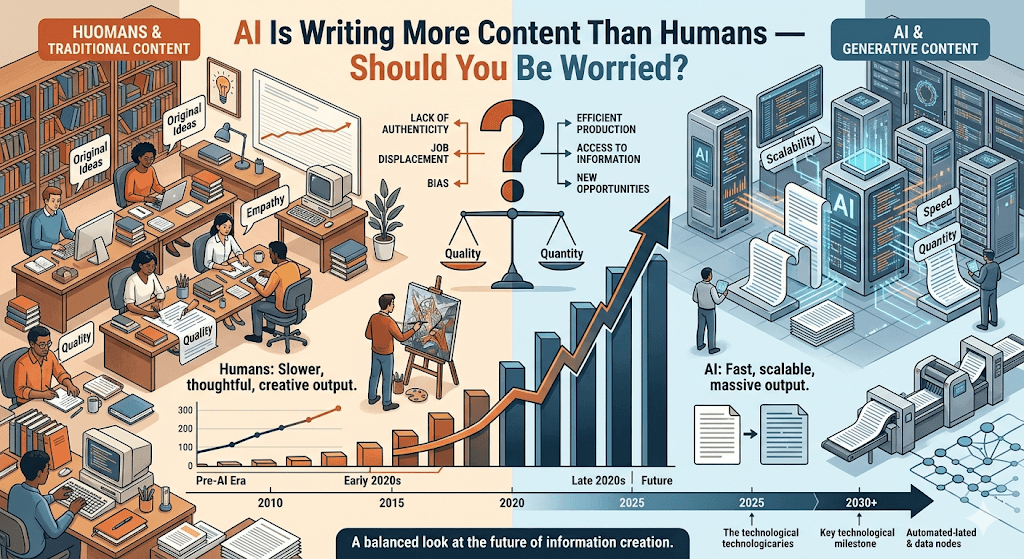
AI Is Writing More Content Than Humans — Should You Be Worried?
The machines have joined the conversation — and they’re prolific. But before you panic, here’s what the AI content wave actually means for writers, businesses, and the rest of us.
Not long ago, a blinking cursor was the writer’s faithful companion — equal parts motivator and tormentor. Today, that cursor barely blinks before an AI model steps in to fill the page. Blog posts, product descriptions, newsletters, social captions, even investigative article drafts: all of it increasingly touched by machine-generated text.
The question isn’t whether AI is writing more content. It clearly is. The more honest question is: what does that actually mean for you?
How Did We Get Here So Fast?
The shift felt sudden, but the groundwork was years in the making. Large language models — trained on virtually the entire written output of the internet — crossed a threshold somewhere around 2022–2023 where their output became genuinely useful, not just impressive in demos. By 2025, AI writing tools had moved from novelty to infrastructure.
Marketing teams started using them for first drafts. News agencies tested them for earnings reports and sports recaps. E-commerce giants deployed them to write millions of product listings overnight. And individual creators — freelancers, bloggers, solopreneurs — began weaving AI into their daily workflow, often without telling their audiences.
“We’re not in an era where AI is occasionally helping humans write. We’re entering one where humans are occasionally helping AI write.”
The numbers back this up. Studies tracking web content at scale suggest a significant and growing share of newly published text carries the fingerprints of AI involvement — from light editing assistance to full generation. The shift is real, and it’s accelerating.
The Legitimate Worries (Yes, They’re Real)
Let’s not be dismissive. There are genuine reasons to feel uneasy about the AI content surge, and pretending otherwise helps nobody.
- Information quality — AI models hallucinate. They state false things with total confidence. When AI content floods the internet at scale, so does plausible-sounding misinformation.
- Job displacement — Entry-level writing roles, content mills, and routine copywriting jobs are already shrinking. This is not hypothetical.
- The homogenization problem — When millions of writers use the same models, trained on the same data, the internet risks sounding like one very eloquent person.
- Trust erosion — Readers who feel deceived by undisclosed AI content tend to distrust the source entirely, even when future content is human-written.
- SEO manipulation — Bad actors use AI to flood search results with low-quality content, degrading the experience for everyone trying to find something real.
These aren’t edge cases. They’re happening now, at scale, across platforms. Acknowledging them isn’t doom-saying — it’s intellectual honesty.
But Here’s What the Panic Misses
The “AI will replace all writers” narrative makes for a gripping headline. It also flattens a more complicated truth. Technology has always changed how we write — and how much of it gets written. The printing press democratized text. The typewriter sped up production. Word processors and spell-checkers made editing faster. The internet made publishing free. Each wave brought concern. Each wave also brought more writers, more audiences, and more content than the generation before could have imagined.
AI is a more dramatic jump, yes. But the underlying dynamic — tools expanding what’s possible — is familiar. The writers who thrived in each previous wave weren’t those who refused new tools. They were those who understood which parts of their craft technology couldn’t touch.
“The writers who thrive aren’t those who out-type the machine. They’re those who out-think it.”
What AI Actually Can’t Do (Yet)
This is where it gets interesting. AI is extraordinarily good at pattern — recognizing it, reproducing it, recombining it. What it lacks is genuine experience, genuine stakes, and genuine perspective shaped by a life actually lived.
An AI can write a technically correct essay about grief. It cannot write about what it felt like to lose someone at 3am and realize the world kept moving anyway. It can generate 10,000 words on startup culture. It cannot tell you about the specific investor meeting that changed everything, from the room it happened in, through the voice it was said with.
Specificity, lived experience, original reporting, unpopular opinions backed by real conviction — these are not things AI generates. They’re things AI mimics, and readers who are paying attention can often feel the difference, even when they can’t articulate it.
- Original interviews, reporting, and firsthand investigation
- Personal essays with genuine emotional stakes
- Cultural commentary with an authentic point of view
- Humor that relies on timing, specificity, and surprise
- The editor’s judgment about what matters and what doesn’t
- Accountability — someone who stands behind the words
Should Businesses Be Worried?
For businesses, the calculus is different from individual writers. The temptation is obvious: AI content is fast and cheap. Deploy it everywhere. Watch the content calendar fill itself. What’s not to love?
The risk is subtler. Audiences are getting better — quickly — at sensing when they’re reading content that doesn’t care about them. AI-generated text optimized for keywords rather than humans is a form of showing your audience exactly how little you value their time. In the short run, it might boost traffic. In the long run, it hollows out trust.
The businesses getting this right treat AI as infrastructure, not voice. AI handles the scaffolding — outlines, research summaries, first drafts of product descriptions, SEO metadata. Humans bring the judgment, the brand perspective, and the final word. The output is faster and more consistent, without reading like it was assembled in a factory.
The Verdict: Worry Wisely
Misinformation at scale, job losses in routine writing roles, the slow erosion of authentic voice across the internet, and platforms that reward volume over quality.
Whether AI will make great writing obsolete. It won’t. Great writing has always been rare. AI makes average writing cheaper, not great writing worthless.
The anxious response to AI content is understandable. The useful response is discernment — learning to tell the difference between content produced to fill space and content produced to illuminate something. That skill will matter more in an AI-saturated world, not less.
And for writers? The path forward isn’t to compete with AI on volume. It’s to be so specific, so grounded, so genuinely yourself that no model trained on the aggregate of the internet can reproduce what you do. That’s always been the differentiator. It just matters more now.
The content landscape is changing faster than most of us can process. The writers and businesses who will shape what comes next aren’t the ones who resisted the change — they’re the ones who understood it clearly enough to stay ahead of it.
Found this worth reading?
Share it with someone navigating the AI content wave — writer, marketer, or just a curious person.


Comments are closed.