
Imagine waking up to news that a nation’s power grid has gone dark—not from bombs falling, but from lines of code executed halfway across the world. No visible explosions, no troops crossing borders, yet hospitals lose power, water stops flowing, and entire economies grind to a halt. It feels like science fiction, yet elements of this scenario have already played out in real conflicts from Ukraine to the Middle East.
At Inspireviraltimes.com, we explore the big questions shaping our future with hope, realism, and a human touch. Cyber warfare raises a profound one: Will invisible digital battles eventually replace the tanks, jets, and boots-on-the-ground of traditional wars? The short answer is no—but the long answer reveals a far more complex, hybrid reality that’s already unfolding. Let’s break it down together.
What Is Cyber War, Really?
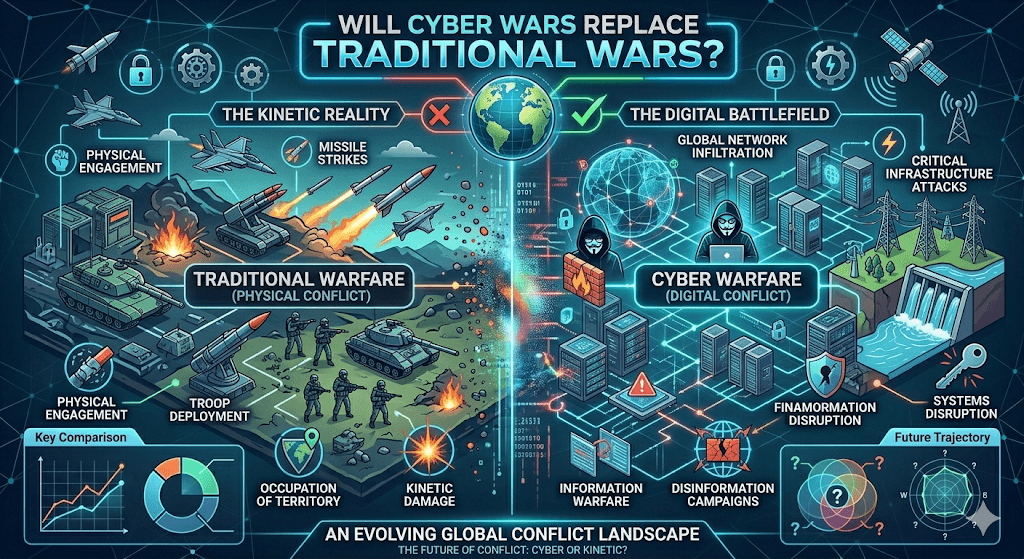
Cyber warfare involves state (or state-backed) actors using digital tools to disrupt, destroy, or manipulate an adversary’s computer systems, networks, and data. Think malware that wipes systems, denial-of-service attacks that knock websites offline, or sophisticated intrusions that steal secrets or sabotage infrastructure.
Traditional (kinetic) warfare, by contrast, relies on physical force: missiles, drones, ground troops, and direct destruction.
The fear many share is that cyber attacks could achieve the same strategic goals—weakening enemies, sowing chaos, or even deciding conflicts—without the human cost or political fallout of visible war. But is that realistic?
Recent Examples: Cyber and Kinetic Working Together
History shows cyber operations are powerful, but they rarely stand alone.
- In the Russia-Ukraine conflict, Russian cyber campaigns preceded the 2022 invasion, targeting government systems, communications, and infrastructure to “prepare the battlefield.” Wiper malware and attempts to disrupt satellite links aimed to create confusion, yet the war quickly turned kinetic—with tanks rolling in and devastating physical destruction following.
- During the 2025 Israel-Iran “Twelve-Day War,” both sides launched coordinated cyber strikes alongside physical operations. Israel-linked groups disrupted Iranian financial systems and crypto exchanges, while Iran-backed hacktivists hit Israeli infrastructure, spread disinformation, and attempted TV hacks. Cyber created disruption and psychological pressure, but missiles and airstrikes decided the immediate outcomes.
- In early 2026 escalations involving the US, Israel, and Iran, cyberattacks targeted critical infrastructure, data centers, and even medical companies, often as retaliation or preparation. Yet physical strikes remained central.
These cases illustrate a pattern: Cyber serves as a powerful force multiplier—disrupting command systems, gathering intelligence, or causing economic pain—but it hasn’t replaced the need for physical dominance when decisive victory is the goal.
Why Cyber Wars Are Unlikely to Fully Replace Traditional Ones
Several practical and strategic reasons keep kinetic warfare relevant:
- Attribution and Escalation Control Cyber attacks are often deniable. A power outage could be blamed on a “glitch” or criminals rather than a state. This ambiguity lowers the threshold for action but also makes it harder to achieve clear strategic wins or deter future aggression. Traditional attacks send unambiguous messages.
- Limited Destructive Power (So Far) While cyber can cause chaos—think the 2021 Colonial Pipeline ransomware or hypothetical grid blackouts—it’s harder to achieve permanent, large-scale physical destruction compared to bombs. Many systems have redundancies, and recovery is often possible. Experts note that “cyber war will not take place” in the classic sense because effects are frequently reversible or containable.
- Human and Territorial Goals Wars are often about controlling land, resources, or populations. Cyber can’t occupy territory, enforce regime change, or secure borders the way physical forces can. Prestige, visible victory, and deterrence through strength still matter in geopolitics.
- The Hybrid Reality Most analysts agree the future lies in hybrid warfare: blending cyber, disinformation, economic pressure, drones, AI-driven systems, and conventional forces. Russia, China, Iran, and others already use this mix to stay below the threshold of full-scale war while advancing objectives.
In short, cyber expands the battlefield into a new domain (alongside land, sea, air, and space), but it complements rather than supplants traditional tools.
The Inspiring Side: Resilience, Innovation, and Human Ingenuity
Here’s where hope shines through. The rise of cyber threats is driving remarkable progress:
- Nations are investing heavily in cyber defenses, zero-trust architectures, AI for threat detection, and international cooperation (think NATO’s cyber exercises and shared intelligence).
- Private companies and governments collaborate more than ever—tech giants now play frontline roles in defending against state actors.
- Everyday people and organizations are becoming more aware, pushing for better cybersecurity hygiene, which strengthens societies overall.
- Ethical and legal frameworks are evolving to govern this new domain, aiming to prevent uncontrolled escalation.
Human creativity thrives under pressure. Just as the nuclear age led to deterrence doctrines that prevented direct superpower war, the cyber age may foster new norms of responsible state behavior in cyberspace.
What This Means for You and Me
While nation-states battle in shadows and on battlefields, the ripple effects touch daily life: higher insurance costs, disrupted services, potential privacy risks, and the spread of disinformation that divides communities.
Your personal playbook for resilience:
- Treat cybersecurity as everyday self-defense—strong unique passwords, multi-factor authentication, software updates, and skepticism toward urgent requests.
- Support policies that fund robust national cyber defenses and international agreements.
- Stay informed but avoid panic; knowledge is power.
- Remember the human element: Build real-world connections and critical thinking skills that no algorithm can fully replace.
Looking Ahead with Cautious Optimism
Cyber wars won’t replace traditional wars anytime soon. Instead, they’re reshaping them into faster, more complex, multi-domain contests where the side that integrates technology, strategy, and resilience best will hold the advantage.
At Inspireviraltimes.com, we believe humanity’s greatest strength isn’t any single weapon—it’s our ability to adapt, collaborate, and choose wisdom over destruction. The digital age challenges us to defend not just borders, but values like truth, security, and human dignity.
The future of conflict may include more code than cannons in the opening moves, but the ultimate battles will still involve human decisions, ethics, and the will to build peace.
What do you think—could cyber tools ever make traditional warfare obsolete, or will they always need physical backing? Share your thoughts in the comments. Let’s keep inspiring smarter conversations and a safer world.
Stay vigilant, stay inspired. Share this if it sparked new thinking for you!
Insights drawn from analyses by the World Economic Forum, security experts, recent conflict reports, and strategic studies (2025–2026).

Comments are closed.