The Biggest Cybersecurity Threats of the Next Decade: What’s Coming and How We Can Stay Ahead
Picture this: It’s 2035. You wake up to a notification that your smart home system has been locked by ransomware—again. Or worse, a deepfake video of your boss demands an urgent wire transfer that looks completely real. Hospitals grind to a halt from AI-orchestrated attacks, and critical infrastructure flickers under quantum-powered breaches. Sounds like science fiction? It’s not. Cybercrime already costs the world trillions annually, and experts warn the next decade could see damages climb even higher if we don’t act now.
At Inspireviraltimes.com, we’re all about turning challenges into opportunities for resilience and innovation. The good news? While threats are evolving at breakneck speed, so is our ability to fight back—with smarter tech, stronger collaboration, and everyday awareness. Let’s unpack the biggest cybersecurity threats looming over the next 10 years (2026–2035), why they matter to regular people like you and me, and—most importantly—how we can build a safer digital future together.
1. AI-Powered and Agentic Attacks: The New Arms Race
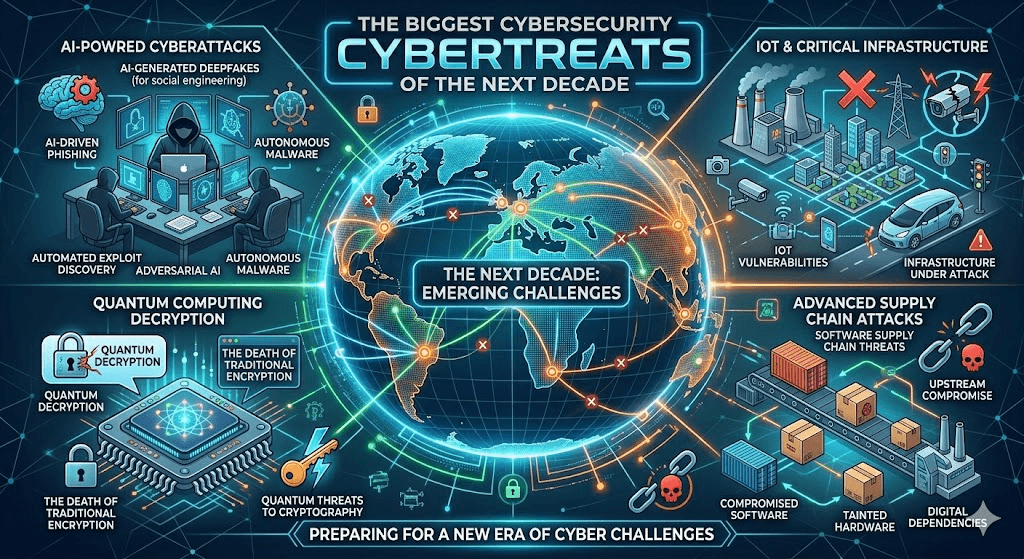
Artificial intelligence isn’t just helping defenders—it’s supercharging attackers. By 2026 and beyond, we’ll see agentic AI: autonomous systems that plan, execute, and adapt cyberattacks with minimal human input. These “AI agents” can scan for vulnerabilities, craft personalized phishing emails, and move laterally across networks faster than any human team.
Generative AI already makes phishing and deepfakes scarily convincing. In the coming decade, expect AI-driven malware that evolves in real-time to dodge detection, plus prompt injection attacks that trick AI systems themselves into leaking data or making bad decisions.
Why it hits home: A single sophisticated attack could drain your savings or expose your family’s private info. The World Economic Forum notes AI vulnerabilities as one of the fastest-growing risks, with 87% of organizations flagging them in recent surveys.
2. Ransomware Evolution: From Lock-and-Extort to Full Enterprise Crime
Ransomware isn’t going away—it’s professionalizing. We’re moving into “Ransomware 3.0” with triple extortion: encrypt your data, steal it, and threaten to attack your customers or partners too. Groups operate like legitimate businesses with RaaS (Ransomware-as-a-Service) models, making it easier for even low-skilled criminals to launch devastating strikes.
By the mid-2030s, expect attacks targeting operational technology (OT) in factories, power grids, and hospitals, where downtime isn’t just costly—it’s dangerous.
Human impact: Families lose access to medical records. Small businesses close their doors. The global cost of cybercrime is already projected to hit massive figures, affecting everyday economies.
3. Supply Chain Attacks: The Domino Effect
One weak link in a vast network of suppliers, software vendors, or cloud providers can topple giants. Supply chain incidents have already quadrupled in recent years, and the trend will accelerate as businesses rely more on interconnected ecosystems.
Attackers target third-party software, hardware, or open-source components. A single compromised update could affect millions—think SolarWinds-style breaches but on steroids.
The personal angle: Your bank, healthcare provider, or favorite app could all be compromised through someone else’s oversight. Visibility and “inheritance risk” (not knowing how secure your vendors really are) top the list of worries for many organizations.
4. Deepfakes and Hyper-Personalized Social Engineering
Deepfakes will become so realistic that video calls, voice messages, and even live interactions won’t be trustworthy. Criminals will use them for CEO fraud, romance scams, or impersonating loved ones in distress.
Combined with AI, these attacks will be hyper-personalized—pulling data from your social media to craft messages that feel eerily authentic.
Why it feels personal: Trust is the foundation of our digital lives. When you can’t believe your eyes or ears, how do you navigate banking, work, or family communication?
5. Quantum Computing Threats: Breaking Encryption as We Know It
Quantum computers promise incredible advances—but they could render today’s encryption obsolete. By around 2030, “harvest now, decrypt later” attacks mean criminals (or nation-states) are already collecting encrypted data today to crack it tomorrow.
This “Q-Day” risk threatens everything from banking transactions to government secrets and personal health data.
Hope on the horizon: Post-quantum cryptography is already in development. Governments and companies are racing to “go quantum-safe” before it’s too late.
6. Identity and Access Management Nightmares (Including Non-Human Identities)
With billions of devices, AI agents, and cloud services, managing “who” or “what” has access becomes incredibly complex. Attacks on identities—human or machine—will surge. Non-human identities (like API keys or AI bots) are especially vulnerable because they often lack strong governance.
Insider threats, whether malicious or accidental, will mix with shadow AI (unauthorized use of public AI tools) to create new weak points.
7. Attacks on Critical Infrastructure and Emerging Tech
IoT devices, autonomous systems, cloud-heavy environments, and even space technologies will expand the attack surface dramatically. Geopolitical tensions could fuel state-sponsored attacks on power grids, transportation, and healthcare.
Disinformation campaigns blended with cyber operations will blur the lines between information warfare and traditional hacking.
The Bigger Picture: Why These Threats Are Interconnected
These aren’t isolated risks—they feed off each other. AI makes supply chain attacks faster and smarter. Quantum threats amplify ransomware payoffs. Deepfakes erode the trust needed for effective incident response. And as cybercrime costs potentially reach $15 trillion or more by 2030, the incentives for criminals only grow.
But here’s the inspiring part: The same technologies driving threats (AI, quantum) are also powering defenses. We’re seeing shifts toward preemptive security, AI-driven detection, zero-trust architectures, and global collaboration. Regulatory frameworks are tightening, and public-private partnerships are expanding.
Your Personal Action Plan: Small Steps, Big Resilience
You don’t need to be a cybersecurity expert to make a difference. Here’s how everyday people can help turn the tide over the next decade:
- Strengthen basics: Use unique, strong passwords with a manager; enable multi-factor authentication everywhere (preferably app- or hardware-based, not SMS).
- Stay skeptical: Verify requests—even from “known” contacts—through a second channel. Question unsolicited videos or urgent demands.
- Update everything: Keep software, apps, and devices current. Enable automatic updates where possible.
- Be mindful of AI: Avoid feeding sensitive data into public AI tools. Use company-approved secure alternatives.
- Support the bigger fight: Back policies that fund quantum-safe encryption, international cooperation, and cyber education. Report scams promptly.
- Build habits: Regular backups (offline or immutable), awareness training for your family, and minimal sharing of personal details online.
Businesses and governments must invest in supply chain visibility, AI governance, post-quantum readiness, and resilient architectures. The good news? Cybersecurity spending is booming, projected to reach hundreds of billions as awareness grows.
Looking Ahead with Optimism
The next decade will test us, but it also offers a chance to redesign a more secure, trustworthy digital world. At Inspireviraltimes.com, we believe humanity’s creativity and collaboration have always overcome tough challenges—from the internet’s birth to today’s AI revolution.
Threats will evolve, but so will our defenses—and our collective will to protect what matters: our privacy, our economies, our way of life.
What worries you most about future cyber threats—AI attacks, deepfakes, or something else? Share in the comments below. Let’s keep the conversation going and inspire smarter, safer choices together.
Stay vigilant, stay inspired. Share this post if it helped you feel more prepared!
Insights drawn from reports by the World Economic Forum, Gartner, IBM, and industry forecasts (2026–2030 projections).