
Which Cloud Platform Is Best for You?
Cloud computing is the backbone of modern technology. From startups to global enterprises, companies rely on cloud platforms to build, scale, and manage applications efficiently.
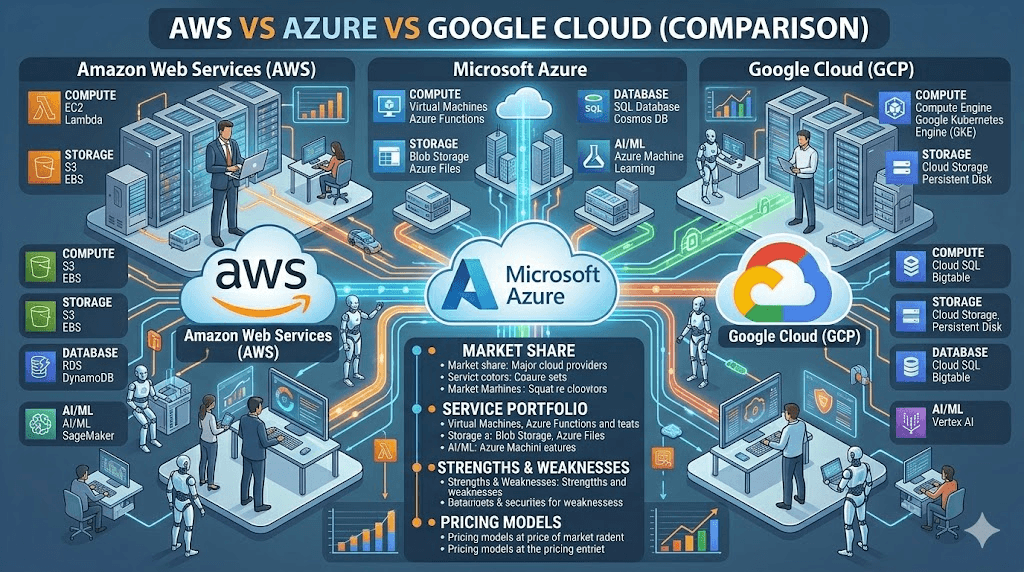
In a world where businesses live and die by their digital infrastructure, choosing the right cloud platform isn’t just a technical decision—it’s a strategic one that can fuel explosive growth or quietly drain resources. Welcome to the definitive 2026 comparison of the “Big Three”: Amazon Web Services (AWS), Microsoft Azure, and Google Cloud Platform (GCP).
Whether you’re a startup founder scaling your first app, an enterprise CTO modernizing legacy systems, or a developer plotting your next career move, this guide cuts through the hype. We’ll break down market dominance, core services, pricing, AI capabilities, global reach, security, and real-world use cases—backed by the latest 2026 data—so you can decide with confidence.
The three biggest cloud providers dominating the market today are:
- Amazon Web Services (AWS)
- Microsoft Azure
- Google Cloud Platform (GCP)
But which one is best? Which should developers, businesses, or beginners choose?
In this complete AWS vs Azure vs Google Cloud comparison, we’ll break everything down in simple terms so you can choose the right cloud platform.
🌐 What Are Cloud Platforms?
Cloud platforms allow you to:
- Store data online
- Host websites and applications
- Run AI & machine learning
- Build scalable infrastructure
- Deploy apps globally
Instead of buying expensive servers, you rent computing power from cloud providers.
🏆 AWS vs Azure vs Google Cloud: Quick Comparison
| Feature | AWS | Azure | Google Cloud |
|---|---|---|---|
| Launch Year | 2006 | 2010 | 2011 |
| Market Share | #1 | #2 | #3 |
| Best For | Startups & Enterprises | Microsoft Ecosystem | AI & Data |
| Global Regions | 30+ | 60+ | 35+ |
| Pricing | Flexible | Enterprise-friendly | Competitive |
| Learning Curve | Moderate | Easy (for Microsoft users) | Easy |
☁️ Amazon Web Services (AWS)
What is AWS?
Amazon Web Services (AWS) is the world’s largest cloud computing platform, used by companies like:
- Netflix
- Airbnb
- NASA
- Spotify
- Samsung
AWS offers 200+ cloud services, making it the most feature-rich platform.
AWS Key Features
- Largest global infrastructure
- Most cloud services
- Strong security
- Scalable architecture
- Mature ecosystem
Popular AWS Services
- EC2 (Virtual Servers)
- S3 (Storage)
- Lambda (Serverless)
- RDS (Databases)
- CloudFront (CDN)
Pros of AWS
✅ Most mature platform
✅ Largest community
✅ Best documentation
✅ Highly scalable
✅ Great for startups
Cons of AWS
❌ Complex pricing
❌ Steeper learning curve
❌ Can become expensive
🔵 Microsoft Azure
What is Azure?
Microsoft Azure is the second-largest cloud provider, especially popular among enterprise businesses.
Azure works best with:
- Windows Server
- Microsoft 365
- Active Directory
- .NET applications
Azure Key Features
- Strong enterprise integration
- Hybrid cloud solutions
- Microsoft ecosystem compatibility
- Enterprise-grade security
Popular Azure Services
- Azure Virtual Machines
- Azure Blob Storage
- Azure Functions
- Azure SQL Database
- Azure Kubernetes Service
Pros of Azure
✅ Best for enterprises
✅ Excellent hybrid cloud support
✅ Strong Microsoft integration
✅ Great security features
Cons of Azure
❌ Interface can be confusing
❌ Documentation not as strong as AWS
❌ Pricing can be complex
🟡 Google Cloud Platform (GCP)
What is Google Cloud?
Google Cloud is known for AI, machine learning, and big data capabilities.
Companies using Google Cloud include:
- YouTube
- PayPal
- Snapchat
- Spotify (partial infrastructure)
Google Cloud Key Features
- Best AI and ML tools
- Strong data analytics
- High-performance networking
- Kubernetes leadership
Popular Google Cloud Services
- Compute Engine
- Cloud Storage
- BigQuery
- Cloud Functions
- Kubernetes Engine (GKE)
Pros of Google Cloud
✅ Best for AI & Machine Learning
✅ Strong data analytics
✅ Competitive pricing
✅ Fast networking
Cons of Google Cloud
❌ Smaller ecosystem than AWS
❌ Fewer enterprise features
❌ Smaller market share
💰 Pricing Comparison
AWS Pricing
- Pay-as-you-go
- Free tier available
- Reserved instances available
- Can become expensive at scale
Azure Pricing
- Pay-as-you-go
- Enterprise discounts
- Hybrid pricing benefits
Google Cloud Pricing
- Pay-as-you-go
- Sustained-use discounts
- Often cheaper for compute
🏆 Winner (Pricing): Google Cloud
🚀 Performance Comparison
| Platform | Performance |
|---|---|
| AWS | Excellent |
| Azure | Very Good |
| Google Cloud | Excellent |
🏆 Winner (Performance): AWS & Google Cloud (Tie)
🤖 AI & Machine Learning Comparison
| Platform | AI & ML Strength |
|---|---|
| AWS | Strong |
| Azure | Strong |
| Google Cloud | Best |
🏆 Winner (AI/ML): Google Cloud
🔐 Security Comparison
All three platforms provide:
- Encryption
- Identity management
- Compliance certifications
- Threat detection
🏆 Winner (Security): Tie (All are enterprise-grade)
🌎 Global Infrastructure
| Platform | Regions |
|---|---|
| AWS | 30+ |
| Azure | 60+ |
| Google Cloud | 35+ |
🏆 Winner (Global Reach): Azure
👨💻 Best Platform for Different Use Cases
Best for Beginners
🏆 Winner: Google Cloud
Simple interface and good free credits.
Best for Startups
🏆 Winner: AWS
Most flexible and scalable.
Best for Enterprises
🏆 Winner: Azure
Perfect Microsoft integration.
Best for AI & Machine Learning
🏆 Winner: Google Cloud
Best AI tools and data analytics.
Best Overall Cloud Platform
🏆 Winner: AWS
Because of:
- Largest ecosystem
- Most features
- Strong community
- Proven reliability
📊 Market Share (2026)
- AWS — ~31%
- Azure — ~25%
- Google Cloud — ~11%
AWS continues to dominate the cloud market globally.
🎯 Final Verdict
| If You Want | Choose |
|---|---|
| Best Overall | AWS |
| Enterprise Use | Azure |
| AI & Data | Google Cloud |
| Beginner Friendly | Google Cloud |
| Startups | AWS |
Conclusion
AWS, Azure, and Google Cloud are all powerful cloud platforms. Your choice depends on your needs:
- Choose AWS for flexibility and scale
- Choose Azure for enterprise integration
- Choose Google Cloud for AI and analytics
No matter which platform you choose, learning cloud computing is one of the most valuable skills in 2026 and beyond.
FAQ Section
Which cloud platform is best in 2026?
AWS remains the most popular, but Azure and Google Cloud are growing rapidly.
Is AWS better than Azure?
AWS is more mature, but Azure is better for Microsoft-based environments.
Is Google Cloud cheaper than AWS?
In many cases, yes — especially for compute and data analytics.
Which cloud is best for beginners?
Google Cloud is often easiest to start with.
Should I learn AWS, Azure, or Google Cloud?
Start with AWS, then expand to Azure and Google Cloud.
Drop your biggest cloud question in the comments below. Which provider are you leaning toward in 2026, and why? Let’s inspire the next wave of digital leaders together!
At Inspireviraltimes.com, we believe the right technology doesn’t just solve problems—it sparks transformation. Share this guide with your network and stay ahead of the cloud curve.
Tags: AWS vs Azure, Google Cloud comparison 2026, best cloud provider, cloud migration, AI in cloud, cloud pricing
Last updated: April 2026 Sources include Synergy Research Group, official provider docs, and independent benchmarks.


Comments are closed.