
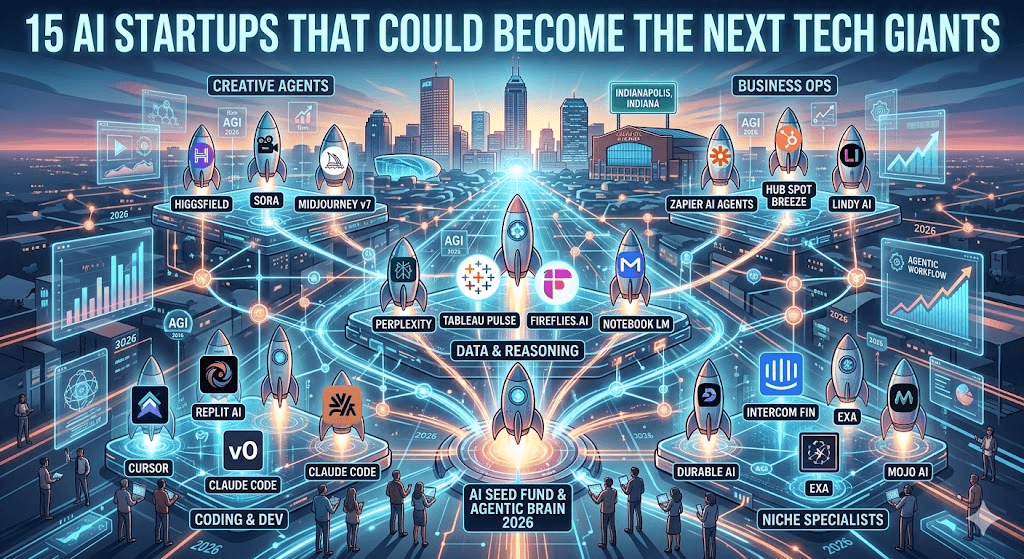
The AI gold rush is in full swing. In 2026, a handful of startups aren’t just building impressive tools—they’re laying the foundation for entirely new platforms, ecosystems, and industries. With massive funding rounds, explosive revenue growth, and breakthroughs in frontier models, agents, multimodality, and robotics, these companies have the potential to follow in the footsteps of Google, Amazon, or Meta.
While giants like OpenAI (valued at hundreds of billions) and established players dominate headlines, the real disruptors are often the fast-moving startups reshaping specific domains or pushing the boundaries of what’s possible.
Here are 15 AI startups poised to become the next tech titans. Selected for their innovation, funding momentum, real-world traction, and long-term ambition as of early 2026.
1. Anthropic
Founded by former OpenAI executives (including Dario Amodei), Anthropic focuses on safe, reliable, and constitutional AI. Its Claude models lead in reasoning, long-context handling, and enterprise adoption. Why it could dominate: Massive funding (including a $30B round at $380B valuation), rapid revenue growth to double-digit billions ARR, and strong emphasis on AI safety that appeals to regulated industries like finance and healthcare. Claude’s coding and agentic capabilities are already powering significant workflows.
2. xAI
Elon Musk’s ambitious venture aims for maximum truth-seeking and understanding the universe. Grok models emphasize real-time knowledge, humor, and fewer restrictions. Why it could dominate: Backed by enormous capital (recent $20B+ rounds) and synergies with Musk’s empire (SpaceX, Tesla, X). The merger with SpaceX infrastructure gives it unmatched compute scale for pursuing AGI-level breakthroughs.
3. Perplexity AI
The AI-powered search engine that delivers conversational answers with real-time citations, challenging traditional Google Search. Why it could dominate: Millions of monthly active users, strong subscription revenue, and a clean, trustworthy alternative to ad-driven search. Its focus on accuracy and research makes it indispensable for professionals.
4. Anysphere (Cursor)
The AI-first code editor transforming software development. Cursor acts as an intelligent pair programmer that understands entire projects and enables agentic coding workflows. Why it could dominate: Explosive growth in ARR (hundreds of millions to $1B+), rapid valuation increases (tens of billions), and adoption by top engineers. As coding becomes AI-augmented, Cursor could own the developer tools market like GitHub did before.
5. ElevenLabs
Leader in hyper-realistic voice synthesis, cloning, and emotional text-to-speech. Why it could dominate: Skyrocketing revenue (hundreds of millions ARR), Fortune 500 adoption, and expansion into audio content, dubbing, and accessibility. Voice is the next frontier for immersive AI experiences in media, education, and entertainment.
6. Runway ML
Pioneering generative video tools that turn text or images into high-quality video with advanced editing and motion control. Why it could dominate: Hollywood and creator adoption, strong partnerships, and leadership in the exploding text-to-video space. As video generation matures, Runway could become the “Adobe of AI video.”
7. Mistral AI
Europe’s flagship AI company building efficient, high-performance open and closed models. Why it could dominate: Backed by Nvidia and others, strong focus on cost-efficient models, and growing enterprise traction. In a world of geopolitical AI tensions, Mistral offers a compelling non-U.S. alternative.
8. Figure AI
Building advanced humanoid robots powered by AI for general-purpose tasks in warehouses, homes, and factories. Why it could dominate: Backing from OpenAI, Microsoft, Nvidia, and Jeff Bezos. Humanoid robotics combined with frontier AI models could revolutionize labor markets, creating a new hardware-software giant.
9. Skild AI
Developing foundational AI models specifically for robotics, enabling more adaptable and intelligent physical agents. Why it could dominate: Massive recent funding at high valuations and focus on bridging the sim-to-real gap in robotics. As AI agents move from digital to physical worlds, Skild’s tech could be foundational.
10. Cognition Labs (Devin)
Creators of Devin, one of the first fully autonomous AI software engineers capable of planning, coding, debugging, and deploying entire projects. Why it could dominate: Leading the agentic AI wave for software engineering. If autonomous coding agents scale reliably, Cognition could redefine how software is built globally.
11. Synthesia
AI avatars and generative video for professional training, marketing, and communication in multiple languages. Why it could dominate: Strong revenue traction (over $100M ARR reported in similar timelines) and enterprise use cases. Personalized video at scale could disrupt content production industries.
12. World Labs (by Fei-Fei Li)
Focused on “spatial intelligence” and world models—AI that truly understands 3D physical spaces and interactions. Why it could dominate: Backed by top talent and investors, with potential to enable next-gen AR/VR, robotics, and simulation. Understanding the physical world is a critical missing piece for general AI.
13. Replit
Browser-based coding platform enhanced with powerful AI agents for collaborative and autonomous software creation. Why it could dominate: Recent large funding at multi-billion valuations and push into agentic development tools. Making coding accessible to everyone via AI could expand the global developer base dramatically.
14. DeepSeek
Chinese open-source AI lab delivering high-performance models at dramatically lower costs. Why it could dominate: Proven ability to challenge Western models on efficiency and performance. In an era of compute constraints, cost-effective open models could capture massive developer and enterprise share globally.
15. Abridge
AI platform for healthcare that turns doctor-patient conversations into structured clinical notes and insights. Why it could dominate: Strong valuation growth, focus on a massive market (healthcare documentation burnout), and proven accuracy in a regulated field. Vertical AI in healthcare could produce trillion-dollar outcomes.
What Makes These Startups Potential Giants?
- Agentic Shift: Many are moving beyond chat to autonomous agents that plan and execute complex tasks.
- Multimodal Mastery: Handling text, voice, video, and physical understanding simultaneously.
- Vertical + Horizontal Ambition: Combining deep domain expertise (healthcare, coding, robotics) with general capabilities.
- Infrastructure Edge: Access to massive compute, unique data, or hardware synergies (e.g., robotics + models).
- Revenue Traction: Several are already generating hundreds of millions to billions in annualized revenue, proving product-market fit.
Challenges Ahead: Intense competition, regulatory scrutiny (especially around safety and IP), skyrocketing compute costs, and the need to deliver reliable, hallucination-free results at scale. Talent wars and energy demands for training will also test these companies.
AI Startup Trends to Watch in 2026
1. AI Agents
AI that can work like humans
2. AI Search
Replacing traditional search engines
3. AI Video & Media
Content automation explosion
4. AI Infrastructure
GPU and compute demand growing
5. Enterprise AI
Businesses adopting AI at scale
The Next Chapter of Tech
The AI era is still young. While today’s giants provide the infrastructure, these startups are building the applications, agents, and physical embodiments that could define the 2030s. Some will merge, get acquired, or go public; a few might stumble. But the ones that execute could reshape entire economies.
Which of these AI startups are you watching most closely? Do you think robotics (Figure, Skild) or agentic coding tools (Cursor, Cognition) will produce the next mega-company? Share your predictions in the comments!
Subscribe for more deep dives into emerging tech, startup analysis, and AI trends shaping our future.