By ARSHIV
Published: March 23, 2026
Introductions
If you are reading this, you likely spend a significant portion of your life online. You shop, bank, work, and connect with loved ones through a screen. But in 2026, the digital world is no longer a separate reality from the physical one—it is our reality.
And just like you wouldn’t leave your front door wide open or your car keys in the ignition, you can no longer afford to leave your digital life unprotected.
Welcome to the world of cybersecurity. If the term makes you think of hooded hackers in dark rooms or confusing IT jargon, let’s clear that up right now. This guide is for beginners. By the end, you won’t just know what cybersecurity is; you’ll know why it’s the most essential life skill of the decade.
In today’s hyper-connected world, cybersecurity is no longer optional—it’s essential. From online banking and social media to remote work and cloud computing, almost every aspect of our lives depends on digital systems. But with this convenience comes risk. Cyber threats are evolving faster than ever in 2026, making it crucial for everyone—not just tech experts—to understand the basics of cybersecurity.
This beginner-friendly guide will help you understand what cybersecurity is, why it matters, and how you can protect yourself in an increasingly digital world.
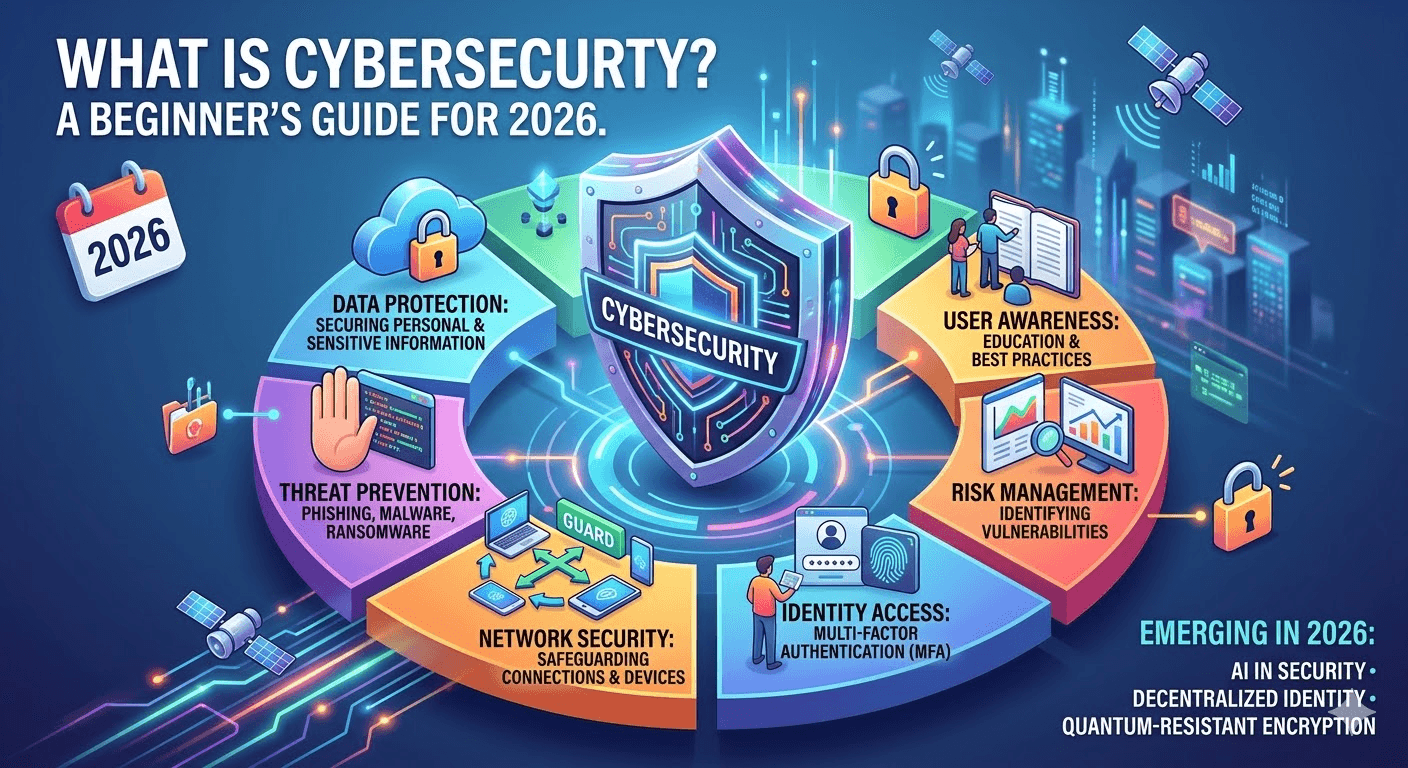
🔐 What Is Cybersecurity?
Cybersecurity refers to the practice of protecting systems, networks, devices, and data from digital attacks, theft, or damage. These attacks are typically carried out by hackers, cybercriminals, or even automated bots looking to exploit vulnerabilities.
In simple terms, cybersecurity is like a digital security system that keeps your personal and professional information safe.
🌐 Why Cybersecurity Matters More in 2026
Cybersecurity has become more critical than ever due to:
1. Rise of AI-Powered Attacks
Cybercriminals now use artificial intelligence to launch smarter and more targeted attacks.
2. Remote Work & Cloud Dependency
With more people working remotely, sensitive data is often accessed from multiple locations and devices.
3. Explosion of IoT Devices
Smart homes, wearables, and connected devices create more entry points for hackers.
4. Data Is the New Currency
Personal data is highly valuable and frequently targeted for identity theft and fraud.
⚠️ Common Types of Cyber Threats
Understanding threats is the first step to staying safe.
1. Phishing Attacks
Fake emails or messages that trick you into revealing personal information.
2. Malware
Malicious software designed to damage or gain unauthorized access to systems.
3. Ransomware
A type of malware that locks your data and demands payment to restore access.
4. Social Engineering
Manipulating people into giving away confidential information.
5. DDoS Attacks (Distributed Denial of Service)
Overloading a system with traffic to make it unavailable.
The Simple Definition: It’s Digital Bodyguards
At its core, cybersecurity is the practice of protecting systems, networks, data, and programs from digital attacks.
Think of it as a team of digital bodyguards. Their job is to ensure three things (what experts call the “CIA Triad”):
- Confidentiality: Ensuring only the right people see your data.
- Integrity: Ensuring your data hasn’t been tampered with or altered.
- Availability: Ensuring you can actually access your data when you need it (and not locked out by a hacker).
In 2026, this doesn’t just apply to your laptop. It applies to your car (which is now a computer on wheels), your smart refrigerator, your doorbell camera, and even your medical implants.
Why 2026 is Different: The New Threat Landscape
If you read a cybersecurity article from five years ago, it was mostly about spam emails and viruses. Today, the stakes are exponentially higher.
Here is what cybersecurity is up against in 2026:
1. The Rise of Generative AI Crime
In 2024 and 2025, we saw the emergence of AI as a tool. In 2026, AI is the weapon. Hackers no longer send poorly worded emails asking for your bank details. They now use AI to:
- Clone voices: Imagine getting a phone call from your “boss” or “mother” telling you to urgently transfer money. The voice is perfect. The mannerisms are perfect. But it’s AI.
- Create hyper-realistic deepfakes: Video calls are being spoofed. If you work in finance, you might join a video meeting with what looks like your CFO and legal team—all AI-generated avatars—telling you to approve a payment.
2. The “Everything” Mesh
We are in the era of the Internet of Things (IoT) . The average person in 2026 owns 15 to 20 connected devices. Your washing machine, your thermostat, and your children’s toys are all entry points into your home network. A hacker doesn’t break in through your strong password; they break in through your unpatched smart lightbulb.
3. Quantum Computing (The Looming Threat)
While quantum computers aren’t yet in the hands of criminals, the threat of “Harvest Now, Decrypt Later” is real. Hackers are stealing encrypted data today because they know that in a few years, quantum computers will be powerful enough to crack the encryption currently protecting our banking and medical records.
The 5 Pillars of Modern Cybersecurity
Cybersecurity isn’t one thing; it’s a structure. To understand it, you need to know the five areas experts focus on:
| Pillar | What It Is | Example in 2026 |
|---|---|---|
| 1. Critical Infrastructure | Protecting the utilities we rely on: power grids, water systems, hospitals. | In 2026, a ransomware attack on a hospital isn’t just about data theft; it’s about preventing surgeons from accessing surgical robots during live operations. |
| 2. Application Security | Ensuring the apps you download (TikTok, your banking app, AI tools) are safe. | Using Zero-Trust Architecture—apps no longer automatically trust you just because you’re inside the office network. They verify you every single time. |
| 3. Network Security | Securing the highway your data travels on. | Moving to SASE (Secure Access Service Edge) —a cloud-based security model that protects you whether you are at home, in a cafe, or on a plane. |
| 4. Cloud Security | Protecting data stored in the cloud (AWS, Google Cloud, etc.). | Since most businesses are “cloud-first,” misconfigured cloud storage is the #1 cause of data breaches in 2026. |
| 5. Human Security | The most overlooked pillar. This is about you. | Phishing simulations and behavioral analytics are now standard. Companies monitor how you type and move your mouse to detect if it’s really you—or a hacker who stole your password. |
The 3 Biggest Threats You Face Right Now
To be safe in 2026, you need to know what the enemy looks like. Here are the top three threats trending this year:
1. Ransomware-as-a-Service (RaaS)
Believe it or not, you don’t need to be a coding genius to be a hacker anymore. RaaS is a business model where professional cybercriminals sell their software to “affiliates” for a cut of the profit. It’s like Uber, but for crime. These groups target small businesses, schools, and individuals, locking their files and demanding cryptocurrency for the key.
2. Credential Stuffing
This is the reason you keep hearing about “data breaches.” Hackers obtain a list of usernames and passwords from one site (say, a forum that got hacked) and then use automated bots to try those same credentials on thousands of other sites (like your bank, email, or Amazon). If you reuse passwords, you are dangerously exposed.
3. Quishing (QR Code Phishing)
As the world went “touchless,” QR codes exploded in popularity. Hackers are now placing fake QR codes on parking meters, restaurant tables, and in emails. You scan the code thinking you’re paying for parking or viewing a menu, but you’re actually downloading malware or handing over your login credentials.
How to Protect Yourself: A Beginner’s Toolkit
You don’t need a degree in computer science to be secure. You just need to adopt the “Cyber Hygiene” habits of 2026.
1. Use a Password Manager (No Exceptions)
If you remember your passwords, they are too weak. In 2026, you should only know one password: the one to your password manager (like Bitwarden or 1Password). Let the computer generate and remember complex, unique passwords for the other 200+ accounts you have.
2. Enable Passkeys, Not Just 2FA
Two-Factor Authentication (2FA) is good. But Passkeys are better. In 2026, most major platforms (Google, Apple, Microsoft) use Passkeys. Instead of a code sent via text (which can be intercepted), Passkeys use your face, fingerprint, or PIN to authenticate you. They are phishing-resistant.
3. Freeze Your Credit and Monitor Your “Digital Exhaust”
In 2026, your data is out there. Accept it. The best defense is vigilance.
- Credit Freeze: Keep your credit files locked so no one can open a loan in your name.
- Data Removal Services: Services like DeleteMe or Incogni scrub your personal info (address, phone number) from data broker sites.
4. The “AI-First” Mindset
Treat every unexpected communication as a potential AI deepfake.
- If a “relative” calls crying asking for money, hang up and call them back on their known number.
- If your “CEO” asks for a wire transfer via Slack, walk to their desk or video call them using a known company link.
- Trust no one. Verify everything.
💼 Career Opportunities in Cybersecurity
Cybersecurity is one of the fastest-growing fields in 2026. Some popular roles include:
- Security Analyst
- Ethical Hacker (Penetration Tester)
- Cybersecurity Engineer
- Cloud Security Specialist
- Incident Responder
With high demand and attractive salaries, it’s a great career path for beginners.
The Future: Where Are We Headed?
Cybersecurity in 2026 is moving from “reactive” (fixing the hack after it happens) to “predictive.”
We are entering the era of AI vs. AI. Security systems now use defensive AI that monitors network traffic 24/7, learns what “normal” behavior looks like for you, and shuts down anomalies before they cause damage.
The concept of the “Perimeter” is dead. You used to think you were safe because you were behind a firewall at work. Now, security is identity-based. It follows you—whether you are in New York, Tokyo, or working from your backyard.
Conclusion: It’s About Resilience, Not Perfection
Here is the truth: In 2026, no one is 100% hack-proof. Governments get breached. Fortune 500 companies get breached.
The goal of cybersecurity isn’t to build an impenetrable fortress—that’s impossible. The goal is to be a harder target than the person next to you.
By using a password manager, enabling passkeys, staying skeptical of AI-generated scams, and keeping your software updated (yes, clicking “update” is a cybersecurity act!), you raise the bar significantly.
Cybersecurity is no longer just an “IT thing.” It is a life skill. It is how we protect our identities, our savings, our families, and our futures in a world that is permanently connected.
Stay safe out there.